

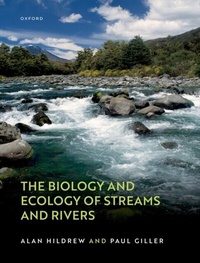
Biology and Ecology of Streams and Rivers
1st Edition
Published on 19. June 2023
432 pages
978-0-19-108576-5 (ISBN)
Description

The challenges that the world's running water systems now face have never been more numerous or acute, at the same time, these complex habitats remain absolutely crucial to human wellbeing and future survival. If rivers can ever be anything like sustainable, ecology needs to take its place as an equal among the physical sciences such as hydrology and geomorphology. A real understanding of the natural history and ecology of running waters must now be brought even more prominently into river management. The primary purpose of this textbook is to provide the up-to-date overview that students and practitioners will require to achieve this aim. The book's unifying focus is on rivers and streams as ecosystems in which the particular identity of organisms is not the main emphasis but rather the processes in which they are involved - specifically energy flow and the cycling of materials. It builds on the physicochemical foundations of the habitat templet and explores the diversity and adaptations of the biota, progressing from the population and community ecology of organisms and linking them to ecosystem processes and services in the wider biosphere via the complexities of species interactions and food webs. These include water quality and patterns of river discharge, as well as aesthetics, waste disposal, and environmental health. While the book is not primarily focused on application per se, each chapter addresses how humans affect rivers and, in turn, are affected by them. A final, future-oriented chapter identifies key strategic areas and sets a roadmap for integrating knowledge of natural history and ecology into policy and management. The Biology and Ecology of Streams and Rivers is an accessible text suitable for both senior undergraduate and graduate students taking courses in both lotic and general ecology as well as more established researchers, practitioners, managers, and conservationists requiring a concise and contemporary overview of running waters.
More details
Other editions
Additional editions
Alan Hildrew | Paul Giller
The Biology and Ecology of Streams and Rivers
Book
06/2023
2nd Edition
Oxford University Press
€136.50
Shipment within 15-20 days
Content
- Intro
- 01-Hildrew-Ch01
- 1 Rivers as ecological systems
- 1.1 Rivers in context
- 1.2 The hydrological cycle
- 1.3 Rivers in space and time
- 1.3.1 Hierarchical networks and scale
- 1.4 The variety of streams and rivers
- 1.5 The naming of parts-living assemblages in rivers and streams
- 1.6 The biology and ecology of streams and rivers
- 1.7 The structure of the book
- 02-Hildrew-Ch02
- 2 The habitat templet
- 2.1 Introduction
- 2.2 The geographical and evolutionary setting and river morphology
- 2.2.1 Patterns in drainage basins and river classification
- 2.2.2 Stream size and stream order
- 2.2.3 Stream morphometry patterns
- 2.2.4 Runoff and flow regimes
- 2.2.5 Groundwater and up- and downwelling zones
- 2.3 Flow and hydraulics
- 2.3.1 The nature of flow
- 2.3.2 Discharge and current
- 2.3.3 Boundary layers and dead zones
- 2.3.4 Shear stress
- 2.3.5 Water velocity and shear stress vary spatially
- 2.3.6 Variability in discharge and shear stress over time
- 2.4 Substratum
- 2.4.1 Physical properties
- 2.5 The chemical habitat and its dynamics
- 2.5.1 Rainwater chemistry
- 2.5.2 Geology, soils and stream pH
- 2.5.3 Vegetation effects
- 2.5.4 Land use, nutrients, suspended solids and pollution
- 2.5.5 Variation in water chemistry over time
- 2.5.6 Spatial differences in water chemistry
- 2.6 Oxygen and temperature
- 2.6.1 Temperature
- 2.6.2 Oxygen
- 2.7 Concluding remarks and patterns in the habitat templet
- 03-Hildrew-Ch03
- 3 River biota: The diversity of life in streams and rivers
- 3.1 Introduction
- 3.2 Microorganisms
- 3.2.1 Bacteria (and Archaea)
- 3.2.2 Fungi
- 3.2.3 Protozoa
- 3.3 Plants
- 3.3.1 Algae
- 3.3.2 Bryophytes (mosses and liverworts)
- 3.3.3 Vascular plants
- 3.4 Invertebrates
- 3.4.1 Smaller metazoans-the meiofauna
- 3.4.2 Larger turbellarians
- 3.4.3 Mollusca: Gastropoda
- 3.4.4 Mollusca: Bivalvia
- 3.4.5 Larger Crustacea-decapods, amphipods and isopods
- 3.4.6 Other non-insect macroinvertebrates
- 3.4.7 Insects
- 3.5 Vertebrates
- 3.5.1 Fish
- 3.5.2 Amphibians and reptiles
- 3.5.3 Birds
- 3.5.4 Mammals
- 3.6 End note
- 04-Hildrew-Ch04
- 4 Matching the habitat templet: Adaptations and species traits
- 4.1 Physiological adaptations
- 4.1.1 Respiration
- 4.1.2 Osmoregulation
- 4.1.3 Drought resistance
- 4.2 Body form, size and other features
- 4.2.1 Shape
- 4.2.2 Size
- 4.2.3 Hooks, bristles and hairs
- 4.2.4 Insect silk: an important evolutionary development
- 4.2.5 Colour
- 4.3 Behaviour and life in running waters
- 4.4 Reproduction, life cycles and life histories
- 4.4.1 Life-history patterns
- 4.4.2 Voltinism and longevity
- 4.4.3 Phenology and life-history responses to environmental conditions
- 4.4.4 Life-history plasticity
- 4.5 Foraging and trophic adaptations
- 4.5.1 Functional feeding groups
- 4.5.2 Morphological aspects of feeding
- 4.5.3 Generalists and specialists
- 4.5.4 Ontogenetic changes
- 4.6 From Adaptations to species traits
- 4.6.1 Adaptations, traits and selection
- 4.6.2 Traits, templets and the use of words
- 4.6.3 Macrophyte traits
- 4.6.4 Macroinvertebrate traits
- 4.6.5 Fish
- 4.7 Conclusions
- 05-Hildrew-Ch05
- 5 Population ecology
- 5.1 Introduction-what is special about populations in rivers and streams?
- 5.2 Distribution
- 5.2.1 Scale, dimensions and the habitat templet
- 5.2.2 Flow and distribution
- 5.2.3 The substratum and lotic organisms
- 5.2.4 Water chemistry and distribution
- 5.2.5 Temperature, oxygen and distribution
- 5.3 Abundance: population dynamics in streams and rivers
- 5.3.1 Long-term patterns and the decline of the `megafauna'
- 5.3.2 Evidence for population regulation in stream animals
- 5.3.3 Density independence and the population-level consequences of disturbance
- 5.3.4 Refugia, environmental heterogeneity and species traits-keys to ecological resilience in lotic populations?
- 5.3.5 Drift and population persistence
- 5.3.6 Migrations and mobility
- 5.4 Abundance: `open' populations
- 5.4.1 Open populations and the river hierarchy
- 5.4.2 Open populations: lessons from genetics
- 5.5 Conclusions-beyond population biology
- 06-Hildrew-Ch06
- 6 Living communities in rivers and streams
- 6.1 Introduction
- 6.2 Assembly, filters, traits and `strategies'
- 6.3 Community patterns in space
- 6.3.1 `Gently down the stream'-longitudinal changes in river assemblages
- 6.3.2 High diversity in small tributaries
- 6.3.3 Larger-scale patterns in space
- 6.4 River communities in time
- 6.4.1 Persistence and change
- 6.4.2 Disturbance in a community context
- 6.5 Scale, space and time and river communities
- 6.5.1 Intermittent river and stream communities
- 6.5.2 `Patchiness', scale and river communities
- 6.6 The river hierarchy and `metacommunities'
- 6.7 Conclusions-from multispecies patterns to interactions, food webs and processes
- 07-Hildrew-Ch07
- 7 Species interactions and food webs
- 7.1 Introduction
- 7.2 Predation
- 7.2.1 Mechanisms of predation
- 7.2.2 Anti-predator adaptations
- 7.2.3 Direct effects of predation
- 7.3 Herbivory
- 7.3.1 Effect of herbivory in lotic systems
- 7.4 Parasitism and disease
- 7.5 Competition
- 7.5.1 Effects of competition
- 7.6 Resource partitioning and coexistence
- 7.6.1 Temporal segregation
- 7.6.2 Food partitioning
- 7.6.3 Habitat segregation
- 7.6.4 Alternative explanations for coexistence of similar species
- 7.7 Positive species interactions
- 7.7.1 Mutualism and commensalism
- 7.7.2 Indirect facilitation
- 7.8 From species interactions to food webs
- 7.8.1 Food webs-some basic features
- 7.8.2 Food webs in streams and rivers
- 7.8.3 Food webs-practical challenges, conceptual difficulties
- 7.8.4 Pattern and process in food webs
- 7.9 Final remarks
- 08-Hildrew-Ch08
- 8 Running waters as ecosystems: Metabolism, energy and carbon
- 8.1 Introduction-rivers as ecosystems
- 8.2 River metabolism
- 8.2.1 Primary production
- 8.2.2 The dark side-ecosystem respiration in rivers
- 8.3 Conceptual approaches to rivers as ecosystems
- 8.4 Secondary production in rivers and streams
- 8.4.1 Microbial production
- 8.4.2 Metazoan production
- 8.5 Organic matter dynamics
- 8.5.1 Allochthonous and authochthonous material
- 8.5.2 Ecosystem efficiency
- 8.5.3 The process of detrital breakdown and the `fate of organic matter' in streams
- 8.5.4 Patterns in the breakdown rate of plant litter
- 8.5.5 Dissolved and fine-particulate material
- 8.6 The support of stream and river food webs
- 8.6.1 The trophic basis of production
- 8.6.2 Experimental evidence
- 8.6.3 Diets, food webs and markers
- 8.7 Streams and rivers in the terrestrial ecosystem
- 8.8 Conclusions
- 09-Hildrew-Ch09
- 9 Running waters as ecosystems: Nutrients
- 9.1 Introduction
- 9.2 Cycles and spirals
- 9.2.1 Nutrient cycles-essential features
- 9.2.2 Nutrients `spiral' in flowing water
- 9.3 Nitrogen and phosphorus in streams and rivers
- 9.3.1 Nitrogen retention and transformations
- 9.3.2 Light and the transfer of nitrogen through stream food webs
- 9.3.3 Habitat, hydrology and nitrogen in streams
- 9.3.4 Nutrients, macrophytes and metazoans
- 9.3.5 The particulars of phosphorus
- 9.3.6 The `coupling' of carbon and nitrogen
- 9.4 `Famine and feast'-nutrient limitation and the eutrophication of stream ecosystems
- 9.4.1 Experimental additions of nutrients
- 9.4.2 Eutrophication of running waters
- 9.5 Elemental stoichiometry
- 9.6 Nutrient subsidies across systems
- 9.7 Nutrients, rivers and new horizons
- 10-Hildrew-Ch10
- 10 New horizons
- 10.1 Introduction
- 10.2 A freshwater biodiversity crisis?
- 10.2.1 What are the drivers of biodiversity loss?-an initial census
- 10.2.2 Biodiversity losses in rivers
- 10.3 Alien and invasive species-`the great mixing'
- 10.3.1 Some basic terms
- 10.3.2 A real example
- 10.3.3 The extent of invasions
- 10.3.4 Invasional meltdown?
- 10.3.5 Ecosystem effects of invasions
- 10.3.6 Invasions are affected by other stressors
- 10.4 New and emerging contaminants
- 10.4.1 What is there?
- 10.4.2 What are the effects?
- 10.5 Ecological assessment of running waters: looking back, looking forward
- 10.5.1 Biological monitoring-a (very) brief introduction
- 10.5.2 New methods for assessing diversity and their application
- 10.5.3 Detecting specific stressors
- 10.5.4 Detecting multiple stressors
- 10.6 The uncertain future of rivers and streams in a changing world
- 10.6.1 Introduction
- 10.6.2 Valuing nature-a few basics
- 10.6.3 What do rivers do for us?
- 10.6.4 Biotic effects on the lotic environment-ecological engineers
- 10.6.5 Rivers and the climate
- 10.6.6 Methanotrophy-an underappreciated `ecosystem service'?
- 10.7 Water scarcity, impoundments and related issues
- 10.8 Conservation and restoration
- 10.8.1 Ecological flows and working at the whole-catchment scale
- 10.8.2 Restoring rivers
- 10.9 Skills for the coming years?
