

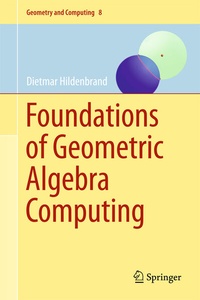
Foundations of Geometric Algebra Computing
Description

The author defines "Geometric Algebra Computing" as the geometrically intuitive development of algorithms using geometric algebra with a focus on their efficient implementation, and the goal of this book is to lay the foundations for the widespread use of geometric algebra as a powerful, intuitive mathematical language for engineering applications in academia and industry. The related technology is driven by the invention of conformal geometric algebra as a 5D extension of the 4D projective geometric algebra and by the recent progress in parallel processing, and with the specific conformal geometric algebra there is a growing community in recent years applying geometric algebra to applications in computer vision, computer graphics, and robotics.
This book is organized into three parts: in Part I the author focuses on the mathematical foundations; in Part II he explains the interactive handling of geometric algebra; and in Part III he deals with computing technology for high-performance implementations based on geometric algebra as a domain-specific language in standard programming languages such as C++ and OpenCL. The book is written in a tutorial style and readers should gain experience with the associated freely available software packages and applications.
The book is suitable for students, engineers, and researchers in computer science, computational engineering, and mathematics.Reviews / Votes
From the book reviews:
"This textbook addresses students (undergraduate to postgraduate), scientists and engineers with an interest in intuitive and highly efficient computer programs based on W. K. Clifford's geometric algebras. The book greatly benefits from the original work of the author, and is very readable. . After a general introduction to the benefits of geometric algebra, geometric algebra computing and its historical development, the book is divided into three main parts." (Eckhard M. S. Hitzer, Mathematical Reviews, May, 2014)More details
Other editions
Additional editions
Person
Dr.-Ing. Dietmar Hildenbrand is a member of the Mathematics Department of the Technische Universität Darmstadt. He is one of the codevelopers of Gaalop (Geometic Algebra Algorithms Optimizer) a software package used to optimize geometric algebra files, and his research interests include geometric algebra, robotics, game engines, computer graphics, and high-performance parallel computing.
