

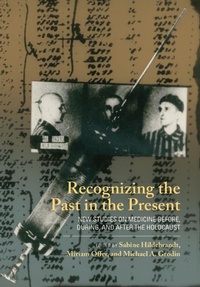
Recognizing the Past in the Present
New Studies on Medicine before, during, and after the Holocaust
1st Edition
Published on 11. December 2020
412 pages
978-1-80539-444-0 (ISBN)
Description

Following decades of silence about the involvement of doctors, medical researchers and other health professionals in the Holocaust and other National Socialist (Nazi) crimes, scholars in recent years have produced a growing body of research that reveals the pervasive extent of that complicity. This interdisciplinary collection of studies presents documentation of the critical role medicine played in realizing the policies of Hitler's regime. It traces the history of Nazi medicine from its roots in the racial theories of the 1920s, through its manifestations during the Nazi period, on to legacies and continuities from the postwar years to the present.
Reviews / Votes
"This collection of scholarly papers illustrates the ongoing, unfinished nature of historical research on the Holocaust and medicine, broadly defined...This sobering book is important reading for anyone interested in Jewish or medical history or in the impact of values, ideology, and ethics on scientific practice...Highly Recommended." * Choice"This volume offers new research and insights on a range of issues not often covered in the extant historical literature. Its mix of topics and perspectives is a particular virtue, ranging from the history of medicine to Jewish religious practice, gender, biographical and institutional studies, and the 'postwar continuities and legacies' that are a particular emphasis and strength of the volume." * Geoffrey Cocks, Professor Emeritus of History at Albion College
More details
Edition
1. Auflage
Language
English
Place of publication
Oxford
United Kingdom
Target group
Professional and scholarly
Illustrations
Bibliography; Index; 21 Illustrations
ISBN-13
978-1-80539-444-0 (9781805394440)
DOI
10.3167/9781789207842
Copyright in bibliographic data and cover images is held by Nielsen Book Services Limited or by the publishers or by their respective licensors: all rights reserved.
Schweitzer Classification
Other editions
Additional editions
Sabine Hildebrandt | Miriam Offer | Michael A. Grodin
Recognizing the Past in the Present
New Studies on Medicine before, during, and after the Holocaust
Book
07/2024
Berghahn Books
€40.50
Shipment within 3-4 weeks
Sabine Hildebrandt | Miriam Offer | Michael A. Grodin
Recognizing the Past in the Present
New Studies on Medicine before, during, and after the Holocaust
Book
12/2020
1st Edition
Berghahn Books
€164.10
Shipment within 3-4 weeks
Persons
Sabine Hildebrandt is Associate Professor of Pediatrics in the Department of Pediatrics at Boston Children's Hospital and serves as an anatomy educator at Harvard Medical School. She is the author of The Anatomy of Murder: Ethical Transgressions and Anatomical Science during the Third Reich (Berghahn, 2016).
Content
List of Illustrations
Acknowledgments
Foreword
William E. Seidelman
Introduction to the Volume: Recognizing the Past in the Present
Sabine Hildebrandt, Miriam Offer, and Michael A. Grodin
Part I: The Past
Chapter 1. Non-Mechanistic Explanatory Styles in Interwar German Racial Theory: A Comparison of Hans F. K. Guenther and Ludwig Ferdinand Clauss
Amit Varshizky
Chapter 2. From "Racial Surveys" to Medical Experiments in Prisoner of War Camps
Margit Berner
Chapter 3. "Der Doktor": The Writings of Mordechai Lensky During the Interwar Period
Miriam Offer
Chapter 4. Rabbinic Responsa During the Holocaust: The Life-for-Life Problem
Johnathan I. Kelly, Erin L. Miller, Rabbi Joseph Polak, Robert Kirschner, and Michael A. Grodin
Chapter 5. Un(B)earable: Pregnant Bodies and Obstetrical Genocide?????????????????????
Annette Finley-Croswhite
Chapter 6. "Complete Mastery of the Subject": The Connection between Forced Sterilization and Gynecological Fertility Research in National Socialism
Gabriele Czarnowski
Chapter 7. Deference, Pragmatism, Ideology: The Medical Student Kurt Gerstein and the Predicament of Ethical Conduct under National Socialism
Mathias Schuetz
Chapter 8. Ludwig Stumpfegger (1910-1945): A Career at the Interface of Hitler, Himmler and Ravensbrueck Concentration Camp
Stephanie Kaiser and Mathias Schmidt
Chapter 9. Between Participation in National Socialist Medicine and Everyday Administrative Action: On the Economic Argument of the Psychiatric Planning Commission (1941-1945)
Felicitas Soehner
Chapter 10. Dentists in National Socialist (Nazi) Germany: A Fragmented Profession
Matthis Krischel
Chapter 11. Only Following Orders? Aviation Medicine in Nazi Germany
Alexander von Luenen
Chapter 12. Blood and Bones from Auschwitz: The Mengele Link
Paul J. Weindling
Part II: The Present: Postwar Continuities, Legacies, and Reflections
Chapter 13. Renewed Trauma: Abraham De La Penha's Testimony against Dr Franz Lucas in the Frankfurt Auschwitz Trial
Andrew Wisely
Chapter 14. "Schluss mit der Rassenschande!" From Separation to Extermination: The Fate of Jewish Mentally Ill Patients in Germany and Occupied Poland 1939-42
Kamila Uzarczyk
Chapter 15. "Since she was in Auschwitz the patient feels that she is being persecuted": Holocaust Survivors and Austrian Psychiatry after World War II
Herwig Czech
Chapter 16. "To Prevent Further Unfounded Aly Constructions"
Goetz Aly
Chapter 17. Baneful Medicine and a Radical Bioethics in Contemporary Art
Andrew Weinstein
Chapter 18. The History of the Vienna Protocol
Sabine Hildebrandt, Joseph A. Polak, Michael A. Grodin, and William E. Seidelman
Conclusion: The Past in the Present and the Future
Index
Acknowledgments
Foreword
William E. Seidelman
Introduction to the Volume: Recognizing the Past in the Present
Sabine Hildebrandt, Miriam Offer, and Michael A. Grodin
Part I: The Past
Chapter 1. Non-Mechanistic Explanatory Styles in Interwar German Racial Theory: A Comparison of Hans F. K. Guenther and Ludwig Ferdinand Clauss
Amit Varshizky
Chapter 2. From "Racial Surveys" to Medical Experiments in Prisoner of War Camps
Margit Berner
Chapter 3. "Der Doktor": The Writings of Mordechai Lensky During the Interwar Period
Miriam Offer
Chapter 4. Rabbinic Responsa During the Holocaust: The Life-for-Life Problem
Johnathan I. Kelly, Erin L. Miller, Rabbi Joseph Polak, Robert Kirschner, and Michael A. Grodin
Chapter 5. Un(B)earable: Pregnant Bodies and Obstetrical Genocide?????????????????????
Annette Finley-Croswhite
Chapter 6. "Complete Mastery of the Subject": The Connection between Forced Sterilization and Gynecological Fertility Research in National Socialism
Gabriele Czarnowski
Chapter 7. Deference, Pragmatism, Ideology: The Medical Student Kurt Gerstein and the Predicament of Ethical Conduct under National Socialism
Mathias Schuetz
Chapter 8. Ludwig Stumpfegger (1910-1945): A Career at the Interface of Hitler, Himmler and Ravensbrueck Concentration Camp
Stephanie Kaiser and Mathias Schmidt
Chapter 9. Between Participation in National Socialist Medicine and Everyday Administrative Action: On the Economic Argument of the Psychiatric Planning Commission (1941-1945)
Felicitas Soehner
Chapter 10. Dentists in National Socialist (Nazi) Germany: A Fragmented Profession
Matthis Krischel
Chapter 11. Only Following Orders? Aviation Medicine in Nazi Germany
Alexander von Luenen
Chapter 12. Blood and Bones from Auschwitz: The Mengele Link
Paul J. Weindling
Part II: The Present: Postwar Continuities, Legacies, and Reflections
Chapter 13. Renewed Trauma: Abraham De La Penha's Testimony against Dr Franz Lucas in the Frankfurt Auschwitz Trial
Andrew Wisely
Chapter 14. "Schluss mit der Rassenschande!" From Separation to Extermination: The Fate of Jewish Mentally Ill Patients in Germany and Occupied Poland 1939-42
Kamila Uzarczyk
Chapter 15. "Since she was in Auschwitz the patient feels that she is being persecuted": Holocaust Survivors and Austrian Psychiatry after World War II
Herwig Czech
Chapter 16. "To Prevent Further Unfounded Aly Constructions"
Goetz Aly
Chapter 17. Baneful Medicine and a Radical Bioethics in Contemporary Art
Andrew Weinstein
Chapter 18. The History of the Vienna Protocol
Sabine Hildebrandt, Joseph A. Polak, Michael A. Grodin, and William E. Seidelman
Conclusion: The Past in the Present and the Future
Index
