

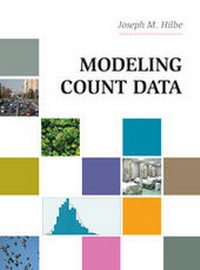
Modeling Count Data
1st Edition
Published on 28. July 2014
978-1-139-98997-8 (ISBN)
Description

This entry-level text offers clear and concise guidelines on how to select, construct, interpret, and evaluate count data. Written for researchers with little or no background in advanced statistics, the book presents treatments of all major models using numerous tables, insets, and detailed modeling suggestions. It begins by demonstrating the fundamentals of modeling count data, including a thorough presentation of the Poisson model. It then works up to an analysis of the problem of overdispersion and of the negative binomial model, and finally to the many variations that can be made to the base count models. Examples in Stata, R, and SAS code enable readers to adapt models for their own purposes, making the text an ideal resource for researchers working in health, ecology, econometrics, transportation, and other fields.
Reviews / Votes
'This is a first-rate introductory book for modeling count data, a key challenge in applied statistics. Hilbe's experience and affability shine in the text. His careful emphasis on establishing the defensibility of models, for example, in the face of overdispersion, will greatly benefit the beginning statistician. His clear informal explanations of important and complicated statistical principles are invaluable.' Andrew Robinson, University of Melbourne 'The negative binomial model is the foundation for modern analysis of count data. Joe Hilbe's work collects a vast wealth of technical and practical information for the analyst. The theoretical developments and thoroughly worked applications use realistic data sets and a variety of computer packages. They will provide to the practitioner an indispensable guide for basic single-equation count data regressions and advanced applications with recently developed model extensions and methods.' William Greene, New York University 'This book is a great introduction to models for the analysis of count data. Using the Poisson GLM as the basis, it covers a wide range of modern extensions of GLMs, and this makes it unique. Potentially complex models (which are often needed when analyzing real data sets) are presented in an understandable way, partly because data sets and software code are provided. I reckon that this volume will be one of the standard GLM reference books for many years to come.' Alain F. Zuur, Highland Statistics Ltd 'Modeling Count Data is a well-organized entry-level book mainly written for applied researchers with little formal theoretical background in statistics who need to analyse count data ... Thoroughly worked examples with software code, several of them devoted to applying alternative count models to the same data set, provide a basic guide for model selection among competing models. The chapters are well structured, starting with points of discussion and ending with a brief summary. Where required, section themes are summarized. Also, the formula used, abbreviations used and examples used are summarized in tabular form. In brief, it is a remarkable book and can be used as a practical guide for introducing count data analysis.' Anoop Chaturvedi, Journal of the Royal Statistical SocietyMore details
Language
English
Place of publication
Cambridge
United Kingdom
Publishing group
Cambridge University Press
Target group
Professional and scholarly
Illustrations
81 Tables, unspecified; 10 Line drawings, unspecified
File size
2725,91 MB
ISBN-13
978-1-139-98997-8 (9781139989978)
Copyright in bibliographic data and cover images is held by Nielsen Book Services Limited or by the publishers or by their respective licensors: all rights reserved.
Schweitzer Classification
Other editions
Additional editions
Joseph M. Hilbe
Modeling Count Data
Book
07/2014
Cambridge University Press
€56.80
Shipment within 15-20 days
Joseph M. Hilbe
Modeling Count Data
Book
07/2014
Cambridge University Press
€131.20
Shipment within 15-20 days
Person
Joseph Hilbe is a solar system ambassador with NASA's Jet Propulsion Laboratory, California Institute of Technology; an Adjunct Professor of Statistics at Arizona State University; an Emeritus Professor at the University of Hawaii; and a statistical modeling instructor for Statistics.com, a web-based continuing-education program in statistics. He is the author of several books on statistical modeling and serves as the coordinating editor for the Cambridge University Press series Predictive Analytics in Action.
Content
Preface; 1. Varieties of count data; 2. Poisson regression; 3. Testing overdispersion; 4. Assessment of fit; 5. Negative binomial regression; 6. Poisson inverse Gaussian regression; 7. Problems with zeros; 8. Modeling under-dispersed count data - generalized Poisson; 9. Complex data: more advanced models; Appendix A: SAS code; References; Index.
