

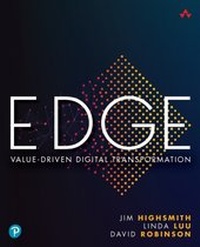
EDGE
Value-Driven Digital Transformation
1st Edition
Published on 28. May 2019
256 pages
978-0-13-526357-0 (ISBN)
Description

EDGE: The Agile Operating Model That Will Help You Successfully Execute Your Digital Transformation
"[The authors'] passion for technology allows them to recognize that for most enterprises in the 21st century, technology is THE business. This is what really separates the EDGE approach. It is a comprehensive operating model with technology at its core."
-From the Foreword by Heidi Musser, Executive Vice President and Principal Consultant, Leading Agile; retired, Vice President and CIO, USAA
Maximum innovation happens at the edge of chaos: the messy, risky, and uncertain threshold between randomness and structure. Operating there is uncomfortable but it's where organizations "invent the future." EDGE is a set of fast, iterative, adaptive, lightweight, and value-driven tools to achieve digital transformation, and EDGE: Value-Driven Digital Transformation is your guide to using this operating model for innovation.
Jim Highsmith is one of the world's leading agile pioneers and a coauthor of the Agile Manifesto. He, Linda Luu, and David Robinson know from their vast in-the-trenches experience that sustainable digital transformation requires far more than adopting isolated agile practices or conventional portfolio management. This hard, indispensable work involves changing culture and mindset, and going beyond transforming the IT department.
EDGE embraces an adaptive mindset in the face of market uncertainty, a visible, value-centered portfolio approach that encourages continual value linkages from vision to detailed initiatives, incremental funding that shifts as strategies evolve, collaborative decision-making, and better risk mitigation. This guide shows leaders how to use the breakthrough EDGE approach to go beyond incremental improvement in a world of exponential opportunities.
Build an organization that adapts fast enough to thrive
Clear away unnecessary governance processes, obsolete "command and control" leadership approaches, and slow budgeting/planning cycles
Improve collaboration when major, fast-paced responses are necessary
Continually optimize investment allocation and monitoring based on your vision and goals
Register your product for convenient access to downloads, updates, and/or corrections as they become available. See inside book for details.
"[The authors'] passion for technology allows them to recognize that for most enterprises in the 21st century, technology is THE business. This is what really separates the EDGE approach. It is a comprehensive operating model with technology at its core."
-From the Foreword by Heidi Musser, Executive Vice President and Principal Consultant, Leading Agile; retired, Vice President and CIO, USAA
Maximum innovation happens at the edge of chaos: the messy, risky, and uncertain threshold between randomness and structure. Operating there is uncomfortable but it's where organizations "invent the future." EDGE is a set of fast, iterative, adaptive, lightweight, and value-driven tools to achieve digital transformation, and EDGE: Value-Driven Digital Transformation is your guide to using this operating model for innovation.
Jim Highsmith is one of the world's leading agile pioneers and a coauthor of the Agile Manifesto. He, Linda Luu, and David Robinson know from their vast in-the-trenches experience that sustainable digital transformation requires far more than adopting isolated agile practices or conventional portfolio management. This hard, indispensable work involves changing culture and mindset, and going beyond transforming the IT department.
EDGE embraces an adaptive mindset in the face of market uncertainty, a visible, value-centered portfolio approach that encourages continual value linkages from vision to detailed initiatives, incremental funding that shifts as strategies evolve, collaborative decision-making, and better risk mitigation. This guide shows leaders how to use the breakthrough EDGE approach to go beyond incremental improvement in a world of exponential opportunities.
Build an organization that adapts fast enough to thrive
Clear away unnecessary governance processes, obsolete "command and control" leadership approaches, and slow budgeting/planning cycles
Improve collaboration when major, fast-paced responses are necessary
Continually optimize investment allocation and monitoring based on your vision and goals
Register your product for convenient access to downloads, updates, and/or corrections as they become available. See inside book for details.
All prices
More details
Edition
1. Auflage
Language
English
Place of publication
Boston
United States
Publishing group
Pearson Education (US)
Target group
Professional and scholarly
File size
5,99 MB
ISBN-13
978-0-13-526357-0 (9780135263570)
Copyright in bibliographic data and cover images is held by Nielsen Book Services Limited or by the publishers or by their respective licensors: all rights reserved.
Schweitzer Classification
Other editions
Additional editions
Jim Highsmith | Linda Luu | David Robinson
EDGE: Value-Driven Digital Transformation
Value-Driven Digital Transformation
Book
12/2019
1st Edition
Addison Wesley
€31.99
Shipment within 15-20 days
Persons
Jim Highsmith, Executive Consultant at ThoughtWorks, Inc, has 50-plus years' experience as a manager, consultant, developer, and storyteller. A leader in the agile community for more than 20 years, he coauthored the Agile Manifesto, cofounded The Agile Alliance, and authored the world-renowned books Adaptive Leadership and Agile Project Management (both from Addison-Wesley).
Linda Luu is a principal product and portfolio consultant at ThoughtWorks, Inc., with over 15 years' experience in product innovation, customer centered design, and organizational transformation. Experienced in Lean, Agile, and Design Thinking practices, Linda has worked with a number of clients worldwide to build digital organizations that can sense and respond to changing customer and business needs. Linda holds a double degree in commerce (finance) and science (applied maths), and an MBA from the Australian Graduate School of Management.
David Robinson is a principal consultant at ThoughtWorks, Inc., with over 30 years experience in information technology management, organizational transformation, and technology consulting. David's career has spanned consulting with large organizations, upper management roles in enterprise IT shops, and running an organization development team.
Linda Luu is a principal product and portfolio consultant at ThoughtWorks, Inc., with over 15 years' experience in product innovation, customer centered design, and organizational transformation. Experienced in Lean, Agile, and Design Thinking practices, Linda has worked with a number of clients worldwide to build digital organizations that can sense and respond to changing customer and business needs. Linda holds a double degree in commerce (finance) and science (applied maths), and an MBA from the Australian Graduate School of Management.
David Robinson is a principal consultant at ThoughtWorks, Inc., with over 30 years experience in information technology management, organizational transformation, and technology consulting. David's career has spanned consulting with large organizations, upper management roles in enterprise IT shops, and running an organization development team.
Content
Foreword xvi
Preface xviii
Acknowledgments xxiii
About the Authors xxiv
Chapter 1: The Big Picture 1
Exploring EDGE 5
Agility Is Key to Fast Enough 7
Building Organizational Responsiveness 8
Toward a Customer-Value Fitness Function 10
It's Not Easy, Just Imperative 16
Final Thoughts 17
Chapter 2: Tech@Core 21
A Digital Enterprise: Technology at the Core 22
Digital Technology Platforms 38
Who Creates Your Technology Strategy? 45
Final Thoughts 47
Chapter 3: EDGE Principles 49
Outcome-Based Strategy 51
Value-Based Prioritization 52
Lightweight Planning and Governance 53
Adaptive, Learning Culture 54
Autonomous Teams 55
Self-Sufficient, Collaborative Decision Making 57
Final Thoughts 57
Chapter 4: Building a Value-Driven Portfolio 59
Strategy and the Lean Value Tree 61
Evolving the Lean Value Tree 68
Funding Allocation 71
Final Thoughts 76
Chapter 5: Measuring and Prioritizing Value 79
Why Measures Matter 79
Identifying Measures of Success 80
Applying MoS to Portfolios 84
Prioritizing Value 85
Final Thoughts 92
Chapter 6: Building a Product Mindset 95
Moving from Projects to Products 96
The Role of Product People in Organizations 99
Product and Portfolio Team Collaboration 101
Defining Products and the Connection to the LVT 102
Defining the Product 106
Creating Agile Product Backlogs 113
Final Thoughts 119
Chapter 7: Integrating Strategic and Business as Usual Portfolios 121
Back to Reality 121
Integrated Backlogs 122
Backlog Components 123
Prioritization 131
Final Thoughts 143
Chapter 8: Lightweight Governance 145
The Lost Objectives of Governance 145
Establishing Lightweight Governance 146
Periodic Value Review 151
Rebalancing the Portfolio 152
Periodic Value Review Dashboard 155
Final Thoughts 155
Chapter 9: Autonomous Teams and Collaborative Decision Making 157
You Are Not Alone 157
Autonomous Teams 158
EDGE Teams 169
Collaborative, Self-Sufficient Decisions 175
Aligning Organizations to Business Capability 183
Final Thoughts 187
Chapter 10: Adaptive Leadership 189
Adaptive Leadership 189
Encourage an Adaptive Mindset 192
Lead Change 194
Be Bold 202
Riding Paradox 205
Inspire Others 207
Final Thoughts 209
Chapter 11: EDGE: Exploring Your Transformative Future 211
Index 217
Preface xviii
Acknowledgments xxiii
About the Authors xxiv
Chapter 1: The Big Picture 1
Exploring EDGE 5
Agility Is Key to Fast Enough 7
Building Organizational Responsiveness 8
Toward a Customer-Value Fitness Function 10
It's Not Easy, Just Imperative 16
Final Thoughts 17
Chapter 2: Tech@Core 21
A Digital Enterprise: Technology at the Core 22
Digital Technology Platforms 38
Who Creates Your Technology Strategy? 45
Final Thoughts 47
Chapter 3: EDGE Principles 49
Outcome-Based Strategy 51
Value-Based Prioritization 52
Lightweight Planning and Governance 53
Adaptive, Learning Culture 54
Autonomous Teams 55
Self-Sufficient, Collaborative Decision Making 57
Final Thoughts 57
Chapter 4: Building a Value-Driven Portfolio 59
Strategy and the Lean Value Tree 61
Evolving the Lean Value Tree 68
Funding Allocation 71
Final Thoughts 76
Chapter 5: Measuring and Prioritizing Value 79
Why Measures Matter 79
Identifying Measures of Success 80
Applying MoS to Portfolios 84
Prioritizing Value 85
Final Thoughts 92
Chapter 6: Building a Product Mindset 95
Moving from Projects to Products 96
The Role of Product People in Organizations 99
Product and Portfolio Team Collaboration 101
Defining Products and the Connection to the LVT 102
Defining the Product 106
Creating Agile Product Backlogs 113
Final Thoughts 119
Chapter 7: Integrating Strategic and Business as Usual Portfolios 121
Back to Reality 121
Integrated Backlogs 122
Backlog Components 123
Prioritization 131
Final Thoughts 143
Chapter 8: Lightweight Governance 145
The Lost Objectives of Governance 145
Establishing Lightweight Governance 146
Periodic Value Review 151
Rebalancing the Portfolio 152
Periodic Value Review Dashboard 155
Final Thoughts 155
Chapter 9: Autonomous Teams and Collaborative Decision Making 157
You Are Not Alone 157
Autonomous Teams 158
EDGE Teams 169
Collaborative, Self-Sufficient Decisions 175
Aligning Organizations to Business Capability 183
Final Thoughts 187
Chapter 10: Adaptive Leadership 189
Adaptive Leadership 189
Encourage an Adaptive Mindset 192
Lead Change 194
Be Bold 202
Riding Paradox 205
Inspire Others 207
Final Thoughts 209
Chapter 11: EDGE: Exploring Your Transformative Future 211
Index 217
