

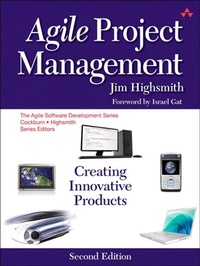
Agile Project Management
Creating Innovative Products
2nd Edition
Published on 10. July 2009
432 pages
978-0-321-65917-0 (ISBN)
Description

Best practices for managing projects in agile environments-now updated with new techniques for larger projects
Today, the pace of project management moves faster. Project management needs to become more flexible and far more responsive to customers. Using Agile Project Management (APM), project managers can achieve all these goals without compromising value, quality, or business discipline. In Agile Project Management, Second Edition, renowned agile pioneer Jim Highsmith thoroughly updates his classic guide to APM, extending and refining it to support even the largest projects and organizations.
Writing for project leaders, managers, and executives at all levels, Highsmith integrates the best project management, product management, and software development practices into an overall framework designed to support unprecedented speed and mobility. The many topics added in this new edition include incorporating agile values, scaling agile projects, release planning, portfolio governance, and enhancing organizational agility. Project and business leaders will especially appreciate Highsmith's new coverage of promoting agility through performance measurements based on value, quality, and constraints.
This edition's coverage includes:
Understanding the agile revolution's impact on product development
Recognizing when agile methods will work in project management, and when they won't
Setting realistic business objectives for Agile Project Management
Promoting agile values and principles across the organization
Utilizing a proven Agile Enterprise Framework that encompasses governance, project and iteration management, and technical practices
Optimizing all five stages of the agile project: Envision, Speculate, Explore, Adapt, and Close
Organizational and product-related processes for scaling agile to the largest projects and teams
Agile project governance solutions for executives and management
The "Agile Triangle": measuring performance in ways that encourage agility instead of discouraging it
The changing role of the agile project leader
Today, the pace of project management moves faster. Project management needs to become more flexible and far more responsive to customers. Using Agile Project Management (APM), project managers can achieve all these goals without compromising value, quality, or business discipline. In Agile Project Management, Second Edition, renowned agile pioneer Jim Highsmith thoroughly updates his classic guide to APM, extending and refining it to support even the largest projects and organizations.
Writing for project leaders, managers, and executives at all levels, Highsmith integrates the best project management, product management, and software development practices into an overall framework designed to support unprecedented speed and mobility. The many topics added in this new edition include incorporating agile values, scaling agile projects, release planning, portfolio governance, and enhancing organizational agility. Project and business leaders will especially appreciate Highsmith's new coverage of promoting agility through performance measurements based on value, quality, and constraints.
This edition's coverage includes:
Understanding the agile revolution's impact on product development
Recognizing when agile methods will work in project management, and when they won't
Setting realistic business objectives for Agile Project Management
Promoting agile values and principles across the organization
Utilizing a proven Agile Enterprise Framework that encompasses governance, project and iteration management, and technical practices
Optimizing all five stages of the agile project: Envision, Speculate, Explore, Adapt, and Close
Organizational and product-related processes for scaling agile to the largest projects and teams
Agile project governance solutions for executives and management
The "Agile Triangle": measuring performance in ways that encourage agility instead of discouraging it
The changing role of the agile project leader
More details
Series
Edition
2nd edition
Language
English
Place of publication
Boston
United States
Publishing group
Pearson Education (US)
Target group
College/higher education
File size
4,57 MB
ISBN-13
978-0-321-65917-0 (9780321659170)
Copyright in bibliographic data and cover images is held by Nielsen Book Services Limited or by the publishers or by their respective licensors: all rights reserved.
Schweitzer Classification
Other editions
Additional editions
Book
07/2009
2nd Edition
Addison Wesley
€51.50
Article not available at the moment
Person
Jim Highsmith directs Cutter Consortium's agile consulting practice. He has over 30 years experience as an IT manager, product manager, project manager, consultant, and software developer. Jim is the author of Agile Project Management: Creating Innovative Products, Addison Wesley 2004; Adaptive Software Development: A Collaborative Approach to Managing Complex Systems, Dorset House 2000 and winner of the prestigious Jolt Award, and Agile Software Development Ecosystems, Addison Wesley 2002. Jim is the recipient of the 2005 international Stevens Award for outstanding contributions to systems development.
He is also co-editor, with Alistair Cockburn, of the Agile Software Development Series of books from Addison Wesley. Jim is a coauthor of the Agile Manifesto, a founding member of The Agile Alliance, coauthor of the Declaration Interdependence for project leaders, and cofounder and first president of the Agile Project Leadership Network. A frequent speaker at conferences worldwide, Jim has published dozens of articles in major industry publications.
Jim has consulted with IT and product development organizations and software companies in the U.S., Europe, Canada, South Africa, Australia, Japan, India, and New Zealand to help them adapt to the accelerated pace of development in increasingly complex, uncertain environments. Jim's areas of consulting include the areas of Agile Software Development, Project Management, and Collaboration. He has held technical and management positions with software, computer hardware, banking, and energy companies. Jim holds a B.S. in electrical engineering and an M.S. in management.
He is also co-editor, with Alistair Cockburn, of the Agile Software Development Series of books from Addison Wesley. Jim is a coauthor of the Agile Manifesto, a founding member of The Agile Alliance, coauthor of the Declaration Interdependence for project leaders, and cofounder and first president of the Agile Project Leadership Network. A frequent speaker at conferences worldwide, Jim has published dozens of articles in major industry publications.
Jim has consulted with IT and product development organizations and software companies in the U.S., Europe, Canada, South Africa, Australia, Japan, India, and New Zealand to help them adapt to the accelerated pace of development in increasingly complex, uncertain environments. Jim's areas of consulting include the areas of Agile Software Development, Project Management, and Collaboration. He has held technical and management positions with software, computer hardware, banking, and energy companies. Jim holds a B.S. in electrical engineering and an M.S. in management.
Content
Chapter 1: The Agile Revolution
Chapter 2: Value over Constraints
Chapter 3: Teams over Tasks
Chapter 4: Adapting over Conforming
Chapter 5: An Agile Project Management Model
Chapter 6: The Envision Phase
Chapter 7: The Speculate Phase
Chapter 8: Advanced Release Planning
Chapter 9: The Explore Phase
Chapter 10: The Adapt and Close Phases
Chapter 11: Scaling Agile Projects
Chapter 12: Governing Agile Projects
Chapter 13: Beyond Scope, Schedule, and Cost: Measuring Agile Performance
Chapter 14: Reliable Innovation
Bibliography
Index
Chapter 2: Value over Constraints
Chapter 3: Teams over Tasks
Chapter 4: Adapting over Conforming
Chapter 5: An Agile Project Management Model
Chapter 6: The Envision Phase
Chapter 7: The Speculate Phase
Chapter 8: Advanced Release Planning
Chapter 9: The Explore Phase
Chapter 10: The Adapt and Close Phases
Chapter 11: Scaling Agile Projects
Chapter 12: Governing Agile Projects
Chapter 13: Beyond Scope, Schedule, and Cost: Measuring Agile Performance
Chapter 14: Reliable Innovation
Bibliography
Index
