

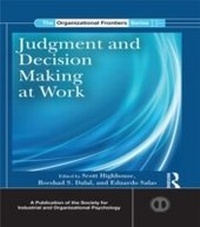
Judgment and Decision Making at Work
1st Edition
Published on 5. September 2013
408 pages
978-1-135-02195-5 (ISBN)
Description

Employees are constantly making decisions and judgments that have the potential to affect themselves, their families, their work organizations, and on some occasion even the broader societies in which they live. A few examples include: deciding which job applicant to hire, setting a production goal, judging one's level of job satisfaction, deciding to steal from the cash register, agreeing to help organize the company's holiday party, forecasting corporate tax rates two years later, deciding to report a coworker for sexual harassment, and predicting the level of risk inherent in a new business venture. In other words, a great many topics of interest to organizational researchers ultimately reduce to decisions made by employees.
Yet, numerous entreaties notwithstanding, industrial and organizational psychologists typically have not incorporated a judgment and decision-making perspective in their research. The current book begins to remedy the situation by facilitating cross-pollination between the disciplines of organizational psychology and decision-making. The book describes both laboratory and more "naturalistic" field research on judgment and decision-making, and applies it to core topics of interest to industrial and organizational psychologists: performance appraisal, employee selection, individual differences, goals, leadership, teams, and stress, among others. The book also suggests ways in which industrial and organizational psychology research can benefit the discipline of judgment and decision-making. The authors of the chapters in this book conduct research at the intersection of organizational psychology and decision-making, and consequently are uniquely positioned to bridging the divide between the two disciplines.
Yet, numerous entreaties notwithstanding, industrial and organizational psychologists typically have not incorporated a judgment and decision-making perspective in their research. The current book begins to remedy the situation by facilitating cross-pollination between the disciplines of organizational psychology and decision-making. The book describes both laboratory and more "naturalistic" field research on judgment and decision-making, and applies it to core topics of interest to industrial and organizational psychologists: performance appraisal, employee selection, individual differences, goals, leadership, teams, and stress, among others. The book also suggests ways in which industrial and organizational psychology research can benefit the discipline of judgment and decision-making. The authors of the chapters in this book conduct research at the intersection of organizational psychology and decision-making, and consequently are uniquely positioned to bridging the divide between the two disciplines.
Reviews / Votes
"Offering enlightening commentary on a wide range of important issues, this rigorous work will be a valuable resource for students and scholars interested in organizational behavior and industrial psychology. Summing Up: Highly recommended. Upper-division undergraduate through research collections." -- J.J. Bailey, University of Idaho, in CHOICE, April 2014"There are not many areas in organizational psychology on which there is a large body of basic psychological research that is directly applicable to various organizational problems. Judgment and decision making is one of those areas. The editors of this volume have assembled an excellent set of authors that provide an excellent overview of the wide variety of applied problems that are informed by basic research on judgment and decision making." -- Neal Schmitt, Michigan State University
"A stimulating collection of essays by both established and emerging scholars, putting the central relevance of JDM research to IO Psychology on a solid and expanding foundation" -- Terry Connolly, Eller Professor of Management and Organizations, University of Arizona. Past President, Society for Judgment and Decision Making
More details
Series
Language
English
Place of publication
London
United Kingdom
Publishing group
Taylor & Francis Ltd
Target group
College/higher education
Illustrations
9 s/w Abbildungen, 11 s/w Tabellen, 9 s/w Zeichnungen
11 Tables, black and white; 9 Line drawings, black and white; 9 Illustrations, black and white
File size
2,39 MB
ISBN-13
978-1-135-02195-5 (9781135021955)
Copyright in bibliographic data and cover images is held by Nielsen Book Services Limited or by the publishers or by their respective licensors: all rights reserved.
Schweitzer Classification
Other editions
Additional editions
Scott Highhouse | Reeshad S. Dalal | Eduardo Salas
Judgment and Decision Making at Work
Book
05/2014
1st Edition
Routledge
€84.70
Shipment within 10-20 days
Scott Highhouse | Reeshad S. Dalal | Eduardo Salas
Judgment and Decision Making at Work
Book
07/2013
1st Edition
Routledge
€173.50
Shipment within 15-20 days
Persons
Scott Highhouse is a Professor and Ohio Eminent Scholar in the Department of Psychology, Bowling Green State University. He received his PhD in 1992 from the University of Missouri at St. Louis. Scott served as Associate Editor of Organizational Behavior and Human Decision Processes (OBHDP) from 2001-2007, and as Associate Editor of the Journal of Occupational and Organizational Psychology from 2007-2009. He is currently co-editor, with Neal Schmitt, of the Industrial-Organizational Psychology volume of Wiley's Handbook of Psychology.
Reeshad S. Dalal received his PhD from the University of Illinois at Urbana-Champaign in 2003. He is now an Associate Professor of Industrial/Organizational Psychology and Chair-Elect of the Psychology Department at George Mason University in Fairfax, Virginia.
Eduardo Salas is Trustee Chair and Pegasus Professor of Psychology at the University of Central Florida (UCF). He also holds an appointment as Program Director for the Human Systems Integration Research Department at UCF's Institute for Simulation & Training. Previously, he was a Senior Research Psychologist and Head of the Training Technology Development Branch of NAVAIR-Orlando for fifteen years. During this period, Dr. Salas served as a principal investigator for numerous R&D programs focusing on teamwork, team training, simulation-based training, decision making under stress, learning methodologies, and performance assessment.
Reeshad S. Dalal received his PhD from the University of Illinois at Urbana-Champaign in 2003. He is now an Associate Professor of Industrial/Organizational Psychology and Chair-Elect of the Psychology Department at George Mason University in Fairfax, Virginia.
Eduardo Salas is Trustee Chair and Pegasus Professor of Psychology at the University of Central Florida (UCF). He also holds an appointment as Program Director for the Human Systems Integration Research Department at UCF's Institute for Simulation & Training. Previously, he was a Senior Research Psychologist and Head of the Training Technology Development Branch of NAVAIR-Orlando for fifteen years. During this period, Dr. Salas served as a principal investigator for numerous R&D programs focusing on teamwork, team training, simulation-based training, decision making under stress, learning methodologies, and performance assessment.
Content
Series Forward Eduardo Salas Introduction Chapter 1. Introduction to Judgment and Decision Making Scott Highhouse Reeshad S. Dalal, Eduardo SalasPart I: Personnel Decision Making Chapter 2. Performance Appraisals as Heuristic Judgments Under Uncertainty Jochen Reb, Gary J. Greguras, Shenghua Luan, Singapore, Michael A. Daniels Chapter 3. The Problem of Recognizing One's Own Incompetence:Implications for Self-Assessment and Development in the Workplace David Dunning Chapter 4. Employee Selection Decisions Jerel E. Slaughter, Edgar Kausel Chapter 5. Individual Differences in Decision Making Skill and Style Reeshad S. Dalal, Margaret E. Brooks Chapter 6. Job Search and Choice Cynthia StevensPart II: Organizational Decision Making Chapter 7. Goals and Decision Making Lisa Ordonez, George Wu Chapter 8. Leadership and Decision Making: Defining a Field Daan van Knippenberg Chapter 9. Judgments about Pay Kristine Kuhn Chapter 10. Combining Information and Judgments Silvia Bonaccio, Lyn Van Swol Chapter 11. Decision Making in Teams Eduardo Salas Chapter 12. Decision Making in Multiteam Distributed Systems Marissa ShufflerPart III: Decision Making in Action Chapter 13. Decision Making under Stress Tripp Driskell, James Driskell, Eduardo Salas Chapter 14. Enhancing Naturalistic Decision-Making and Accelerating Expertise in the Workplace: Training Strategies that Work Rebecca Grossman, Jacqueline M. Spencer, Eduardo Salas Chapter 15. Assessing Decision-Making Competence in Managers Christopher J. Lake, Scott Highhouse Commentary Chapter 16. Apollo, Dionysus, or Both? The Evolving Models and Concerns of JDM Kevin R. Murphy
