

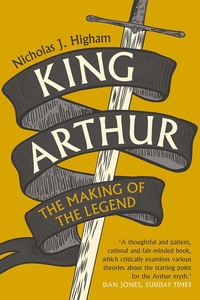
King Arthur
The Making of the Legend
1st Edition
Published on 20. November 2018
336 pages
978-0-300-24086-3 (ISBN)
Description

"A leading medievalist takes a clear-eyed look at the evidence for the existence of the legendary Arthur." -
The Sunday Times
"Best Paperbacks of 2021"
According to legend, King Arthur saved Britain from the Saxons and reigned over it gloriously sometime around A.D. 500. Whether or not there was a "real" King Arthur has all too often been neglected by scholars; most period specialists today declare themselves agnostic on this important matter. In this erudite volume, Nick Higham sets out to solve the puzzle, drawing on his original research and expertise to determine precisely when, and why, the legend began.
Higham surveys all the major attempts to prove the origins of Arthur, weighing up and debunking hitherto claimed connections with classical Greece, Roman Dalmatia, Sarmatia, and the Caucasus. He then explores Arthur's emergence in Wales-up to his rise to fame at the hands of Geoffrey of Monmouth. Certain to arouse heated debate among those committed to defending any particular Arthur, Higham's book is an essential study for anyone seeking to understand how Arthur's story began.
"Likely to be the definitive text on the legendary warrior for the foreseeable future.With his profound knowledge of the rules of historical narrative and patient but forensic analysis of the evidence, Higham's riveting book brings the historical Arthur to what may be his last, decisive battle." -MaxAdams, author of The First Kingdom
"Fascinating, authoritative analysis." -P. D. Smith, The Guardian
"Intelligent and eminently readable... For fans of a fascinating story that is wonderfully well told, this is the perfect book to take you back to King Arthur's time." - All About History
According to legend, King Arthur saved Britain from the Saxons and reigned over it gloriously sometime around A.D. 500. Whether or not there was a "real" King Arthur has all too often been neglected by scholars; most period specialists today declare themselves agnostic on this important matter. In this erudite volume, Nick Higham sets out to solve the puzzle, drawing on his original research and expertise to determine precisely when, and why, the legend began.
Higham surveys all the major attempts to prove the origins of Arthur, weighing up and debunking hitherto claimed connections with classical Greece, Roman Dalmatia, Sarmatia, and the Caucasus. He then explores Arthur's emergence in Wales-up to his rise to fame at the hands of Geoffrey of Monmouth. Certain to arouse heated debate among those committed to defending any particular Arthur, Higham's book is an essential study for anyone seeking to understand how Arthur's story began.
"Likely to be the definitive text on the legendary warrior for the foreseeable future.With his profound knowledge of the rules of historical narrative and patient but forensic analysis of the evidence, Higham's riveting book brings the historical Arthur to what may be his last, decisive battle." -MaxAdams, author of The First Kingdom
"Fascinating, authoritative analysis." -P. D. Smith, The Guardian
"Intelligent and eminently readable... For fans of a fascinating story that is wonderfully well told, this is the perfect book to take you back to King Arthur's time." - All About History
More details
Other editions
Additional editions
Book
10/2018
Yale University Press
€34.05
Shipment within 10-20 days
Person
HighamNicholas J.:
N. J. Higham is professor emeritus in history at the University of Manchester. His many works include Ecgfrith: King of the Northumbrians, High-King of Britain; King Arthur: Myth-making and History; and The Anglo-Saxon World. He lives in Cheshire, UK.
N. J. Higham is professor emeritus in history at the University of Manchester. His many works include Ecgfrith: King of the Northumbrians, High-King of Britain; King Arthur: Myth-making and History; and The Anglo-Saxon World. He lives in Cheshire, UK.
Content
- Cover page
- Halftitle page
- Title page
- Copyright page
- Dedication
- CONTENTS
- PLATES AND MAPS
- ACKNOWLEDGEMENTS
- Plates
- INTRODUCTION Arthur, History and the Storytellers
- Arthur in and out of history
- The 'Dalmatian' Arthur and the Sarmatians
- The 'Greek' Arthur
- The 'British' Arthurs
- Approach and organisation
- PART I The 'Foreign' Arthurs
- 1 LUCIUS ARTORIUS CASTUS A 'Dalmatian' King Arthur?
- The inscriptions
- The longer inscription
- The shorter inscription
- A career in time
- L. Artorius Castus and King Arthur
- The 'Dalmatian connection'
- 2 THE 'SARMATIAN CONNECTION'
- Sarmatia and the Sarmatians
- The Iazyges, Marcus Aurelius and Sarmatian cavalry
- The Sarmatians in Britain
- Sarmatians and the later Empire
- King Arthur and the Sarmatians
- Culture and language
- Sarmatian cavalry and medieval knights
- The sword in the stone
- Arthur and the Sarmatians
- 3 KING ARTHUR AND THE NARTS
- The Nart sagas
- The story of Batraz
- Batraz, Arthur and the sword in the water
- Arthur's approach to Avalon
- Arthur and the sword in the water
- The deaths of Batraz and Arthur: parallels and possible origins
- The Holy Grail
- The cauldron of Annwn
- The Wasamonga
- King Arthur and the Narts
- 4 KING ARTHUR AND THE GREEKS
- The Arktouros tradition
- Greek influences in pre- Roman Britain
- Roman Britain and Greek culture
- The name Arcturus
- Excalibur and the Round Table
- Arthur and the Greeks: in conclusion
- PART II The 'British' Arthur
- 5 A DARK AGE KING ARTHUR
- The mythological Arthur
- Riothamus
- Arthur and Gildas's De Excidio Britanniae
- Y Gododdín
- 'The Lament for Cynddylan' (Marwnad Cynddylan)
- Princely Arthurs around the Irish Sea
- Bede and the Britons
- Arthur in the British Dark Ages
- 6 ARTHUR AND THE HISTORIA BRITTONUM
- A 'history' in context
- Establishing the text
- Style, authorship and purpose
- Arthur in chapter 56 of the Historia Brittonum
- Historical method in early ninth- century Wales
- The northern dimension
- The Arthur of the Historia Brittonum
- 7 A BRITISH ARTHUR Starting the Tradition
- Camelot
- The Annales Cambriae
- The Mirabilia Britanniae
- Arthur in the landscape
- What man is the Gate- Keeper?
- Geraint, Son of Erbin
- Preiddeu Annwn
- Culhwch and Olwen
- The Welsh Triads
- The British saints' lives
- Concerning the Miracles of Saint Maria of Laon
- 'A certain very old book in the British tongue'
- The Arthurian tradition: beginnings
- 8 'FIRE', 'SMOKE' AND 'HIGHLAND MIST'
- Arthur's rise and fall
- Arthur's return
- 'Positivist' solutions post-Morris
- Arthur and the agnostics
- Arthur and British history
- Appendix I THE 'ARTORIUS' INSCRIPTIONS
- Appendix II ARTHUR'S BATTLES AS DESCRIBED IN THE HISTORIA BRITTONUM AND ANNALES CAMBRIAE
- Appendix III THE MIRABILIA: A LIST OF WONDERS AND MIRACLES THAT BECAME ATTACHED TO THE HISTORIA BRITTONUM
- ABBREVIATIONS
- ENDNOTES
- BIBLIOGRAPHY
- INDEX
