

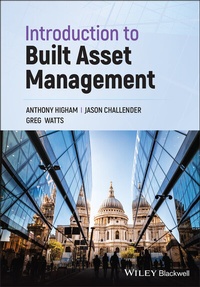
Introduction to Built Asset Management
Description

Provides a multidisciplinary introduction to building maintenance management and execution, covering a wide range of current technical and management issues
The maintenance and upgrading of existing buildings is no longer viewed as separate from the operational phase of the completed building. Maintenance and management are now regarded as fundamental parts of a building's life cycle, forming a significant percentage of the construction industry's total output. As higher education programmes in the UK and elsewhere continue to place greater emphasis on the longer-term view of construction projects, students and instructors require a thorough and up-to-date textbook that emphasises the comprehensive nature of building maintenance.
Introduction to Built Asset Management is a systematic introduction to both the technology and management issues central to building maintenance and refurbishment. Covering the entire life cycle of built assets, the textbook reviews the role of framework agreements, describes key performance indicators, discusses recent advancements in the procurement of maintenance activities and more. Detailed yet accessible chapters include illustrative examples, seminar questions and self-assessment tasks that enable students to measure their progress as they work through the material. Designed to meet the needs of today's learners, this much-needed textbook:
- Addresses a variety of both environmental and commercial concerns
- Evaluates important concepts of sustainability, sustainable maintenance and carbon resilience
- Discusses the growing retrofit market in the wider context of asset management and maintenance
- Describes information management tools such as building information modelling (BIM) and geographic information systems (GIS)
Introduction to Built Asset Management is ideally suited for courses in construction, construction management, building surveying and facilities management with modules in built asset management and maintenance.
More details
Other editions
Additional editions
Persons
Anthony Higham is a Senior Lecturer at the University of Salford, where he has delivered a range of quantity surveying modules. A Chartered Building Engineer and Chartered Construction Manager, Anthony was heavily involved in the financial and project management of major planned maintenance schemes for a range of corporate clients before moving into academia in 2006.
Jason Challender is Director of Estates and Facilities at the University of Salford, UK, a member of its Senior Leadership Team, and responsible for overseeing a large department of approximately 350 estates and construction related staff. He is a Fellow and Board Director of the Royal Institution of Chartered Surveyors.
Greg Watts is a Chartered Quantity Surveyor and Director of the Quantity Surveying Programme at the University of Salford. Before becoming a lecturer, Greg worked in the construction industry up to the level of Senior Quantity Surveyor, for various companies, on a range of multi-million pound projects.
Content
List of Figures ix
List of Tables xi
Foreword xiii
Acknowledgement xv
1 Introduction 1
1.1 Introduction to the Book 1
1.2 The Main Areas and Themes Covered in the Book 1
1.3 Research Sources 7
2 Surveying Existing Buildings 9
2.1 Introduction 9
2.2 A Background to Conducting Building Surveys 10
2.3 The Process of Undertaking Building Survey 11
2.4 Challenges and Obstacles When Undertaking Building Surveys 17
2.5 The Importance of Building Investigations 19
2.6 Managing the Remedial Work Process 21
2.7 Summary 23
3 Common Maintenance Issues and Managing Defects 25
3.1 Introduction 25
3.2 Exploring the Pathology of Building Maintenance Issues 26
3.3 Context to the Discussion on Building Defects 27
3.4 The Importance of Understanding the Nature and Effect of Agents That Can Lead to Building Defects 31
3.5 Dilemmas Associated with Repair or Renewal Decisions 33
3.6 Managing the Remedial Works Process to Address Maintenance Issues and Defects 35
3.7 Measures to Mitigate and Prevent Defects 37
3.8 Summary 39
Reference 41
4 Maintenance Management and Performance Measurement as Part of Private Financing Initiative (PFI) Schemes 43
4.1 Introduction 43
4.2 Definitions and Concepts of Facilities Management 44
4.3 Background to the Discussion on Performance Measurement (PM) of Facilities Management and Maintenance in the Healthcare Sector 45
4.4 The Advantages and Disadvantages of PFI Ventures in a Facilities Management Context 53
4.5 Quality Improvements in Maintenance Management Brought about through Performance Measurement 53
4.6 Financial and Non-financial Measurements 55
4.7 Performance Management 56
4.8 The Challenges for Performance Measurement 56
4.9 Payment Mechanisms as Part of PFI Contracts 59
4.10 Performance Monitoring Tools 60
4.11 The Importance of the Helpdesk for the Success of Maintenance and Facilities Management Services in PFI Initiatives 68
4.12 The Performance Monitoring Process 68
4.13 Key Issues Arising for Performance Management as Part of a Maintenance Management and FM Tool on PFI Schemes 72
4.14 Conclusions and Reflections 72
Acknowledgement 73
References 73
Further Reading 80
5 Procurement and Contracting for Maintenance and Refurbishment Works 87
5.1 Introduction 87
5.2 Rationale for Procurement of Maintenance Interventions 87
5.3 The Procurement Process 88
5.4 Project Initiation 90
5.5 Procurement Strategy 92
5.6 Client Brief 93
5.7 Procurement Route 94
5.7.1 Categorisation of Procurement Routes and Pricing Mechanisms 94
5.7.2 Pricing Mechanism 97
5.7.3 Procurement Routes 100
5.8 Contract Arrangements 109
5.8.1 The Joint Contracts Tribunal (JCT) Suite of Contracts 110
5.8.2 The New Engineering Contract (NEC) Suite of Contracts 111
5.8.3 The ACA PPC 2000 Form of Contract 115
5.9 Summary 120
References 120
6 Financial Management: Capital Costs 123
6.1 Introduction 123
6.2 Project Appraisal and Developing the Business Case 124
6.2.1 Optional Appraisal 126
6.3 Order of Cost Estimate 127
6.3.1 Developing the Order of Cost Estimate 127
6.3.2 Developing the Order of Cost Estimate Using the Functional Unit Method 129
6.3.3 Developing the Order of Cost Estimate Using the Floor Area Method 130
6.3.4 Developing the Order of Cost Estimate Using the Elemental Method 134
6.4 Cost Planning 137
6.4.1 Preparing the Cost Plan 140
6.4.2 Formal Cost Plan 1 147
6.4.3 Formal Cost Plan 2 155
6.4.4 Formal Cost Plan 3 157
6.5 Summary 158
References 159
7 Financial Management: Life Cycle Costing 161
7.1 Introduction 161
7.2 Forecasting Financial Impacts of Building Maintenance 162
7.3 Defining Life Cycle Costing 165
7.4 Challenges Associated with Life Cycle Prediction 167
7.4.1 Benefits of LCC 170
7.5 Undertaking Life Cycle Costing 170
7.5.1 Time Value of Money 170
7.5.2 Determining the Time Period of Appraisal 181
7.5.3 Component Life Considerations 185
7.5.4 Discount Rate, Interest Rate and Inflation 186
7.5.5 Building In-Use Considerations 189
7.5.6 Life Cycle Costing - Applications through the Building Life Cycle 190
7.5.7 Developing a Life Cycle Cost Plan 191
7.6 Example Life Cycle Cost Models 194
7.7 Summary 197
References 198
8 Sustainable Maintenance Management 201
8.1 Introduction 201
8.2 Sustainable Maintenance Management 201
8.3 Circular Economy 203
8.4 Carbon Neutrality 204
8.5 Retrofitting 207
8.6 BREEAM 210
8.7 Corporate Social Responsibility 212
8.8 Sustainable Development Goals 214
8.9 Conclusion 216
Reference 216
9 Risk Management 217
9.1 Introduction 217
9.2 What Is Risk? 217
9.3 The Nature of Risk 219
9.4 Risk in the Built Environment 220
9.5 Risk in Asset Management and Maintenance 224
9.6 What Is Risk Management? 224
9.7 The Nature of Risk Management 228
9.8 Risk Management in Asset Management and Maintenance 228
9.9 How Is Risk Classified? 232
9.10 Risk Events in Building Maintenance and Asset Management 233
9.11 The Consequences of Risk Events 235
9.12 Proactive and Reactive Risk Management 237
9.13 Procurement Risk 238
9.14 Why Risk Events Still Happen 239
9.15 Conclusion 240
References 240
10 Managing the Maintenance Process 243
10.1 Introduction 243
10.2 How to Manage Building Maintenance 243
10.3 Planning for Building Maintenance 244
10.4 Proactive Maintenance 244
10.5 Reactive Maintenance 245
10.6 Maintenance Schedules and Budgets 246
10.7 The Importance of a Programme 246
10.8 Site and Task Constraints 248
10.9 Health and Safety of Building Maintenance 249
10.9.1 Having Thorough Supply Chain Selection Methods in Place 250
10.9.2 Operating a Permit to Work System 250
10.9.3 Ensuring Inspections Are Carried Out for All Required Works 250
10.9.4 Ensuring the Risks Are Fully Understood 250
10.9.5 Being Up-to-Date with the Latest Guidance and Legislation 250
10.9.6 Having an Up to Date Training Matrix 251
10.10 Common Difficulties Encountered during Maintenance Works 251
10.11 Soft Landings 252
10.12 Operation and Maintenance Manuals 253
10.13 Building Information Modelling 254
10.14 Conclusion 255
11 Conclusion 257
About the Authors 261
Index 263
1
Introduction
1.1 Introduction to the Book
Undertaking responsible and practical repairs and maintenance policies and strategies are becoming an ever-important factor in life cycle management of property assets from owner occupiers to large property portfolios. In this sense, building maintenance practices are needed in every development and is therein a very crucial part in every life of every building. This may be predicated on buildings requiring to be well maintained in order to retain the value of the property itself. Furthermore, the buildings will also continue to fulfil their functions if properly maintained and will give the convenience to the tenant and occupants in the buildings.
With the technological advancement in buildings over many years and the advent of more complex building elements and services, the area of building management is becoming a 'hot topic' and one that is worthy of a more profound and professional approach and address. There has become a need for more prescriptive and perhaps regimented maintenance programmes and procedures to ensure statutory compliance is maintained as legislation becomes more convoluted, and to ensure buildings do not develop defects and deteriorate.
Some earlier publications have successfully considered aspects of maintenance, including its dimensions, planning, organisation, procurement and post-contract management and finally the role of knowledge management within maintenance organisations. Despite the comprehensive coverage of the fundamental issues, most of these previous works have not considered the increasingly important areas of carbon resilience and information management, which the present book will address. This is an important and topical aspect, as it is now essential that clients need to consider the viability of retrofitting microgeneration and renewable technologies to existing structures during major maintenance activities. This book will seek to readdress the balance and will provide readers with a depth of knowledge around such areas in an attempt to improve best practice in maintenance management.
1.2 The Main Areas and Themes Covered in the Book
As an introduction to the book and to provide context for readers, an overview is provided below of all the main areas and themes covered alongside related discussion points.
1.2.1 Chapter 2 Surveying Existing Buildings
This chapter will outline the background to conducting building surveys and identify the skills, steps and requirements for them to be completed successfully. It will describe the methodology by which defects are correctly diagnosed through collection of evidence and observing telltale signs. Notwithstanding this premise, it will provide instances when this can sometimes be challenging, and misdiagnosis may remain a real factor. To assist readers, it will describe circumstances and practical examples where there may be more than one force of nature at play and how these can lead to different forms of building deterioration. Furthermore, it will provide examples where certain defects have been misdiagnosed for others and where symptoms are similar, e.g., alternative forms of structural cracking and dampness.
The chapter will also highlight the importance of client engagement both before and after building surveys and will describe the type and form of background information that may be useful to them. In this regard the usefulness of desktop studies and reviewing previous technical reports will be discussed. Following on from this, the importance of understanding the clients' requirements in the type and nature of information to be captured in the survey will be articulated and explained.
The different types of building survey, ranging from full structural surveys to valuation surveys, will be outlined in the chapter together with the respective benefits and possible limitations of each. In addition, the range of different surveying equipment and tools will be identified. The use and application of each piece of equipment to assist surveyors in their inspections will be covered, especially where access and visibility difficulties are experienced. Photographs of different building surveying equipment and apparatus will be provided.
The modus operandi by which surveyors will conduct their inspections will be discussed, alongside factors such as health and safety and limitations which will need to be considered. In addition, the challenges and obstacles which sometimes confront building surveyors in the course of their inspection will be identified, especially where disruption to normal building operations remains an important factor. Examples of such factors will be given and an understanding of the difficulties that these constraints can impose on the building surveying process.
Following on from this, the importance of further investigation work will be outlined in circumstances that require opening up works or more specialist input. Finally, the various stages of managing the remedial work process will be described, alongside the importance of client consultation of the different options and preferred solutions. Examples of different scenarios leading up to the agreement of the agreed remedial works will be provided.
1.2.2 Chapter 3 Common Maintenance Issues and Managing Defects
This chapter of the book is focused on the pathology of buildings with particular emphasis on building degradation and will describe the ways and means of identifying and addressing potential defective elements and defects within buildings. In this pursuit, it will examine the different methodologies for diagnosis of defects and their root cause (rather than just the symptoms of defects) to assist in identifying the most appropriate type of repair.
An analysis of the underlying conditions and mechanisms that lead to defects and building failures resulting from poor design and quality of build during the construction stage or refurbishment will be covered, from dampness to structural movement, corrosion and timber decay. Furthermore, the role of maintenance across the life cycles of buildings will then be discussed and the influence that this has on their preservation and deterioration. The debate around this important area will then extend into the examination of planned and reactive policies for maintenance management of buildings estates.
The challenges associated with identifying the underlying causes of building failures will be presented where one or more possible different diagnoses may be initially debated. In this context the requirements for further investigation will be examined in correctly determining the underlying root cause of problems more accurately and confidently. The different categories of building failures which lead to the emergence of defects will then be discussed and the mitigation measures that should be undertaken to reduce the risk of such failures. In addition, the individual forces at work leading to different types of defects and how these can vary depending on climate and the geographical locations around the world will be articulated. Furthermore, the difficulties and challenges of correctly identifying faults and defects to building services such as heating, lighting, fire alarms, cooling and other forms of gas and electrical installation will be explained, and practical examples provided.
The importance of understanding the nature and effect of agents that can lead to building defects will be examined in detail, including human misuse of buildings and deliberate vandalism, coupled with electromagnetic, mechanical, chemical, building user, thermal and biological related forces and effects at work. The wrong use of materials and components and design defects will be discussed and how these can develop into latent construction defects in the future, therein introducing maintenance liabilities for building owners. Thereafter, the magnitude of managing remedial works and the associated disruption that this can bring for building users will then be investigated with reference to different examples in practice. Dilemmas associated with repair or renewal decisions will be introduced and debated in detail and the overall effects that decision making can have on future maintenance and lifecycle costings analysis. This will entail a discussion around capital cost (CAPEX) versus operational cost (OPEX) perspectives. Following on from this, the various influences of different factors on the repair or renewal decision making will be covered, including capital funding, building longevity and potential disruption from proposed remedial works.
Managing the remedial works processes to address maintenance issues and defects will be examined, with a focus on best practice and achieving the correct level of supervision and quality control throughout the contract period. This will introduce quality control and best practices in selecting the right design, a team and contractors from the perspective of attaining the necessary skills, experience and competency levels required to undertake projects successfully. Finally, measures to mitigate and prevent defects will be covered and the importance of allowing access provisions in building to enable and carry out regular maintenance inspections as part of planned preventative maintenance programmes.
1.2.3 Chapter 4 Maintenance Management and Performance Measurement as Part of Private Financing Initiative (PFI) Schemes
The chapter will start with a background to the discussion on performance measurement (PM) of maintenance and other facilities management services in the healthcare...
