

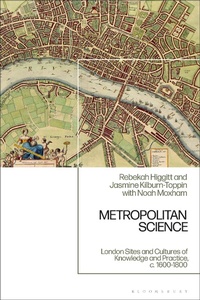
Metropolitan Science
London Sites and Cultures of Knowledge and Practice, c. 1600-1800
1st Edition
Published on 22. August 2024
240 pages
978-1-350-41704-5 (ISBN)
Description

Exploring distinctive practices in the artisanal, mercantile, and governmental sites of London, Metropolitan Science offers a new perspective on the development of a scientific culture between the years 1600-1800.
Beginning with the demographics of London in the 17th and 18th centuries, including its attraction of migrants, importance as a centre of empire, and the role of its institutions in government, the authors analyse how and why London was a unique site of scientific activity. Through the use of case studies, such as the Tower of London's Royal Mint, and the Livery Company Halls, this book examines the city's sites of exchange for knowledge and practice, and highlights the importance of both public and private spaces.
With exploration of London's military and colonial history, the authors acknowledge how its port and maritime trade were not only central to growth and protection, but also facilitated the organisation, assessment, valuation, and pursuit of knowledge in the city. Ultimately, this book demonstrates that London corporations produced unique knowledge communities that drew on networks across the city and beyond, and uses a variety of spatial and material approaches to reveal the use, representation, and exchange of practice in these collective settings.
Beginning with the demographics of London in the 17th and 18th centuries, including its attraction of migrants, importance as a centre of empire, and the role of its institutions in government, the authors analyse how and why London was a unique site of scientific activity. Through the use of case studies, such as the Tower of London's Royal Mint, and the Livery Company Halls, this book examines the city's sites of exchange for knowledge and practice, and highlights the importance of both public and private spaces.
With exploration of London's military and colonial history, the authors acknowledge how its port and maritime trade were not only central to growth and protection, but also facilitated the organisation, assessment, valuation, and pursuit of knowledge in the city. Ultimately, this book demonstrates that London corporations produced unique knowledge communities that drew on networks across the city and beyond, and uses a variety of spatial and material approaches to reveal the use, representation, and exchange of practice in these collective settings.
More details
Edition
1. Auflage
Language
English
Place of publication
London
United Kingdom
Publishing group
Bloomsbury Publishing PLC
Target group
Professional and scholarly
Illustrations
43 bw illus
ISBN-13
978-1-350-41704-5 (9781350417045)
Copyright in bibliographic data and cover images is held by Nielsen Book Services Limited or by the publishers or by their respective licensors: all rights reserved.
Schweitzer Classification
Other editions
Additional editions
Rebekah Higgitt | Jasmine Kilburn-Toppin | Noah Moxham
Metropolitan Science
London Sites and Cultures of Knowledge and Practice, c. 1600-1800
Book
04/2026
Bloomsbury Academic
€62.30
Shipment within 15-20 days
Rebekah Higgitt | Jasmine Kilburn-Toppin | Noah Moxham
Metropolitan Science
London Sites and Cultures of Knowledge and Practice, c. 1600-1800
Book
09/2024
Bloomsbury Academic
€121.50
Shipment within 15-20 days
Persons
Rebekah Higgitt is Principal Curator of Science at National Museums Scotland, UK.
Jasmine Kilburn-Toppin is Lecturer in Early Modern History at Cardiff University, UK.
Noah Moxham is a former postdoctoral researcher at the University of Kent, UK.
Jasmine Kilburn-Toppin is Lecturer in Early Modern History at Cardiff University, UK.
Noah Moxham is a former postdoctoral researcher at the University of Kent, UK.
Content
Introduction
1. Sites of Exchange and Objects of Knowledge in Early Modern London
2. The Tower of London and the Royal Mint: Technical Knowledge, Experiment and Secrecy
3. The Ordnance Office at the Tower and Woolwich: Trial, Manufacture and Mathematics
4. Livery Company Halls: Production and Regulation
5. The Trinity House on Water Lane: Experience and Expertise
6. East India House: Enterprise and Authority
Conclusion
Index
1. Sites of Exchange and Objects of Knowledge in Early Modern London
2. The Tower of London and the Royal Mint: Technical Knowledge, Experiment and Secrecy
3. The Ordnance Office at the Tower and Woolwich: Trial, Manufacture and Mathematics
4. Livery Company Halls: Production and Regulation
5. The Trinity House on Water Lane: Experience and Expertise
6. East India House: Enterprise and Authority
Conclusion
Index
