

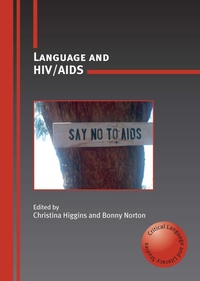
Language and HIV/AIDS
Published on 4. December 2009
280 pages
978-1-84769-383-9 (ISBN)
Description

This volume focuses on the role of language in the construction of knowledge about HIV/AIDS in diverse regions of the world. The collection of studies yields helpful insights about the discursive construction of this knowledge in both formal and informal contexts, while demonstrating how the tools of applied linguistics can be exercised to reveal a deeper understanding of the production and dissemination of this knowledge. The authors use a range of qualitative methodologies to critically explore the role of language and discourse in educational contexts in which various and sometimes competing forms of knowledge about HIV/AIDS are constructed. They draw on various forms of discourse analysis, ethnography, and social semiotics to interpret meaning-making practices in HIV/AIDS education in Australia, Cambodia, Burkina Faso, Hong Kong, India, South Africa, Tanzania, Thailand, and Uganda.
Reviews / Votes
Christina Higgins and Bonny Norton have brought together a remarkably diverse group of scholars who focus on the intersection of language and HIV/AIDS. The result is a stunningly vibrant volume, one that brims with insights based on qualitative analyses of a variety of public and private discourses from around the globe. _Language and HIV/AIDS_ is an outstanding example of the power of applied linguistics to illuminate critical real-world issues. A true treasure! -- Heidi Hamilton, Georgetown University, USA While the existence of HIV/AIDS is sadly a global phenomenon, its significance is always local, personal, constructed and mediated through diverse networks both professional and intimate. Communication is central to these processes, yet too little attention has been paid as yet by researchers in applied linguistics to our understanding of both the disease and the workings of the networks themselves. This well-edited and coherent book takes up this challenge as its central motivation. Its diversity of authorship, site and focus will both greatly enhance our understanding of HIV/AIDS and further underscore the essential applied linguistic goal of ensuring practical relevance in its research. -- Christopher N Candlin, Macquarie University, Sydney, Australia Applied linguistics doesn't get better than this. -- Gael Fonken, St Cloud State University * Applied Linguistics (2010), First published online: December 8, 2010 * This important volume initiates a necessary dialogue exploring the interrelationship between complex social issues that sit at the crux of policy, practice, development, health care, education, and medicine. The book presents a geographically, contextually, and methodologically diverse contribution to research on language and HIV/AIDS - one that is sensitive, complicated, valuable, and thought-provoking. -- Maureen T. Matarese, City University of New York, USA * Discourse Studies, 13(3) 381-392, 2011 * The discourses and levels of analysis in the book provide linguists and researchers in communication studies with a fresh glimpse into strategies in interpersonal, inter-group and official communication not only in offline face-to-face contexts but also in computer-mediated situations. This book is therefore a good companion for students and researchers interested in linguistic and communicative aspects of HIV/AIDS discourses. -- Eric A. Anchimbe, University of Bayreuth, Germany * Discourse & Communication 6(1), 2012 *More details
Series
Language
English
Place of publication
Bristol
United Kingdom
Publishing group
Channel View Publications Ltd
Target group
Professional and scholarly
ISBN-13
978-1-84769-383-9 (9781847693839)
Copyright in bibliographic data and cover images is held by Nielsen Book Services Limited or by the publishers or by their respective licensors: all rights reserved.
Schweitzer Classification
Other editions
Additional editions
Christina Higgins | Bonny Norton
Language and HIV/AIDS
Book
12/2009
Multilingual Matters
€42.20
Shipment within 10-20 days
Persons
Dr Christina Higgins is an Assistant Professor in the Department of Second Language Studies at the University of Hawaii at Manoa, where she teaches courses in sociolinguistics, discourse analysis, and intercultural communication. Her recent research has focused on communication in NGO-sponsored HIV/AIDS prevention and awareness education in Tanzania, where she has investigated the discursive construction of local and global worldviews. In her book, English as a local language: Post-colonial identities and multilingual practices (Multilingual Matters), she has also explored the role of language and popular culture in HIV/AIDS awareness efforts in hip hop lyrics and in public health advertisements. Her website can be found at http://www2.hawaii.edu/~cmhiggin.
Dr Bonny Norton is Professor and Distinguished University Scholar in the Department of Language and Literacy Education, University of British Columbia, Canada. Her award-winning research addresses identity and language learning, education and international development, and critical literacy. Her current research investigates the use of innovative technology to promote multilingual literacy in sub-Saharan Africa. Recent publications include Identity and Language Learning (Longman/Pearson, 2000); Critical Pedagogies and Language Learning (Cambridge University Press, 2004, w. K. Toohey); and Gender and English Language Learners (TESOL, 2004, w. A. Pavlenko). Her website can be found at http://lerc.educ.ubc.ca/fac/norton/.
Dr Bonny Norton is Professor and Distinguished University Scholar in the Department of Language and Literacy Education, University of British Columbia, Canada. Her award-winning research addresses identity and language learning, education and international development, and critical literacy. Her current research investigates the use of innovative technology to promote multilingual literacy in sub-Saharan Africa. Recent publications include Identity and Language Learning (Longman/Pearson, 2000); Critical Pedagogies and Language Learning (Cambridge University Press, 2004, w. K. Toohey); and Gender and English Language Learners (TESOL, 2004, w. A. Pavlenko). Her website can be found at http://lerc.educ.ubc.ca/fac/norton/.
Content
Introduction - Applied Linguistics, Local Knowledge, and HIV/AIDS - Christina Higgins and Bonny Norton
Chapter 1 Lengths of Life - Stories of Being with HIV - William Savage
Chapter 2 Ugandan Students' Visual Representations of Health Literacies: A Focus on HIV/AIDS Knowledge - Harriet Mutonyi and Maureen E. Kendrick
Chapter 3 Is It Safer to Talk about Sex in Spanish or English?: Performing Young Adulthood in Oaxaca, Mexico - Angeles Clemente and Michael J. Higgins
Chapter 4 Safe Sex - Not So Straightforward: Intersubjective Positioning in Gay Men's Accounts of Sexual Exposure to HIV - Henrike Koerner
Chapter 5 Dangerous Dogmas: AIDS, Discourse, and the Reality of the Rakhel System in India - Noushin Khushrushahi
Chapter 6 Discursive Constructions of Responsibility in HIV/AIDS Prevention: Investigating Re-entextualization Practices in Tanzania - Christina Higgins
Chapter 7 Uganda's ABC Program on HIV/AIDS Prevention: A Discursive Site of Struggle - Shelley Jones and Bonny Norton
Chapter 8 Learning about AIDS Online: Identity and Expertise on a Gay Internet Forum - Rodney H. Jones
Chapter 9 Contextualizing Local Knowledge: Reformulation in HIV/AIDS Prevention in Burkina Faso - Martina Drescher
Chapter 10 What Difference Does This Make?: Studying Southern African Youth as Knowledge Producers within a New Literacy of HIV and AIDS - Claudia Mitchell, Jean Stuart, Naydene de Lange, Relebohile Moletsane, Thabisile Buthelezi, June Larkin, and Sarah Flicker
Chapter 11 Articulations of Knowing: NGOs and HIV-positive Health in India - Mark Finn and Srikant Sarangi
Chapter 12 Signs Show the Way: Reading HIV Prevention on the Andaman Islands - Annabelle Mooney
Chapter 1 Lengths of Life - Stories of Being with HIV - William Savage
Chapter 2 Ugandan Students' Visual Representations of Health Literacies: A Focus on HIV/AIDS Knowledge - Harriet Mutonyi and Maureen E. Kendrick
Chapter 3 Is It Safer to Talk about Sex in Spanish or English?: Performing Young Adulthood in Oaxaca, Mexico - Angeles Clemente and Michael J. Higgins
Chapter 4 Safe Sex - Not So Straightforward: Intersubjective Positioning in Gay Men's Accounts of Sexual Exposure to HIV - Henrike Koerner
Chapter 5 Dangerous Dogmas: AIDS, Discourse, and the Reality of the Rakhel System in India - Noushin Khushrushahi
Chapter 6 Discursive Constructions of Responsibility in HIV/AIDS Prevention: Investigating Re-entextualization Practices in Tanzania - Christina Higgins
Chapter 7 Uganda's ABC Program on HIV/AIDS Prevention: A Discursive Site of Struggle - Shelley Jones and Bonny Norton
Chapter 8 Learning about AIDS Online: Identity and Expertise on a Gay Internet Forum - Rodney H. Jones
Chapter 9 Contextualizing Local Knowledge: Reformulation in HIV/AIDS Prevention in Burkina Faso - Martina Drescher
Chapter 10 What Difference Does This Make?: Studying Southern African Youth as Knowledge Producers within a New Literacy of HIV and AIDS - Claudia Mitchell, Jean Stuart, Naydene de Lange, Relebohile Moletsane, Thabisile Buthelezi, June Larkin, and Sarah Flicker
Chapter 11 Articulations of Knowing: NGOs and HIV-positive Health in India - Mark Finn and Srikant Sarangi
Chapter 12 Signs Show the Way: Reading HIV Prevention on the Andaman Islands - Annabelle Mooney
