

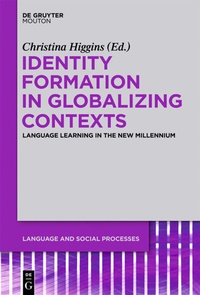
Identity Formation in Globalizing Contexts
Description

The volume explores how new millennium globalization mediates language learning and identity construction. It seeks to theorize how global flows are creating new identity options for language learners, and to consider the implications for language learning, teaching and use. To frame the chapters theoretically, the volume asserts that new identities are developing because of the increasingly interconnected set of global scapes which impact language learners' lives. Part 1 focuses on language learners in (trans)national contexts, exploring their identity formation when they shuttle between cultures and when they create new communities of fellow transnationals. Part 2 examines how learners come to develop intercultural selves as a consequence of experiencing global contact zones when they sojourn to new contexts for study and work. Part 3 investigates how learners construct new identities in the mediascapes of popular culture and cyberspace, where they not only consume, but also produce new, globalized identities. Through case studies, narrative analysis, and ethnography, the volume examines identity construction among learners of English, French, Japanese, and Swahili in Canada, England, France, Hong Kong, Tanzania, and the United States.
More details
Other editions
Additional editions
Person
Content
2 - Notes on contributors [Seite 11]
3 - Chapter 1. The formation of L2 selves in a globalizing world [Seite 19]
4 - Part I. Forming. identities within (trans)national ethnoscapes [Seite 37]
4.1 - Introduction to Part I [Seite 39]
4.2 - Chapter 2. "I'm two pieces inside of me": Negotiating belonging through narratives of linguistic and ethnic hybridity [Seite 45]
4.3 - Chapter 3. Integration through the accueil program: Language and belonging among newcomer adolescents in Quebec [Seite 67]
4.4 - Chapter 4. Performing "national" practices: Identity and hybridity in immigrant youths' communication [Seite 91]
4.5 - Chapter 5. L1 and L2 reading practices in the lives of Latina immigrant women studying English: School literacies, home literacies, and literacies that construct identities [Seite 117]
5 - Part II. Identifying with third spaces among ideoscapes [Seite 137]
5.1 - Introduction to Part II [Seite 139]
5.2 - Chapter 6. Mutuality, engagement, and agency: Negotiating identity on stays abroad [Seite 145]
5.3 - Chapter 7. National identity and language learning abroad: American students in the post 9/11 era [Seite 165]
5.4 - Chapter 8. "You're a real Swahili!": Western women's resistance to identity slippage in Tanzania [Seite 185]
6 - Part III. Constructing identities in mediascapes [Seite 211]
6.1 - Introduction to Part III [Seite 213]
6.2 - Chapter 9. Doing-Hip-Hop in the transformation of youth identities: Social class, habitus, and cultural capital [Seite 219]
6.3 - Chapter 10. When life is off da hook: Hip-hop identity and identification, BESL, and the pedagogy of pleasure [Seite 239]
6.4 - Chapter 11. Identity theft or revealing one's true self?: The media and construction of identity in Japanese as a foreign language [Seite 257]
6.5 - Chapter 12. Identity and interaction in internet-mediated contexts [Seite 275]
6.6 - Epilogue. Hybridizing scapes and the production of new identities [Seite 297]
7 - References [Seite 303]
8 - Index [Seite 347]
