

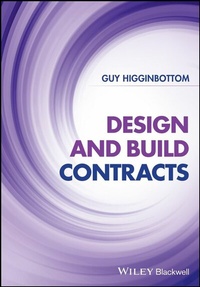
Design and Build Contracts
Description

Design and build (D&B) construction procurement relies on a project's main contractor shouldering the responsibility for creating the design and executing the construction for a project. While the extent of contractor-produced design can vary, this method of construction procurement affords the contractor a greater level of input and responsibility than traditionally procured contracts (where the employer has greater design responsibility). Over the last decade in the UK, it has become clear that D&B contracts are becoming the most popular method for procuring construction projects; often echoing the ways in which contracts for infrastructure and process plant can be procured.
Whilst D&B can provide a greater degree of contractor input for producing feasibility and concept designs, then the detailed design to deliver a project, many clients amend standard forms of D&B contracts to alter the contractors' design input. This can significantly change D&B, deviating from the procedures set out in the standard forms of D&B contract.
This book firstly takes the reader through each stage of a project (based upon the RIBA Plan of Work 2020) to provide guidance on how D&B contracts were intended to operate, then secondly, identifying how D&B contracts and their procedures have changed.
Readers will find:
* Outline commentary and guidance on commonly used standard forms of D&B contract, including: JCT Design and Build 2016; FIDIC Conditions of Contract for Plant Design-Build 2017; and NEC4
* How each D&B contract is intended to operate during each stage of the RIBA Plan of Work 2020
* How the operation of D&B contracts and their procedures are often amended.
An ideal resource for contractors, employers, and consultants, as well as those studying construction at university, Design and Build Contracts offers helpful commentary and guidance for how each stage of a D&B engineering or construction project should progress.
More details
Other editions
Additional editions
Person
Guy Higginbottom is an experienced consultant who has spent much of his career working in private practice, including as commercial director for a large, regional building contractor. He has extensive experience of commercial matters and project delivery across many sectors, including using different forms of contract (main contracts, sub-contracts, and consultants' appointments), and in particular those which include contractor's design elements. He is now director of Guy Higginbottom Consultancy Limited, a company providing specialist contract and commercial advice to the construction and engineering industries.
Content
List of Figures xiii
List of Tables xv
List of Cases xvii
Preface xix
1 Introduction 1
1.1 Some Types of 'Design and Build' 1
1.2 The Nature of Design and Build 2
1.3 A Brief History of Design and Build Contracts 4
1.4 Recent Developments in Design and Build 5
1.5 How to Use This Book 6
2 Construction Contracts 7
2.1 General 7
2.2 The Structure of a Construction Contract 7
2.3 Fairness as a Concept 14
Part I 19
3 Design and Build as Originally Intended 21
3.1 The Parties' Primary Obligations Under a Design and Build Contract 21
3.2 The Employer's Representative 24
3.3 The Relationship Between the Employer's Requirements and the Contractor's Proposals 26
3.4 The Employer's Requirements 29
3.5 The Contractor's Proposals 34
3.6 The Pricing Document 41
4 Consultants and the Employer's Representative 55
4.1 Means of Appointing Consultants 56
4.2 Obligations and Services 58
5 Procurement and Tendering 73
5.1 Procurement 73
5.2 Tendering 75
5.3 Types of Tender Processes 79
5.4 Early Contractor Involvement 83
5.5 Tender Returns and Evaluation 91
5.6 Contractor Selection and Appointment 94
6 Subcontracting 97
6.1 General 97
6.2 Domestic Subcontractors 103
6.3 'Nominated' or 'Named' Subcontractors 106
6.4 Early Subcontractor Involvement 114
7 Collateral Warranties, Third-Party Rights, Bonds, and Guarantees 117
7.1 General 117
7.2 Collateral Warranties 119
7.3 Third-Party Rights 123
7.4 Bonds and Guarantees 125
8 Construction133
8.1 General 133
8.2 Commencement 135
8.3 Completion in Sections (Subdividing the WholeWorks) 138
8.4 Progress 144
8.5 Acceleration 152
8.6 Programme 156
8.7 Interim Payments 162
8.8 Variations 178
8.9 Valuation (or Assessment) of Variations 196
8.10 Extensions of Time 212
8.11 Additional Costs (Loss and Expense) 225
8.12 Testing and Defects 229
9 Concluding the Contract 243
9.1 Termination 243
9.2 Obligations Prior to Completing the Physical Works 265
9.3 Meaning of 'Completion' 269
9.4 Damages for Late Completion 278
9.5 Rectification or Completing Outstanding Works After Completion 286
9.6 Final Account 298
9.7 Resolving Disputes 313
9.8 Concluding the Contract 330
Part II 335
10 Design and Build in Its Current Form 337
10.1 Reduction of the Contractor's Design 337
10.2 Novation of Design Consultants 339
11 Common Amendments to Design and Build Contracts 347
11.1 Project-Specific Amendments 348
11.2 Amendments with a Practical Benefit 349
11.3 Increased Liability for Contractor's Design 350
11.4 Reduced Employer's Risk/Increased Employer's Benefit 352
11.5 Reduced Contractor Rights (Not Design Related) 353
11.6 Increased Benefits to the Contractor 355
11.7 Clarifications 356
12 Possible Future Development in Design and Build 359
12.1 Continuing Trend of Reducing the Extent of Contractor Design 359
12.2 Novation of Design Consultants 361
12.3 Detailed Pricing Documents 362
12.4 Detailed Procedures for Testing and Commissioning 363
12.5 CollateralWarranties (FIDIC and NEC4) 365
Appendix A JCT Design and Build Contracts Reconciliation 367
Appendix B FIDIC Yellow Book Reconciliation 381
Appendix C NEC Engineering and Construction Contract (ECC) Reconciliation 387
Index 395
1
Introduction
The concept of engaging a single organisation to carry out both the design and construction for a project is nothing new. In various subsets within the engineering and construction sectors, the concept is regularly adopted, used to varying extents, and continues to evolve to suit the prevailing market conditions.
This book examines the methods of what we now know as 'design and build' by considering how works are procured under three of the UK's standard forms of building contract. The book begins with a general introduction to 'design and build' and construction contracts in Chapters 1 and 2. Part One (consisting of Chapters 3-9) looks at how these contracts are intended to function in their unamended form throughout each stage of a project, from bidding to the project's conclusion. Part Two (comprising Chapters 10-12) examines how those procedures have changed in recent years, who brought about these changes, and the effects these changes have had on employers, contractors, and consultants (such as designers and those with responsibility to certify matters under the building contract).
1.1 Some Types of 'Design and Build'
The terminology for engaging a single entity to design and construct the works can be varied and depends upon (i) the nature of the works themselves and (ii) the extent to which the employing party is involved. For projects within what can be described as the 'construction sector' (such as constructing commercial buildings and residential construction by a non-housebuilder), this type of procurement is usually called 'design and build'.
For projects of a more 'engineering' nature, such as civil engineering infrastructure or process plant projects, terms such as 'engineering, procurement, and construction' (EPC), 'design, build, operate' (DBO), and 'turnkey' may be used. The EPC and DBO terms usually apply where the employing party retains an element of control over the design. However, 'turnkey' is often used where the employer has little involvement with the project until its completion, when he or she takes possession of the finished works to 'turn the key' to begin their operation.
1.2 The Nature of Design and Build
Any project, whether its nature is construction or engineering, can be procured in a number of ways. All projects begin with a concept, and depending upon their nature, the 'initial brief' will vary in form, length, and detail. The initial brief may consist of no more than an idea, and it may never even be written down. All projects must be designed. The extent of the design can range from a general idea of what to build to a design that's fully developed, specified, and coordinated for each of its constituent elements.
To understand the nature of 'design and build' as a concept, it is useful to compare the project stages at which the employer engages the design team and the contractor under more 'traditional' procurement. 'Traditional' procurement is often used to describe projects for which the employer firstly obtains the design and then engages the contractor to construct that design but without being responsible for it. The Royal Institute of British Architects (RIBA) publishes its Plan of Work, which divides a project into distinct stages. Its most recent version was published in 2020 and divides the work into eight stages as shown in Table 1.1.
For each stage, RIBA's 2020 plan of work describes the common activities under the following headings:
- Stage Outcome
- Core Tasks
- Core Statutory Processes
- Procurement Route
- Information Exchanges
It seems appropriate to refer to the 2020 plan of work for two reasons. Firstly, the 2020 version is substantially the same as its predecessor (from 2013), and it is likely that the building contracts referred to in this book were drafted with the plan of work in mind. Secondly, the Institute of Civil Engineers' Civil Engineering Procedure (7th ed., 2015) contains key references to RIBA's 2020 Plan of Work, so it has obvious applications to both construction and engineering projects.
Table 1.1 Project stages in the 2020 Royal Institute of British Architects' Plan of Work.
General description Project stage(s)- Initial brief
- Design
- Construction
- Operation
Initially (through RIBA Stages 0, 1, and 2), the employer develops the project's general requirements - often with a design team comprising an architect, engineer, and possibly a cost consultant (such as a quantity surveyor). Subsequently, and following the latter design stages (RIBA Stages 3 and 4), a contractor is selected; this is done either following negotiations, such as a pre-qualification process, or in a competitive tender. The contractor's involvement usually starts at this point and will normally be formalised by entering into a building contract just before the start of RIBA Stage 5 (Construction). The employer remains responsible for the project's design and bears the risk if the design is incorrect, uncoordinated, or causes delay if it is not provided to the contractor on time. The employer firstly will have to assess and pay the contractor for any rework and overruns and must then take action against the offending member (or members) of the design team.
For design and build projects, the contractor's involvement may begin at any point between RIBA Stages 0 through 5. Depending upon their detail, the employer's requirements may be finalised at any point between RIBA Stage 1 (Preparation and Brief) and Stage 5. The contractor reviews the project's requirements (normally called the 'employer's requirements') and then develops proposals for carrying out the works. The contractor's proposals normally include any contractor's design, the specification for the works, a method statement, and health and safety information. The extent of design provided by the contractor will depend upon the extent of design provided by the employer's requirements. This may simply be 'filling in the gaps' in cases where the employer's requirements are quite prescriptive, but it may include a more detailed design if the employer's requirements are fairly brief.
Allied to the proposals, the contractor will normally set out a price for the works in a separate document. Typically, this provides far less detail than in bills of quantities, with the price simply being broken down into building elements (such as substructure, superstructure, etc.). Importantly, and unlike traditional procurement, the contractor assumes responsibility for the adequacy, accuracy, completeness, and consistency of the design. If it has any shortcomings, including an undue delay in its development or coordination, then the contractor will have to bear the cost of putting this right. The main advantage to the employer is that he no longer carries the design risk, as this is now held by the contractor. For example, if the design contains errors, isn't properly coordinated, or takes longer to develop, this remains the contractor's problem. The employer only has to manage dealing with the contractor (and not a design team), which is called 'single point responsibility'.
In the past, many contractors marketed their design and build expertise by claiming it added 'buildability' to a project. This term implied that the contractor would optimise the design so it became more practicable and would avoid design that was unnecessarily complicated and difficult to construct. Whilst the concept of 'buildability' may have originated from a desire for more efficient construction, it also provided the contractor with opportunities to increase profits by adopting a cheaper design. If the employer's requirements did not set out a precise specification or standard, contractors were often able to reduce their build costs by using cheaper materials and products, whilst still complying with the contract and remaining entitled to the same contract sum. Many employers soon countered this by ensuring their requirements contained specific quality standards. They also sought continuity of design from pre-contract (RIBA Stages 0-4) into construction (RIBA Stages 5 and 6), by transferring the employment of its pre-contract design team to the contractor for the construction phase. This concept is called novation and remains very popular.
1.3 A Brief History of Design and Build Contracts
Standard forms of building contract in the UK have been around for some time. The Institute...
