

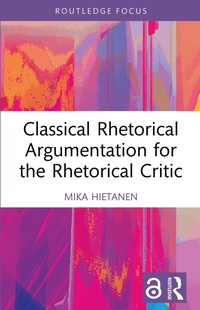
Classical Rhetorical Argumentation for the Rhetorical Critic
Published on 8. July 2025
162 pages
978-1-040-40547-5 (ISBN)
Description

This book offers a reassessment of argumentation in classical rhetoric, foregrounding its rational dimension. Moving beyond introductions, it provides insights from Aristotle, Quintilian, and other ancient thinkers while addressing common misconceptions and offering clarifications that are particularly valuable for the rhetorical critic.
Adopting a Scandinavian rhetorical perspective, this book argues that classical rhetoric offers enduring tools for both the analysis and the construction of persuasive argumentation. By bridging theory and practice, it demonstrates how classical rhetoric remains highly relevant, while also naturally integrating with analyses that focus on classical concepts such as ethos, pathos, or style - whether through neo-Aristotelian methods or contemporary approaches rooted in the classical rhetorical tradition. Key concepts are explored in dedicated chapters: the 'art' of logos-based argumentation is reassessed; enthymeme and epicheireme structures are examined; and topoi and staseis are discussed in relation to their later developments. A chapter on the centenary of rhetorical criticism traces its evolution from Herbert Wichelns (1925) to today, proposing a new template for the rhetorical critic.
This concise yet comprehensive book will interest intermediate and advanced students, as well as scholars of rhetoric, argumentation, persuasion, speech and writing studies, and communication studies.
Adopting a Scandinavian rhetorical perspective, this book argues that classical rhetoric offers enduring tools for both the analysis and the construction of persuasive argumentation. By bridging theory and practice, it demonstrates how classical rhetoric remains highly relevant, while also naturally integrating with analyses that focus on classical concepts such as ethos, pathos, or style - whether through neo-Aristotelian methods or contemporary approaches rooted in the classical rhetorical tradition. Key concepts are explored in dedicated chapters: the 'art' of logos-based argumentation is reassessed; enthymeme and epicheireme structures are examined; and topoi and staseis are discussed in relation to their later developments. A chapter on the centenary of rhetorical criticism traces its evolution from Herbert Wichelns (1925) to today, proposing a new template for the rhetorical critic.
This concise yet comprehensive book will interest intermediate and advanced students, as well as scholars of rhetoric, argumentation, persuasion, speech and writing studies, and communication studies.
Reviews / Votes
"Much contemporary work in rhetorical argumentation has lost sight of its roots in the Classical tradition, roots that are important for a full understanding of how we can reason rhetorically. Mika Hietanen's excellent Classical Argumentation for the Rhetorical Critic is a welcome correction to this situation, reviving valuable tools to support the critic's work."-- Christopher W. Tindale, Centre for Research in Reasoning, Argumentation and Rhetoric, University of Windsor, Canada
"Mika Hietanen succinctly presents from a contemporary background the theoretical framework of the classical rhetorical approach to argumentation. This is the overview all readers interested in analysing argumentation from a rhetorical perspective are eagerly waiting for: clear, solid, and enlightening."
-- Frans van Eemeren, University of Amsterdam and Leiden University, The Netherlands
"I see great value in Mika Hietanen's book on classical rhetorical argumentation. There is a need for an in-depth book on how classical rhetoric can contribute to argumentation studies, and Hietanen's work demonstrates thorough knowledge of both fields and excellent skills in exposition and analysis."
-- Christian Kock, University of Copenhagen, Denmark
"Mika Hietanen has written a clear, nuanced, and well-documented book on classical rhetorical argumentation, which will be highly useful to scholars across various fields, including advanced students of rhetoric. Presenting the Aristotelian tradition in classical rhetorical argumentation theory is no small task, as it is complex, sometimes inconsistent, and often misrepresented in modern scholarly literature influenced by formal logic. Hietanen also offers useful pedagogical models. Another valuable aspect of this work is its inclusion of Scandinavian and German research on classical rhetorical argumentation."
-- Hanne Roer, University of Copenhagen, Denmark; President of The International Society for the History of Rhetoric (ISHR), Switzerland
"This book is a welcome and valuable resource for teachers and students of rhetorical argumentation. It tackles complex conceptual discussions related to the core ideas of classical rhetorical argumentation theory in an accessible and engaging way, while maintaining a dialogue with contemporary argumentation theory and widely used textbooks. The book makes a compelling case for the importance of sustained engagement with classical theory in contemporary argumentation studies."
-- Tommy Bruhn, University of Copenhagen, Denmark; President of the Nordic Rhetoric Association
More details
Series
Language
English
Place of publication
London
United Kingdom
Publishing group
Taylor & Francis Ltd
Target group
College/higher education
Professional and scholarly
Illustrations
4 Tables, black and white; 7 Line drawings, black and white; 7 Illustrations, black and white
File size
2,38 MB
ISBN-13
978-1-040-40547-5 (9781040405475)
Copyright in bibliographic data and cover images is held by Nielsen Book Services Limited or by the publishers or by their respective licensors: all rights reserved.
Schweitzer Classification
Other editions
Additional editions
Book
07/2025
1st Edition
Routledge
€78.00
Shipment within 10-20 days
Person
Mika Hietanen is a Senior Lecturer in Rhetoric at Lund University, Sweden. He is a rhetorician, an argumentation scholar, an exegete, and a pedagogue with a focus on both authentic and literary argumentation in political, religious, and educational contexts. His interests include a variety of both classical and modern rhetorical methods and historical and contemporary persuasive and argumentative techniques, as well as hate speech, argument literacy, and rhetorical citizenship.
Content
1. Rhetorical Argumentation
2. The Logos Proof
3. The Enthymeme
4. The Epicheireme
5. The Topoi
6. The Staseis
7. Evaluating Argumentation
8. Rhetorical Criticism
Index
2. The Logos Proof
3. The Enthymeme
4. The Epicheireme
5. The Topoi
6. The Staseis
7. Evaluating Argumentation
8. Rhetorical Criticism
Index
