

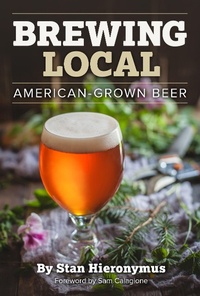
Brewing Local
American-Grown Beer
Published on 7. October 2016
350 pages
978-1-938469-37-4 (ISBN)
Description

Beer has never been a stranger to North America. Author Stan Hieronymous explains how before European colonization, Native Americans were making beer from fermented corn, such as the tiswin of the Apache and Pueblo tribes. European colonists new to the continent were keen to use whatever local flavorings were at hand like senna, celandine, chicory, pawpaw, and persimmon. Before barley took hold in the 1700s, early fermentables included corn (maize), wheat bran, and, of course, molasses.
Later immigrants to the young United States brought with them German and Czech yeasts and brewing techniques, setting the stage for the ubiquitous Pilsner lagers that came to dominate by the late 1800s. But local circumstances led to novel techniques, like corn and rice adjuncts, or the selection of lager yeasts that could ferment at ale-like temperatures. Despite the emergence of brewing giants with national distribution, "common brewers" continued to make "common beer" for local taverns and pubs. Distinctive American styles arose. Pennsylvania Swankey, Kentucky Common, Choc beer, Albany Ale, and steam beer?now called California common?all distinctive styles born of their place.
From its post-war fallow period, the US brewing industry was reignited in the 1980s by the craft beer scene. Follow Stan Hieronymous as he explores the wealth of ingredients available to the locavores and beer aficionados of today. He takes the reader through grains, hops, trees, plants, roots, mushrooms, and chilis?all ingredients that can be locally grown, cultivated, or foraged. The author supplies tips on how to find these as well as dos and don'ts of foraging. He investigates the nascent wild hops movement and initiatives like the Local Yeast Project. Farm breweries are flourishing, with more breweries operating on farms than the US had total breweries fewer than 50 years ago. He gives recipes too, each one showing how novel, local ingredients can be used to add fermentables, flavor, and hop-like bitterness, and how they might be cultivated or gathered in the wild. Armed with this book, brewers in America have never been better equipped to create a beer that captures the essence of its place.
Later immigrants to the young United States brought with them German and Czech yeasts and brewing techniques, setting the stage for the ubiquitous Pilsner lagers that came to dominate by the late 1800s. But local circumstances led to novel techniques, like corn and rice adjuncts, or the selection of lager yeasts that could ferment at ale-like temperatures. Despite the emergence of brewing giants with national distribution, "common brewers" continued to make "common beer" for local taverns and pubs. Distinctive American styles arose. Pennsylvania Swankey, Kentucky Common, Choc beer, Albany Ale, and steam beer?now called California common?all distinctive styles born of their place.
From its post-war fallow period, the US brewing industry was reignited in the 1980s by the craft beer scene. Follow Stan Hieronymous as he explores the wealth of ingredients available to the locavores and beer aficionados of today. He takes the reader through grains, hops, trees, plants, roots, mushrooms, and chilis?all ingredients that can be locally grown, cultivated, or foraged. The author supplies tips on how to find these as well as dos and don'ts of foraging. He investigates the nascent wild hops movement and initiatives like the Local Yeast Project. Farm breweries are flourishing, with more breweries operating on farms than the US had total breweries fewer than 50 years ago. He gives recipes too, each one showing how novel, local ingredients can be used to add fermentables, flavor, and hop-like bitterness, and how they might be cultivated or gathered in the wild. Armed with this book, brewers in America have never been better equipped to create a beer that captures the essence of its place.
More details
Other editions
Additional editions
Book
10/2016
Brewers Publications
€19.00
No shipping information available
Person
By Stan Hieronymus
Content
Table of Contents
Acknowledgments
Foreword
Introduction: The Importance of Being Local
Part I ? Local, Now and Then
1 Beer From a Place
2 Tiswin to Choc
3 King Corn
Part II ? Where Beer Is Grown
4 Cultivating Beer
5 Foraging for Beer
6 Foraging for Yeast
Part III ? From Farms, Gardens, Fields, and Woods
7 Grains
8 Trees
9 Plants
10 Roots
11 Mushrooms
12 Chiles
Part IV ? Brewing Local
13 History + Local = Recipes
Le Pamplemousse Enorme
1835 Albany Ale
Kentucky Common
Your Father's Mustache
Indigenous: All-American Chile Corn Lager
The Great Pumpkin Ale
Rosemary Pumpkin Belgian Ale
Sweet Potato Ale
D.A.M.'s Bloom BRU Kölsch
Our Mother the Meadow
Single Tree: Hickory
Dead Leaves & Burdock
Birch Sap Black Bière de Garde
Paw Paw
Pecan Porter
Cucumber Crush
Beet Berliner Weisse
Beets, Rhymes, and Life
2015 Hibernal Dichotomous
Wee Shroomy
Golden Shroomy
Dark Old Ale
Appendix: Resources
Bibliography
Index
Acknowledgments
Foreword
Introduction: The Importance of Being Local
Part I ? Local, Now and Then
1 Beer From a Place
2 Tiswin to Choc
3 King Corn
Part II ? Where Beer Is Grown
4 Cultivating Beer
5 Foraging for Beer
6 Foraging for Yeast
Part III ? From Farms, Gardens, Fields, and Woods
7 Grains
8 Trees
9 Plants
10 Roots
11 Mushrooms
12 Chiles
Part IV ? Brewing Local
13 History + Local = Recipes
Le Pamplemousse Enorme
1835 Albany Ale
Kentucky Common
Your Father's Mustache
Indigenous: All-American Chile Corn Lager
The Great Pumpkin Ale
Rosemary Pumpkin Belgian Ale
Sweet Potato Ale
D.A.M.'s Bloom BRU Kölsch
Our Mother the Meadow
Single Tree: Hickory
Dead Leaves & Burdock
Birch Sap Black Bière de Garde
Paw Paw
Pecan Porter
Cucumber Crush
Beet Berliner Weisse
Beets, Rhymes, and Life
2015 Hibernal Dichotomous
Wee Shroomy
Golden Shroomy
Dark Old Ale
Appendix: Resources
Bibliography
Index
