

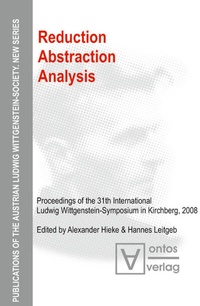
Reduction - Abstraction - Analysis
Description

Philosophers often have tried to either reduce "disagreeable" objects or concepts to (more) acceptable objects or concepts. Reduction is regarded attractive by those who subscribe to an ideal of ontological parsimony. But the topic is not just restricted to traditional metaphysics or ontology. In the philosophy of mathematics, abstraction principles, such as Hume's principle, have been suggested to support a reconstruction of mathematics by logical means only. In the philosophy of language and the philosophy of science, the logical analysis of language has long been regarded to be the dominating paradigm, and liberalized projects of logical reconstruction remain to be driving forces of modern philosophy.
This volume collects contributions comprising all those topics, including articles by Alexander Bird, Jaakko Hintikka, James Ladyman, Rohit Parikh, Gerhard Schurz, Peter Simons, Crispin Wright and Edward N. Zalta.
More details
Other editions
Additional editions

Persons
Content
1.1 - A PROOF OF NOMINALISM:AN EXERCISE IN SUCCESSFUL REDUCTION IN LOGIC JAAKKO HINTIKKA [Seite 13]
1.2 - PRESERVATION OF EMPIRICAL SUCCESS AND INTERTHEORETICAL CORRESPONDENCE: JUSTIFYING REALISM WITHOUT THE NO MIRACLES ARGUMENT GERHARD SCHURZ [Seite 27]
1.3 - EMPIRICAL ADEQUACY AND RAMSIFICATION, II JEFFREY KETLAND [Seite 41]
1.4 - ELIMINATING MODALITY FROM THE DETERMINISM DEBATE?MODELS VS. EQUATIONS OF PHYSICAL THEORIES THOMAS MÜLLER [Seite 59]
1.5 - DETERMINISTIC VERSUS INDETERMINISTIC DESCRIPTIONS:NOT THAT DIFFERENT AFTER ALL? CHARLOTTE WERNDL [Seite 75]
1.6 - THE "MULTIREALIZATION" OF MULTIPLE REALIZABILITY HOLGER LYRE [Seite 91]
1.7 - PESSIMISTIC META-INDUCTION AND THE EXPONENTIAL GROWTH OF SCIENCE1 LUDWIG FAHRBACH [Seite 107]
1.8 - WEAK PHYSICALISM AND SPECIAL SCIENCE ONTOLOGY JAMES LADYMAN [Seite 125]
1.9 - ARE NATURAL KINDS REDUCIBLE?ALEXANDER BIRD [Seite 139]
1.10 - ONTIC GENERATION: GETTING EVERYTHING FROM THE BASICS PETER SIMONS [Seite 149]
1.11 - WHAT REDUCTIONISTS BELIEVE IN Christian Kanzian [Seite 165]
1.12 - SUPERVENIENCE AND MORAL REALISM ALISON HILLS [Seite 175]
1.13 - ALTERNATIVE REDUCTIONS FOR DYNAMIC DEONTIC LOGICS ALBERT J.J. ANGLBERGER [Seite 191]
2 - II.Abstraction [Seite 205]
2.1 - THE METAPHYSICS AND EPISTEMOLOGY OF ABSTRACTION* CRISPIN WRIGHT [Seite 207]
2.2 - HOW ABSTRACTION WORKS LEON HORSTEN and HANNES LEITGEB [Seite 229]
2.3 - THIN OBJECTS ØYSTEIN LINNEBO [Seite 239]
2.4 - RUSSELL'S MANY POINTS THOMAS MORMANN [Seite 251]
2.5 - FROM DESCRIPTIVE FUNCTIONS TO SETS OF ORDERED PAIRS1 BERNARD LINSKY [Seite 271]
2.6 - DIAGONALIZATION, THE LIAR PARADOX, AND THE INCONSISTENCY OF THE FORMAL SYSTEM PRESENTED IN THE APPENDIX TO FREGE'S GRUNDGESETZE: VOLUME II ROY T COOK [Seite 285]
2.7 - A PROBLEM AND A SOLUTION FOR NEO-FREGEANISM* MICHAEL GABBAY [Seite 301]
2.8 - ED ZALTA'S VERSION OF NEO-LOGICISM -A FRIENDLY LETTER OF COMPLAINT Philip A. Ebert [Seite 317]
2.9 - REPLY TO P. EBERT AND M. ROSSBERG'S FRIENDLY LETTER OF COMPLAINT EDWARD N. ZALTA [Seite 323]
3 - III.Analysis [Seite 333]
3.1 - ON THE BENEFITS OF AREDUCTION OF MODAL PREDICATES TO MODAL OPERATORS VOLKER HALBACH [Seite 335]
3.2 - CALCULI OF INDIVIDUALS AND SOME EXTENSIONS: AN OVERVIEW* KARL-GEORG NIEBERGALL [Seite 347]
3.3 - DEFINITE DESCRIPTIONS: LANGUAGE, LOGIC, AND ELIMINATION NORBERT GRATZL [Seite 367]
3.4 - FROM LANGUAGE GAMES TO SOCIAL SOFTWARE ROHIT PARIKH [Seite 377]
3.5 - ON THE RELATION BETWEEN GAMES IN EXTENSIVE FORM AND GAMES IN STRATEGIC FORM SIMON M. HUTTEGGER [Seite 389]
3.6 - TWO ACCOUNTS OF SIMILARITY COMPARED LIEVEN DECOCK and IGOR DOUVEN [Seite 401]
3.7 - CONTEXTUALISM, RELATIVISM, AND FACTIVITY.ANALYZING 'KNOWLEDGE' AFTER THE NEW LINGUISTIC TURN IN EPISTEMOLOGY ELKE BRENDEL [Seite 415]
