

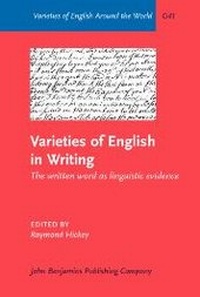
Varieties of English in Writing
The written word as linguistic evidence
1st Edition
Published on 28. October 2010
X, 378 pages
978-90-272-8778-6 (ISBN)
Description

This volume is concerned with assessing fictional and non-fictional written texts as linguistic evidence for earlier forms of varieties of English. These range from Scotland to New Zealand, from Canada to South Africa, covering all the major forms of the English language around the world. Central to the volume is the question of how genuine written representations are. Here the emphasis is on the techniques and methodology which can be employed when analysing documents. The vernacular styles found in written documents and the use of these as a window on earlier spoken modes of different varieties represent a focal concern of the book. Studies of language in literature, which were offered in the past, have been revisited and their findings reassessed in the light of recent advances in variationist linguistics.
More details
Other editions
Additional editions
Book
10/2010
John Benjamins Publishing Co
€95.40
Shipment within 10-15 days
Person
Content
- Varieties of English in Writing
- Editorial page
- Title page
- LCC data
- Table of contents
- Preface
- List of contributors
- Linguistic evaluation of earlier texts
- 1. The question of 'standard' in previous centuries
- 1.1 Standard and non-standard English in linguistic research
- 2. Identifying and analysing varieties of English
- 2.1 Deciding what belongs to the standard
- 2.2 What was previously 'non-standard'
- 2.3 The yardstick for preferred usage
- 3. Investigating 'non-standard' texts
- 3.1 Fidelity of representation
- 3.2 Classification criteria for non-standard texts
- 3.3 Classification in Schneider (2002)
- 4. Conclusion
- References
- Non-standard language in earlier English
- 1. Aims of the study
- 2. Defining non-standard in the past
- 3. Theory and data: Empirical evidence from early texts
- 3.1 Regional language use
- 3.2 Social and stylistic varieties ("lower class")
- 4. The status of 'standard' vs. 'non-standard' features in Early Modern English: Assessing textual evidence
- 4.1 Them for demonstrative those
- 4.2 Third-person subject-verb concord
- 5. Conclusion
- References
- Appendix
- a. Northern words listed in Ray (1674 and recorded in the CED
- b.Northern words listed in Ray (1674 and recorded in the CED but unclear whether the same sense was intended
- c. Southern/Eastern words listed in Ray (1674 and recorded in the CED
- d.Southern/Eastern word listed in Ray (1674 and recorded in the CED but unclear whether the same sense was intended
- e. Words of potential interest found in the CED but not listed in Ray (1674)
- Assessing non-standard writing in lexicography
- 1. Revising the OED
- 1.1 Historical regional variation in the OED
- 1.2 Scots and English regional variation contrasted
- 1.3 What of the unpublished writings of 'naïve' non-professional writers?
- 2. An examination of the spelling forms found in some sample texts
- 2.1 John Clare, prose piece The Farmer and the Vicar
- 2.2 A comparison with a contemporary U.S. source: The journals of Lewis and Clark
- 2.3 How does the evidence of 'naïve' witnesses differ for earlier periods?
- 3. Some conclusions
- References
- Northern English in Writing
- 1. The foundations of Northern English
- 2. Northern English 1500-1900: Weighing the evidence
- 3. Northern English features 1500-1900
- 3.1 Phonology
- 3.2 Grammar
- 3.3 Lexis
- 3.4 Discourse features
- 4. Conclusion
- References
- Primary sources
- Secondary Sources
- Southern English in writing
- 1. Introduction
- 2. An outline of the area and its demographic history
- 3. The middle and south of England as a linguistic area
- 4. The representation of non-standard dialect in writing: Variation, problems, accuracy
- 5. The significance of genre, motivation and awareness
- 6. Concluding remarks
- References
- The distinctiveness of Scots
- 1. Historical background
- 2. Gavin Douglas' Eneados
- 3. The status of Scots
- 4. The Valiant Scot
- 5. Alexander Hume's Of the Orthographie and Congruitie of the Britan Tongue
- 6. Scots in the seventeenth and eighteenth centuries
- 6.1 Allan Ramsay's The Ever Green
- 6.2 James Elphinstone's Propriety Ascertained in her Picture
- 6.3 Alexander Geddes' Dissertation on the Scoto-Saxon Dialect
- 7. Conclusion
- References
- Irish English in early modern drama
- 1. Introduction
- 1.1 The rise of the stage Irishman
- 1.2 The limits of reconstruction via satire
- 2. The late sixteenth century
- 3. The seventeenth century
- 4. The eighteenth century
- 4.1 Drama in the eighteenth century
- 4.2 Summary of features up to 1800
- 5. The nineteenth century
- 7. Conclusion
- References
- '[H]ushed and lulled full chimes for pushed and pulled'
- 1. Writing Ulster English
- 2. Research on Ulster English
- 3. Approaching text types
- 4. Studies of written Ulster English
- 4.1 Ulster English recorded
- 4.2 Northern Irish English observed
- 4.3 Ulster English imagined
- 4.4 Ulster English invented
- 4.4.1 Documenting the vernacular
- 4.4.2 Extending the vernacular
- 4.4.3 (Re)shaping the vernacular
- 4.5 ICE-Ireland - a corpus of present-day Irish English
- 4.6 CORIECOR - Corpus of Irish English Correspondence
- 5. Prospect
- References
- Dialect literature and English in the USA
- 1. Introduction
- 2. Methodological considerations and assumptions
- 3. The early American context
- 4. Literary dialect, a new national identity, and standardization in American English
- 5. Standard American English, literary dialect, and African American as other
- 6. Conclusion
- References
- Written sources for Canadian English
- 1. Written sources and sociolinguistic reconstruction
- 1.1 Approaching written sources: Methodology and supporting evidence
- 1.2 Types of complementary evidence
- 1.3 Literary dialect
- 1.4 Non-literary sources
- 2. Literary sources East to West: Points of departure
- 3. Tracing the low-back vowel merger in Canadian English
- 3.1 Contemporary evidence
- 3.2 Diachronic evidence
- 3.2.1 Literary sources: Haliburton's literary eye and ear
- 3.2.2 Literary dialect and authentic data
- 4. Conclusions
- Acknowledgements
- References
- Earlier Caribbean English and Creole in writing
- 1. Introduction
- 2. The writing context in the eighteenth- and nineteenth-century Caribbean
- 2.1 The authors
- 2.2 The nature of the texts
- 2.3 Technical issues
- 3. Linguistic analysis of early texts
- 3.1 Research aims and methodological approaches
- 3.2 Overview of grammatically oriented studies of historical Creole documents
- 3.3 The findings from research on historical documents written in a Creole
- 4. Sociolinguistic research on early texts
- 4.1 Aims and Methods
- 4.2 Overview of research in this area
- 4.3 Sample analysis
- 4.4 Problems
- 5. Conclusions and outlook
- References
- Earliest St Helenian English in writing
- 1. Introduction
- 2. A brief social history of St Helena
- 3. Earlier evidence of St Helenian English
- 4. Assessing the sociolinguistic significance of earlier evidence
- 5. Conclusion
- References
- 'An abundant harvest to the philologer'?
- 1. Introduction
- 2. Early South African English
- 3. Sources for South African English
- 4. Methodology
- 5. Jeremiah Goldswain and Thomas Shone
- 6. Phonological features
- 6.1 h-dropping
- 6.2 h-insertion
- 6.3 /w/ merger
- 7. Grammatical features
- 7.1 Past tense done
- 7.2 Past tense be
- 7.3 Verbal concord
- 8. Conclusions
- References
- 'A peculiar language'
- 1. Introduction
- 1.1 Background - early Australian English (AusE)
- 1.2 Written texts as evidence for early Australian English
- 2. Sydney's lawbreakers and lawmakers of the 1850s
- 2.1 Irish background speakers
- 2.2 One speaker of Scottish origin
- 2.3 Speakers of London origin
- 2.4 Speakers of unknown background
- 3. Whence Australian English? What Corbyn's texts reveal
- 3.1 The Cockney clout
- 3.1.1 W(h)ither the Irish features?
- 4. In conclusion
- References
- Appendix - Corbyn's extracts
- Irish background
- Scottish background
- London background
- Unknown background
- Describing and complaining
- 1. Samuel McBurney: The describer
- 1.1 Vowels
- 2. The school inspectors and The Triad: The complainers
- 2.1 Vowels
- 2.1.1 The closing diphthongs
- 2.1.2 The short unstressed vowel
- 2.1.3 H-dropping
- 3. Methodological issues
- 4. Comparing written records with spoken evidence
- 4.1 Variability in early New Zealand English spoken data
- 4.2 H-dropping in the spoken data
- 4.3 Closing diphthongs in the spoken data
- 4.4 The unstressed vowel - the spoken evidence
- 5. Conclusions
- References
- Feature index
- Name index
- Subject index
- The series Varieties of English Around the World
