

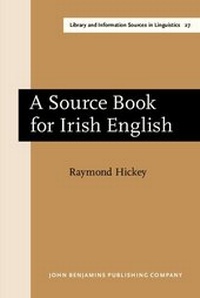
A Source Book for Irish English
1st Edition
Published on 6. September 2002
XII, 541 pages
978-90-272-7295-9 (ISBN)
Description

The current book intends to provide a flexible and comprehensive bibliographical tool to those scholars working or interested in Irish English. A whole range of references (approx. 2,500) relating to Irish English in all its aspects are gathered together here and in the majority of cases annotations are supplied. The book has a detailed introduction dealing the history of Irish English, the documentation available and contains an overview of the themes in Irish English which have occupied linguists working in the field. Various appendixes offer information on the history of Irish English studies and biographical notes on scholars from this area. All the bibliographical material is contained on the accompanying CD-ROM along with appropriate software (Windows, PC) for processing the databases and texts. The databases are fully searchable, information can be exported at will and customised extracts can be created by users from within an intuitive software interface. This bibliography is part of a larger project, called the Irish English Resource Centre. Additions and updates to the bibliography can be found on the centre's website.
More details
Other editions
Additional editions
Raymond Hickey
A Source Book for Irish English
Book
09/2002
John Benjamins Publishing Co
€159.00
Shipment within 10-15 days
Person
Content
- A SOURCE BOOK FOR IRISH ENGLISH
- Editorial page
- Title page
- Copyright page
- Table of contents
- Foreword
- I An historical outline
- 1 Matters of terminology
- 2 External history of Irish English
- 2.1 Initial settlement
- 2.1.1 Spread of English
- 2.1.2 The linguistic situation in medieval Ireland
- 2.2 Renewed dominance of English
- 2.2.1 Transplantation and transportation
- 2.3 The eighteenth century
- 2.3.1 Hedge schools
- 2.3.2 The ascendancy
- 2.4 The nineteenth century
- 3 English in the north of Ireland
- 3.1 Emigration from Ulster
- 4 Documents for the first period
- 4.1 Medieval period
- 4.2 Manuscripts of the medieval period
- 4.2.1 English texts
- 4.2.2 Anglo-Norman (French) texts
- 5 Forth and Bargy
- 5.1 Documents
- 5.2 Link with medieval Irish English
- Notes
- II Research themes
- 1. Approaching the field
- 2. The history of Irish English
- 3. Retention versus contact
- 4. Present-day developments
- 5. Linguistic levels
- 6.Varieties of Irish English
- 7.Irish English as non-standard English
- 8.Relationships abroad
- 1 Approaching the field
- 2 The history of Irish English
- 3 Retention versus contact
- 4 Present-day developments
- 5 Linguistic levels
- 6 Varieties of Irish English
- 7 Irish English as non-standard English
- 8 Relationships abroad
- References
- III Annotated bibliography
- III Annotated bibliography
- 1 English in Ireland
- 1.1 A first orientation
- 1.1.1 Questions of nomenclature
- 1.1.2 Bibliographies of Irish English
- 1.1.3 Linguistic surveys of Irish English
- 1.2 Overviews and general works
- 1.2.1 Overviews of Irish English
- 1.2.2 Works with remarks on Irish English
- 1.3 Regional and sociolinguistic studies
- 1.3.1 Regional studies of Irish English
- 1.3.2 The language of Dublin
- 1.3.3 Sociolinguistic treatments
- 1.4 The historical dimension
- 1.4.1 Medieval Irish English
- 1.4.2 The dialect of Forth and Bargy
- 1.4.3 The early modern period
- 1.4.3.1 Thomas Sheridan
- 1.4.4 The nineteenth century
- 1.5 Contact and borrowing
- 1.5.1 Contact between Irish and English
- 1.5.2 The influence of Irish (and Celtic) on English
- 1.5.3 The influence of English on Irish
- 1.6 Linguistic levels
- 1.6.1 The phonology of Irish English
- 1.6.2 The morphology of Irish English
- 1.6.3 Syntax of Irish English
- 1.6.4 Tense, mood and aspect
- 1.6.5 The lexicon of Irish English
- 1.7 The language of literature
- 1.7.1 General works
- 7.7.2 Works on 'Stage Irish'
- 1.7.3 The term 'Brogue'
- 1.8 The language of individual authors
- 1.8.1 Swift
- 1.8.2 Synge
- 1.8.3 O'Casey
- 1.8.4 Joyce
- 1.9 Non-linguistic studies
- 1.10 The North of Ireland
- 1.10.1 The history of English in Ulster
- 1.10.2 Ulster Scots English
- 1.10.3 General studies
- 1.10.4 Individual descriptions
- 1.10.5 Sociolinguistic studies
- 1.10.6 The language of Belfast
- 1.10.8 Non-linguistic works
- 1.10.9 Works on Ulster Irish
- 2 Extraterritorial varieties
- 2.1 The Celtic regions
- 2.1.1 Scotland
- 2.1.1.1 General studies
- 2.1.1.2 Scots
- 2.1.1.3 Scottish lexicography
- 2.1.1.4 Gaelic and English contact
- 2.1.1.5 Norn
- 2.1.2 Wales
- 2.1.3 Manx English
- 2.1.4 The South-West
- 2.2 Mainland England
- 2.2.1 General
- 2.2.2 Dialect studies
- 2.2.3 Scouse
- 2.2.4 Tyneside
- 2.3 Atlantic
- 2.3.1 North America
- 2.3.1.1 Immigration to the New World
- 2.3.1.2 Canada
- 2.3.1.2.1 Newfoundland
- 2.3.1.3 United States
- 2.3.1.3.1 Appalachia
- 2.3.1.3.2 African American Vernacular English
- 2.3.2 Caribbean
- 2.3.2.1 Creoles
- 2.4 The Southern Hemisphere
- 2.4.1 Africa and Asia
- 2.4.2 A ustralia and New Zealand
- 3 Additional languages
- 3.1 The Celtic background
- 3.1.1 Celtic
- 3.1.2 Irish
- 3.1.3 Scottish Gaelic
- 3.1.4 Manx
- 3.1.5 Welsh
- 3.1.6 Cornish
- 3.1.7 Breton
- 3.1.8 Onomastics
- 3.2 Minor languages in Irish history
- 3.2.1 Norse
- 3.2.2 Flemish
- 3.2.3 Anglo-Norman
- 3.2.4 Shelta, Polari and Romani
- 3.3 Irish in contemporary Ireland
- 3.3.1 Bilingualism
- 3.3.2 Education
- 3.3.3 Language planning
- 4 General references
- 4.1 The cultural and historical setting
- 4.1.1 General
- 4.1.2 The arts
- 4.1.3 Geography
- 4.1.4 Politics
- 4.1.5 History
- 4.2 Literature in Ireland
- 4.2.1 The Irish tradition
- 4.2.2 Writers and writings in English
- 5 Collections
- 5.1 General collections
- 5.2 Dedicated collections
- 5.2.1 Ireland
- 5.2.2 Scotland
- 5.2.3 England
- 5.2.4 America
- 5.2.5 Africa and Asia
- IV Appendixes
- 1 Journals
- 2 Biographical notes
- 3 Institutions, associations
- 4 Conferences on Irish English
- 5 Dates in the history of Irish English
- 6 Outline of Irish history
- 7 Glossary
- Maps
- V Index of names
- VI Software for A Source Book for Irish English
- VII Update information
