

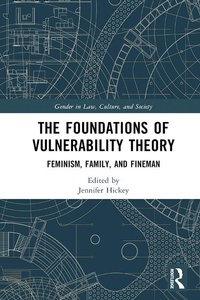
The Foundations of Vulnerability Theory
Feminism, Family, and Fineman
1st Edition
Published on 3. November 2023
196 pages
978-1-000-98881-9 (ISBN)
Description

This volume is the first collection of Martha Albertson Fineman's most important and influential work. Feminist legal theorist Martha Albertson Fineman has spent decades pushing the boundaries of law, questioning and reconceptualizing legal and social definitions of family, dependency, vulnerability, and state responsibility. The pieces collected in this book trace the arc of Fineman's scholarship, from gender equality; to the role of the family as a social institution; to dependency; to autonomy; to the legal subject and vulnerability theory.
This book reflects a lifetime of radical reimagining of the relationship between the state, individuals, families, and other social institutions that is just as relevant today, if not more so. In this book, Fineman offers a foundation for the achievement of true social justice, through the centering of our shared human vulnerability and dependency, grounded in the recognition of the ontological body and its material needs. Arranged in sections, and introduced by leading scholars in the field, these pieces ask us to re-examine our legally enshrined commitment to formal equality and the "mythological" autonomous independent legal subject; recognizing instead that we must call for an active and responsive state that meaningfully provides resilience through its social institutions. This collection demonstrates an evolution of heretical thought that has always pressed for a deeper understanding of the foundations of law and society, offering a model for other scholars on how to keep pressing through the hard work of thinking and rethinking the conceptual basics of language, law, society, and justice.
This book will appeal to academics, policymakers, lawyers, activists, and students in law and politics theory with interests in law and society, human dependency and vulnerability, state responsibility, and feminism and the family; as well as others who have applied Fineman's vulnerability theory to issues in the fields of bioethics, artificial intelligence, and policing, to name just a few.
This book reflects a lifetime of radical reimagining of the relationship between the state, individuals, families, and other social institutions that is just as relevant today, if not more so. In this book, Fineman offers a foundation for the achievement of true social justice, through the centering of our shared human vulnerability and dependency, grounded in the recognition of the ontological body and its material needs. Arranged in sections, and introduced by leading scholars in the field, these pieces ask us to re-examine our legally enshrined commitment to formal equality and the "mythological" autonomous independent legal subject; recognizing instead that we must call for an active and responsive state that meaningfully provides resilience through its social institutions. This collection demonstrates an evolution of heretical thought that has always pressed for a deeper understanding of the foundations of law and society, offering a model for other scholars on how to keep pressing through the hard work of thinking and rethinking the conceptual basics of language, law, society, and justice.
This book will appeal to academics, policymakers, lawyers, activists, and students in law and politics theory with interests in law and society, human dependency and vulnerability, state responsibility, and feminism and the family; as well as others who have applied Fineman's vulnerability theory to issues in the fields of bioethics, artificial intelligence, and policing, to name just a few.
More details
Series
Edition
1. Auflage
Language
English
Place of publication
London
United Kingdom
Publishing group
Taylor & Francis Ltd
Target group
College/higher education
ISBN-13
978-1-000-98881-9 (9781000988819)
Copyright in bibliographic data and cover images is held by Nielsen Book Services Limited or by the publishers or by their respective licensors: all rights reserved.
Schweitzer Classification
Other editions
Additional editions
Book
11/2023
1st Edition
Routledge
€207.40
Shipment within 10-20 days
Book
11/2023
1st Edition
Routledge
€65.00
Shipment within 10-20 days
Person
Jennifer Hickey is a Postdoctoral Fellow with the Vulnerability and the Human Condition Initiative at Emory University School of Law, USA.
Content
Introduction Jennifer Hickey Part I. Gender Equality Introduction Deborah Dinner 1. The Equality Ideal 2. Challenging Law, Establishing Differences 3. Equality Discourse and Economic Decisions Made at Divorce 4. The Individualization of the Family: Child Advocacy 5. The Illusion of Equality Part II. The Sexual Family Introduction Teemu Ruskola 6. The End of Family Law? Intimacy in the Twenty-First Century 7. A Claim for Justice Part III. Dependency Introduction Michael Thomson 8. A Dystopian Fantasy 9. Dependency and Social Debt: Cracking the Foundational Myths 10. The New Tokenism Part IV. Autonomy Introduction Martha McCluskey 11. Equality and Autonomy 12. Posing the Philosophy for an Active State 13. What Place for Family Privacy? Part V. Vulnerability Introduction Aziza Ahmed 14. Vulnerability and Inevitable Inequality 15. Equality and Difference - The Restrained State 16. The "Still Face" of a Compassionately-Challenged Society 17. Injury in the Unresponsive State 18. Vulnerability and Social Justice 19. Conclusion: Resilience is the Watchword Lua Kamal Yuille Afterword Atieno Mboya Samandari
