

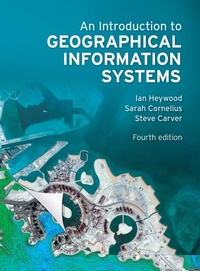
Introduction to Geographical Information Systems
Description

The full text downloaded to your computer
With eBooks you can:
- search for key concepts, words and phrases
- make highlights and notes as you study
- share your notes with friends
eBooks are downloaded to your computer and accessible either offline through the Bookshelf (available as a free download), available online and also via the iPad and Android apps.
Upon purchase, you'll gain instant access to this eBook.
Time limit
The eBooks products do not have an expiry date. You will continue to access your digital ebook products whilst you have your Bookshelf installed.
The 4th Edition of this highly regarded and successful text continues to provide a clear and accessible introduction to the world of GIS for students and professionals. With an increased focus on the practical applications of GIS, the new edition features a wealth of new multi-disciplinary case studies and examples of GIS in practice, demonstrating how it is used worldwide and within a variety of different industries.
Furthermore, the new edition has been substantially revised and updated to include coverage of the latest advances in GIS such as web and mobile applications.
An Introduction to Geographical Information Systems is suitable for students of Geographical Information studies at all levels, from undergraduate to professionals retraining in GIS.
More details
Other editions
Additional editions
Persons
Ian Heywood, previously Director of Director of Growing Business and Skills for Scottish Enterprise Grampian, Director of Open and Distance Learning for RobertGordonUniversity, Aberdeen, and a Senior Lecturer in GIS at ManchesterMetropolitanUniversity, is now a freelance consultant and Director of the Ideas Academy Ltd.
Sarah Cornelius is a Lecturer in the School of Education at the University of Aberdeen, specializing in adult and online learning. She was previously an Associate Lecturer for the Open University and has taught GIS at Manchester Metropolitan University and the Free University of Amsterdam.
Steve Carver is a Senior Lecturer in the Department of Geography at the University of Leeds. He is Director of the MA in GIS and MSc in GIS.
Content
Part 1 Fundamentals of GIS
- 1 What is GIS?
- 2 Spatial data
- 3 Spatial data modelling
- 4 Database management
- 5 Data input and editing 6 Data analysis
- 7 Analytical modelling in GIS
- 8 Output: from new maps to enhanced decisions
Part 2 Issues in GIS
- 9 The development of computer methods for handling spatial data
- 10 Data quality issues
- 11 Human and organizational issues
- 12 GIS project design and management
- 13.The Future of GIS
