

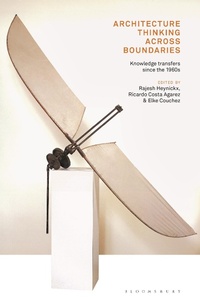
Architecture Thinking across Boundaries
Knowledge Transfers Since the 1960s
1st Edition
Published on 14. January 2021
216 pages
978-1-350-15319-6 (ISBN)
Description

While most studies on the history of architectural theory have been concerned with what has been said and written, this book is concerned with how architecture theory has been created and transmitted.
Architecture Thinking across Boundaries looks at architectural theory through the lens of intellectual history. Eleven original essays explore a variety of themes and contexts, each examining how architectural knowledge has been transferred across social, spatial and disciplinary boundaries - whether through the international circulation of ideas, transdisciplinary exchanges, or transfers from design practice to theory and back again.
Dissecting the frictions, transformations and resistances that mark these journeys, the essays in this book reflect upon the myriad routes that architectural knowledge has taken while developing into architectural theory. They critically enquire the interstices - geographical, temporal and epistemological - that lie beyond fixed narratives. They show how unstable, vital and eminently mobile the processes of thinking about architecture have been.
Architecture Thinking across Boundaries looks at architectural theory through the lens of intellectual history. Eleven original essays explore a variety of themes and contexts, each examining how architectural knowledge has been transferred across social, spatial and disciplinary boundaries - whether through the international circulation of ideas, transdisciplinary exchanges, or transfers from design practice to theory and back again.
Dissecting the frictions, transformations and resistances that mark these journeys, the essays in this book reflect upon the myriad routes that architectural knowledge has taken while developing into architectural theory. They critically enquire the interstices - geographical, temporal and epistemological - that lie beyond fixed narratives. They show how unstable, vital and eminently mobile the processes of thinking about architecture have been.
More details
Edition
1. Auflage
Language
English
Place of publication
London
United Kingdom
Publishing group
Bloomsbury Publishing PLC
Target group
College/higher education
Illustrations
40 bw illus
ISBN-13
978-1-350-15319-6 (9781350153196)
Copyright in bibliographic data and cover images is held by Nielsen Book Services Limited or by the publishers or by their respective licensors: all rights reserved.
Schweitzer Classification
Other editions
Additional editions

Rajesh Heynickx | Ricardo Costa Agarez | Elke Couchez
Architecture Thinking across Boundaries
Knowledge transfers since the 1960s
Book
07/2022
Bloomsbury Visual Arts
€44.90
Shipment within 15-20 days
Persons
Rajesh Heynickx is a Professor in Architectural Theory and Intellectual History at the Faculty of Architecture, KU Leuven, Belgium.
Ricardo Costa Agarez is Assistant Professor of Architectural Theory and History at the University of Évora, Portugal.
Elke Couchez is Postdoctoral Research Fellow at the University of Hasselt, Belgium.
Ricardo Costa Agarez is Assistant Professor of Architectural Theory and History at the University of Évora, Portugal.
Elke Couchez is Postdoctoral Research Fellow at the University of Hasselt, Belgium.
Content
List of Illustrations
List of Contributors
Introduction
Part One: Translations and Appropriations
1. Deconstruction and Architecture: translation as a matter of speculative theory
2. Gehry's Lou Ruvo Center in Las Vegas as a Housing Critique
3. "Boomerang Effect": The Repercussions of Critical Regionalism in 1980s Greece
4.The Autonomy of Theory: Tendenzen - Neuere Architektur im Tessin, ETH Zurich, 1975
SECTION 2: Imprints and Undercurrents
5. Royston Landau and the Research Programmes of Architecture
6. Theoretical a/gnosticisms: Paul Tillich, Colin Rowe, and the theology of architecture
SECTION 3: Vehicles
7. Cedric Price's Chats: Orality and the Production of Architectural Theory
8. Alternative Facts: Towards a Theorisation of Oral History in Architecture
9. Abandoning the Plan
10. Deltiology as History. Informal Communication as Praxis.
11. Theorizing from the South. The Seminar of Latin American Architecture (SAL)
Index
List of Contributors
Introduction
Part One: Translations and Appropriations
1. Deconstruction and Architecture: translation as a matter of speculative theory
2. Gehry's Lou Ruvo Center in Las Vegas as a Housing Critique
3. "Boomerang Effect": The Repercussions of Critical Regionalism in 1980s Greece
4.The Autonomy of Theory: Tendenzen - Neuere Architektur im Tessin, ETH Zurich, 1975
SECTION 2: Imprints and Undercurrents
5. Royston Landau and the Research Programmes of Architecture
6. Theoretical a/gnosticisms: Paul Tillich, Colin Rowe, and the theology of architecture
SECTION 3: Vehicles
7. Cedric Price's Chats: Orality and the Production of Architectural Theory
8. Alternative Facts: Towards a Theorisation of Oral History in Architecture
9. Abandoning the Plan
10. Deltiology as History. Informal Communication as Praxis.
11. Theorizing from the South. The Seminar of Latin American Architecture (SAL)
Index
