

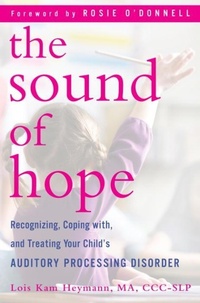
The Sound of Hope
Recognizing, Coping with, and Treating Your Child's Auditory Processing Disorder
Published on 27. April 2010
256 pages
978-0-345-51933-7 (ISBN)
Description

There is more to listening than just hearing.
A miraculous process that begins in the womb, learning to communicate is a vital part of expressing oneself and of understanding and interacting with the world. A child's ability to listen well affects every aspect of his or her life. But for some 1.5 million children in the United States who have normal hearing and intelligence, communication and language are blocked. Words are jumbled and distorted. These children have a hard time following directions and become frustrated in trying to make themselves understood, which often leads to unruly behavior, poor school performance, social isolation, and low self-esteem.
Auditory Processing Disorder (APD) affects the brain's ability to accurately process the sounds of speech, which in turn impedes the ability to communicate. Experts are just beginning to unlock the mystery of this confounding condition. As a result, APD is often undiagnosed or misdiagnosed. But hope is here. Now veteran speech-language pathologist Lois Kam Heymann offers the first practical guide to help parents dramatically improve the listening and language skills of their children, whether they have a diagnosed auditory processing disorder, slow language development-or simply need practice listening. Inside this reassuring, action-oriented book you'll find
• easy-to-identify milestones to help parents pinpoint challenges that may arise during each stage of their child's development from birth to age eight
• the tools and checklists needed to assist parents in recognizing APD early
• tips to distinguish APD from other listening/learning disorders, including ADD, ADHD, LPD, and PDD
• methods to encourage a child's natural listening abilities through books, stories, nursery rhymes, songs, lullabies, toys, and games
• home techniques to hone a child's auditory processing-whether he or she has severe APD limitations or just needs to build listening "muscles"
• specific suggestions on how to improve a child's listening skills outside the home-at school, during after-school activities, even when at a restaurant
• an analysis of traditional classroom settings and effective ways parents can advocate for better sound quality
• guidelines for finding the right professionals to work with your child
With hands-on ways for improving a child's ability to listen to instructions, process information, and follow directions, parents can turn simple activities into powerful listening lessons in only minutes a day. The bottom line: Learning how to listen in our noisy, complicated world is the key to a happy and engaged child.
A miraculous process that begins in the womb, learning to communicate is a vital part of expressing oneself and of understanding and interacting with the world. A child's ability to listen well affects every aspect of his or her life. But for some 1.5 million children in the United States who have normal hearing and intelligence, communication and language are blocked. Words are jumbled and distorted. These children have a hard time following directions and become frustrated in trying to make themselves understood, which often leads to unruly behavior, poor school performance, social isolation, and low self-esteem.
Auditory Processing Disorder (APD) affects the brain's ability to accurately process the sounds of speech, which in turn impedes the ability to communicate. Experts are just beginning to unlock the mystery of this confounding condition. As a result, APD is often undiagnosed or misdiagnosed. But hope is here. Now veteran speech-language pathologist Lois Kam Heymann offers the first practical guide to help parents dramatically improve the listening and language skills of their children, whether they have a diagnosed auditory processing disorder, slow language development-or simply need practice listening. Inside this reassuring, action-oriented book you'll find
• easy-to-identify milestones to help parents pinpoint challenges that may arise during each stage of their child's development from birth to age eight
• the tools and checklists needed to assist parents in recognizing APD early
• tips to distinguish APD from other listening/learning disorders, including ADD, ADHD, LPD, and PDD
• methods to encourage a child's natural listening abilities through books, stories, nursery rhymes, songs, lullabies, toys, and games
• home techniques to hone a child's auditory processing-whether he or she has severe APD limitations or just needs to build listening "muscles"
• specific suggestions on how to improve a child's listening skills outside the home-at school, during after-school activities, even when at a restaurant
• an analysis of traditional classroom settings and effective ways parents can advocate for better sound quality
• guidelines for finding the right professionals to work with your child
With hands-on ways for improving a child's ability to listen to instructions, process information, and follow directions, parents can turn simple activities into powerful listening lessons in only minutes a day. The bottom line: Learning how to listen in our noisy, complicated world is the key to a happy and engaged child.
More details
Other editions
Additional editions
Lois Kam Heymann
The Sound of Hope
Recognizing, Coping with, and Treating Your Child's Auditory Processing Disorder
Book
04/2010
Random House Inc
€25.00
Shipment within 10-20 days
Person
Lois Kam Heymann, MA, CCC-SLP, is a recognized leader in the treatment of children with listening, learning, and auditory challenges. As a private speech and language pathologist, she has more than thirty years of experience working with families and also serves as a consultant to hospitals and schools, including the Children's Hearing Institute and more than a dozen school districts in and around New York City. A noted educator, Heymann teaches auditory therapy at the State University of New York at New Paltz and has presented hundreds of seminars and workshops nationally for doctors, speech and language pathologists, teachers, and parents. She lives in Rosendale, New York.
Content
- Intro
- Title Page
- Dedication
- Contents
- Foreword
- Introduction
- Part One - Recognizing and Understanding APD
- Chapter One - When Hearing Isn't Listening: The ABCs of APD
- Chapter Two - Confusing APD with Other Three-Letter Syndromes
- Chapter Three - The Developmental Elements of Listening
- Part Two - Coping Daily with APD
- Chapter Four - A Sound Strategy for Moving Ahead
- Chapter Five - The Art of Noise: Creating Better Listening Environments
- Part Three - Treating APD Through Skill Building
- Chapter Six - Strengthening Listening Skills in the Early Years
- Chapter Seven - Getting Ready for School: Making the Listening and Learning Connection
- Chapter Eight - Music to the Ears: Using Rhythm and Rhyme to Build Listening Skills
- Chapter Nine - The Skill-Building Value of Play
- Chapter Ten - Nurturing Social Skills: The Listening-Speaking-Relating Connection
- Chapter Eleven - The Magic of Reading: Using Books to Build Listening and Critical-Thinking Skills
- Chapter Twelve - Finding Help
- Resources
- Selected References and Bibliography
- Acknowledgments
- About the Author
- Copyright
