

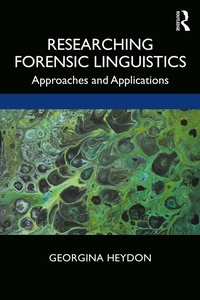
Researching Forensic Linguistics
Approaches and Applications
1st Edition
Published on 15. May 2019
164 pages
978-1-000-02017-5 (ISBN)
Description

Researching Forensic Linguistics is an informative, hands-on guide to conducting research in forensic linguistics that can underpin legal and justice practices and address social justice problems involving language.
Georgina Heydon takes readers step by step through the research process using case studies that draw on different types of forensic and legal language data such as police interviews, anonymous reports of sexual assault, threatening letters and justice stakeholder interviews. Each chapter is framed by a language problem arising from either forensic linguistic case work or a key issue in language and the law. Up-to-date research methods in forensic linguistics are presented, including authorship attribution using online corpora, practice-based linguistic analysis and experimental techniques.
This is an ideal companion for linguists who want to apply their skills to a forensic setting, practitioners in the legal and justice fields seeking to understand how linguistic analysis can support their work, and any student undertaking research in forensic linguistics within English language, linguistics, applied linguistics and legal studies.
Georgina Heydon takes readers step by step through the research process using case studies that draw on different types of forensic and legal language data such as police interviews, anonymous reports of sexual assault, threatening letters and justice stakeholder interviews. Each chapter is framed by a language problem arising from either forensic linguistic case work or a key issue in language and the law. Up-to-date research methods in forensic linguistics are presented, including authorship attribution using online corpora, practice-based linguistic analysis and experimental techniques.
This is an ideal companion for linguists who want to apply their skills to a forensic setting, practitioners in the legal and justice fields seeking to understand how linguistic analysis can support their work, and any student undertaking research in forensic linguistics within English language, linguistics, applied linguistics and legal studies.
Reviews / Votes
'It is altogether fitting and proper for experienced and knowledgeable scholars like Professor Heydon to share their expertise about how to solve human problems. And this is exactly what she does with numerous highly readable, evidence-based case studies that will surely inspire newcomers to enter this field while also supporting veteran linguists in our rapidly developing field of forensic linguistics. Although her book abounds with citations from linguistic theory and research, Professor Heydon still treats her readers to a fascinating tour of law cases in which linguistic rubber meets the realistic road of law.'Roger W. Shuy, Georgetown University, USA
More details
Edition
1. Auflage
Language
English
Place of publication
London
United Kingdom
Publishing group
Taylor & Francis Ltd
Target group
College/higher education
Product notice
Reflowable
Illustrations
2 Tables, black and white; 4 Halftones, black and white; 4 Illustrations, black and white
ISBN-13
978-1-000-02017-5 (9781000020175)
Copyright in bibliographic data and cover images is held by Nielsen Book Services Limited or by the publishers or by their respective licensors: all rights reserved.
Schweitzer Classification
Other editions
Additional editions
Book
05/2019
1st Edition
Routledge
€67.10
Shipment within 10-20 days
Book
05/2019
1st Edition
Routledge
€205.80
Shipment within 10-20 days
Person
Georgina Heydon is an Associate Professor of Criminology and Justice Studies at the Royal Melbourne Institute of Technology (Melbourne, Australia) and President of the International Association of Forensic Linguists. She has published extensively on the discourse and conversational structures of police interviews and other forms of crime reporting. Associate Professor Heydon regularly delivers interviewing training to police and judicial audiences around the world and provides expert evidence in court cases involving language issues.
Content
List of illustrations
Acknowledgements
Introduction
Part I Language Crimes
Chapter 1 Authorship Attribution Case File: Murder in Mackay
Chapter 2 Legal Language Interpretation Case File: Solvency and Semantics
Part II Police procedures
Chapter 3 Police Interviewing: Questioning Strategies in UK and USA Models of Training
Chapter 4 Lie Detection and Linguistics
Chapter 5 Police Cautions and Comprehension
Part III Legal Process
Chapter 6 Anonymous Reporting of Sexual Assault: Assessing the Value of Online, Form-Based Reporting
Chapter 7 Legal Investigative Interviewing: Questioning Strategies in Civil and Administrative Investigations
Chapter 8 Access to Justice: Post-Colonial Language Attitudes
Chapter 9 Generating Data for Forensic Linguistic Research
Index
Acknowledgements
Introduction
Part I Language Crimes
Chapter 1 Authorship Attribution Case File: Murder in Mackay
Chapter 2 Legal Language Interpretation Case File: Solvency and Semantics
Part II Police procedures
Chapter 3 Police Interviewing: Questioning Strategies in UK and USA Models of Training
Chapter 4 Lie Detection and Linguistics
Chapter 5 Police Cautions and Comprehension
Part III Legal Process
Chapter 6 Anonymous Reporting of Sexual Assault: Assessing the Value of Online, Form-Based Reporting
Chapter 7 Legal Investigative Interviewing: Questioning Strategies in Civil and Administrative Investigations
Chapter 8 Access to Justice: Post-Colonial Language Attitudes
Chapter 9 Generating Data for Forensic Linguistic Research
Index
