

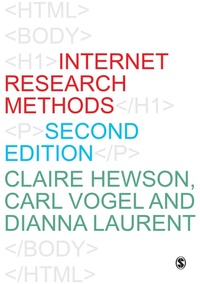
Internet Research Methods
2nd Edition
Published on 7. December 2015
232 pages
978-1-4739-4404-6 (ISBN)
Description

The internet is a compelling tool for research, enabling efficient, cost-effective data collection and facilitating access to large samples and new populations. This book presents a state-of-the-art guide to the internet as a tool for conducting research in the social and behavioural sciences using qualitative, quantitative and mixed methods approaches.
New to this edition:
Fully re-written to reflect the emergence of Web 2.0 technologies
Expanded coverage of web surveys for data collection
Unobtrusive methods to harvest data from online archives and documents
New practical tools and resources, where to find them, and how to keep up-to-date with new developments as they emerge
New chapter on research ethics and discussion of ethical practicalities throughout
Guiding the reader through the theoretical, ethical and practical issues of using the internet in research, this is an essential resource for researchers wishing to assess how the latest techniques, tools and methods in internet-mediated research may support and expand research in their own field.
New to this edition:
Fully re-written to reflect the emergence of Web 2.0 technologies
Expanded coverage of web surveys for data collection
Unobtrusive methods to harvest data from online archives and documents
New practical tools and resources, where to find them, and how to keep up-to-date with new developments as they emerge
New chapter on research ethics and discussion of ethical practicalities throughout
Guiding the reader through the theoretical, ethical and practical issues of using the internet in research, this is an essential resource for researchers wishing to assess how the latest techniques, tools and methods in internet-mediated research may support and expand research in their own field.
Reviews / Votes
Written from the perspective of psychology and cognitive science, this interdisciplinary book offers a valuable introduction to both quantitative and qualitative Internet research methods. With many hands-on examples, it is a practical guide to dos and don'ts of the profession. -- Dr. Lars Kaczmirek A much needed update to Internet-mediated research that will be highly useful for students and researchers. The book's chapters are nicely interwoven, with in-depth explanation of methods and applications. A must read. -- Ulf-Dietrich Reips This book is a comprehensively referenced starting point for a vast range of directions in social and behavioural research. At under 200 pages it is a worthwhile read as an introduction or an overview of what the internet can offer researchers in a range of academic disciplines. A useful guide. -- Lydia WysockiMore details
Edition
Second Edition
Language
English
Place of publication
London
United Kingdom
Target group
College/higher education
Product notice
Reflowable
File size
1,71 MB
ISBN-13
978-1-4739-4404-6 (9781473944046)
Copyright in bibliographic data and cover images is held by Nielsen Book Services Limited or by the publishers or by their respective licensors: all rights reserved.
Schweitzer Classification
Other editions
Additional editions
Claire Hewson | Carl Vogel | Dianna Laurent
Internet Research Methods
Book
01/2016
2nd Edition
SAGE Publications Ltd
€186.40
Shipment within 15-20 days
Claire Hewson | Carl Vogel | Dianna Laurent
Internet Research Methods
Book
01/2016
2nd Edition
SAGE Publications Ltd
€94.00
Shipment within 15-20 days
Persons
Claire Hewson is Lecturer in Psychology at The Open University. She has a long-standing interest in using the Internet to carry out primary research, and has collected data using a range of IMR methods including surveys, psychometrics and experiments, to investigate issues in: commonsense understanding, particularly folk psychology; online assessment methods in an educational context; the validity of IMR
methods. She was commissioned to lead a working party to produce the recent British Psychological Society (BPS) guidelines on ethics in Internet-mediated research (2013), has delivered a number of talks and training sessions on this and related topics, and has published more broadly in the area of IMR
Carl Vogel, a Fellow of Trinity College Dublin, is Senior Lecturer in Computational Linguistics and Director of the Centre for Computing and Language Studies at Trinity College Dublin, the University of Dublin. His work in computational linguistics as a cognitive science frequently draws upon evidence abstracted from Internet accessed data, and accordingly he dwells on the accompanying research methodology issues. Vogel was on the Management Committee of the successful European COST Action IS1004: Web-based data-collection -- methodological challenges, solutions and implementations (WEBDATANET).
Dianna Laurent teaches a variety of classes for both the English and the Languages and Communication departments at Southeastern Louisiana University and at St. Joseph's Abbey and Seminary College. She publishes on a variety of subjects involving the Internet. Dr. Laurent is the associate editor of the yearly ATTW bibliography and the business manager of 19th Century Studies for the Nineteenth Century Studies Association.
methods. She was commissioned to lead a working party to produce the recent British Psychological Society (BPS) guidelines on ethics in Internet-mediated research (2013), has delivered a number of talks and training sessions on this and related topics, and has published more broadly in the area of IMR
Carl Vogel, a Fellow of Trinity College Dublin, is Senior Lecturer in Computational Linguistics and Director of the Centre for Computing and Language Studies at Trinity College Dublin, the University of Dublin. His work in computational linguistics as a cognitive science frequently draws upon evidence abstracted from Internet accessed data, and accordingly he dwells on the accompanying research methodology issues. Vogel was on the Management Committee of the successful European COST Action IS1004: Web-based data-collection -- methodological challenges, solutions and implementations (WEBDATANET).
Dianna Laurent teaches a variety of classes for both the English and the Languages and Communication departments at Southeastern Louisiana University and at St. Joseph's Abbey and Seminary College. She publishes on a variety of subjects involving the Internet. Dr. Laurent is the associate editor of the yearly ATTW bibliography and the business manager of 19th Century Studies for the Nineteenth Century Studies Association.
Content
Chapter 1: Introduction
Chapter 2: The Internet
Chapter 3: Internet-mediated Research: State of the Art
Chapter 4: Sampling in Internet-mediated Research
Chapter 5: Ethics in Internet-mediated Research
Chapter 6: Tools and Design Strategies for Internet-mediated Research
Chapter 7: What Can Go Wrong?
Afterword
Chapter 2: The Internet
Chapter 3: Internet-mediated Research: State of the Art
Chapter 4: Sampling in Internet-mediated Research
Chapter 5: Ethics in Internet-mediated Research
Chapter 6: Tools and Design Strategies for Internet-mediated Research
Chapter 7: What Can Go Wrong?
Afterword
