

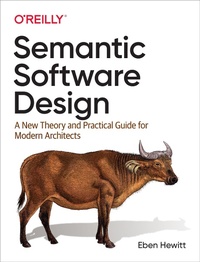
Semantic Software Design
A New Theory and Practical Guide for Modern Architects
Published on 25. September 2019
334 pages
978-1-4920-4590-8 (ISBN)
Description

With this practical book, architects, CTOs, and CIOs will learn a set of patterns for the practice of architecture, including analysis, documentation, and communication. Author Eben Hewitt shows you how to create holistic and thoughtful technology plans, communicate them clearly, lead people toward the vision, and become a great architect or Chief Architect.This book covers each key aspect of architecture comprehensively, including how to incorporate business architecture, information architecture, data architecture, application (software) architecture together to have the best chance for the systems success.Get a practical set of proven architecture practices focused on shipping great products using architectureLearn how architecture works effectively with development teams, management, and product management teams through the value chainFind updated special coverage on machine learning architectureGet usable templates to start incorporating into your teams immediatelyIncorporate business architecture, information architecture, data architecture, and application (software) architecture together
More details
Other editions
Additional editions
Book
10/2019
O'Reilly
€46.50
Article not available at the moment
Content
- Intro
- Copyright
- Table of Contents
- Preface
- Conventions Used in This Book
- Using Code Examples
- O'Reilly Online Learning
- How to Contact Us
- Acknowledgments
- Part I. Episteme: The Philosophy of Design
- Chapter 1. Origins of Software Architecture
- Software's Conceptual Origins
- Copies and Creativity
- Why Software Projects Fail
- The Impact of Failures
- Chapter 2. The Production of Concepts
- Semantics and the Software Factory
- The Myth of Requirements
- Semantics and Software Architecture
- The Semantic Field
- Designers Are Producers of Concepts
- Designing Concepts
- What Is a Concept?
- Accomplish, Avoid, Fix
- Outlining Your Concept on the Concept Canvas
- Ideas Are Captured in a Lookbook
- Fit to Purpose
- The Concept Is Expressed in a Parti
- An Example
- Adding Aspects to the Parti
- The Parti Is Based on a Series of Reveals
- Understanding Ideas
- Sense Certainty
- Metacognition
- Context
- Sets
- Relations
- Advantages of Semantic Design
- Chapter 3. Deconstruction and Design
- Introduction to Deconstruction
- Simplexity
- (De)composition
- Affordance
- Give Intention and Use Value to Negative Space
- Give Design Decisions at Least Two Justifications
- Design from Multiple Perspectives
- Create a Quarantine or Embassy
- Design for Failure
- Design Language
- Naming
- Start Opposite the User
- Platforms
- Disappearing
- Part II. Semantic Design in Practice
- Chapter 4. Design Thinking
- Why Design Thinking?
- Exploring Design Thinking
- Principles
- The Method
- Implementing the Method
- Summary
- Chapter 5. Semantic Design Practices and Artifacts
- Design Principles
- Pair Designing
- Murals
- Vision Box
- Mind Maps
- Use Cases
- Guidelines and Conventions
- Utils
- Domain
- service-api
- service-impl
- service-client
- Approaches
- Design Definition Document
- Considerations for Composing Your Design Definition
- Position Papers
- RAID
- Presentations and Multiple Viewpoints
- Summary
- Chapter 6. The Business Aspect
- Capturing the Business Strategy
- Provide a Common Understanding
- Align Strategic Objectives and Tactical Demands
- Framework Introduction
- Scope of the Framework
- Create the Business Glossary
- Create the Organizational Map
- Create a Business Capabilities Model
- Create a Process Map
- Reengineer Processes
- Take Inventory of Systems
- Define the Metrics
- Institute Appropriate Governance
- Business Architecture in Applications
- Summary
- Chapter 7. The Application Aspect
- Embrace Constraints
- Decouple User Interfaces
- UI Packages
- On Platform Design
- Service Resources and Representations
- Domain Language
- API Guidelines
- Deconstructed Versioning
- Cacheability and Idempotence
- Independently Buildable
- Strategies and Configurable Services
- Application-Specific Services
- Communicate Through Services
- Expect Externalization
- Design for Resilience
- Interactive Documentation
- Anatomy of a Service
- UI Packages
- Orchestrations
- Engines
- Data Accessors
- Eventing
- Structure of an Event Message
- Contextual Services and Service Mixins
- Performance Improvement Checklist
- Separating API from Implementation
- Languages
- Radical Immutability
- Specifications
- A Comment on Test Automation
- A Comment on Comments
- Summary
- Chapter 8. The Data Aspect
- Business Glossary
- Strategies for Semantic Data Modeling
- Polyglot Persistence
- Persistence Scorecard
- Multimodeling
- Data Models for Streams
- Feature Engineering for Machine Learning
- Classpath Deployment and Network Proxies
- Peer-to-Peer Persistent Stores
- Graph Databases
- OrientDB and Gremlin
- Data Pipelines
- Machine Learning Data Pipelines
- Metadata and Service Metrics
- Auditing
- ADA Compliance
- Summary
- Chapter 9. The Infrastructure Aspect
- Considerations for Architects
- DevOps
- Infrastructure as Code
- Metrics First
- Compliance Map
- Automated Pipelines Also First
- The Production Multiverse and Feature Toggling
- Implementing Feature Toggles
- Multi-Armed Bandits: Machine Learning and Infinite Toggles
- Infrastructure Design and Documentation Checklist
- Chaos
- Stakeholder Diversity and Inside/Out
- Summary
- Part III. Operations, Process, and Management
- Chapter 10. The Creative Director
- The Semantic Designer's Role
- Creative Directors Across Industries
- In Fashion
- In Film
- In Video Games
- In Advertising
- In Theater
- In Technology
- What's In a Name?
- Chapter 11. Management, Governance, Operations
- Strategy and Tooling
- Oblique Strategies
- Lateral Thinking and Working with Concepts
- Conceptual Tests
- Code Reviews
- Demos
- The Operational Scorecard
- The Service-Oriented Organization
- Cross-Functional Teams
- The Designed Scalable Business Machine
- Managing Modernization as a Program
- Change Management
- Governance
- Goals
- Metrics
- Service Portfolio
- Service Inventory and Metadata
- Service Design Checklist
- Service Design
- Service Operations
- Business Processes
- Data
- Errors
- Performance
- Security
- Quality Assurance
- Availability and Support
- Deployment
- Documentation
- Further Reading on Organizational Design
- Chapter 12. The Semantic Design Manifesto
- The Manifesto
- The Four Ideals
- The Key Practices
- Opening
- Appendix A. The Semantic Design Toolbox
- The Tools
- Thinking Stage
- Concept Stage
- Design Stage
- Operations and Governance
- Appendix B. Further Reading
- Architecture and Design Books
- Philosophy Books
- Software Books
- Index
- About the Author
- Colophon
