

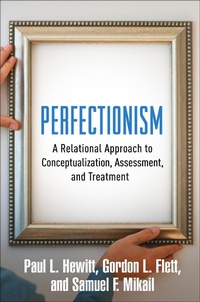
Perfectionism
A Relational Approach to Conceptualization, Assessment, and Treatment
Published on 16. March 2017
336 pages
978-1-4625-2912-4 (ISBN)
Description

Grounded in decades of influential research, this book thoroughly examines perfectionism: how it develops, its underlying mechanisms and psychological costs, and how to target it effectively in psychotherapy. The authors describe how perfectionistic tendencies--rooted in early relational and developmental experiences--make people vulnerable to a wide range of clinical problems. They present an integrative treatment approach and demonstrate ways to tailor interventions to the needs of individual clients. A group treatment model is also detailed. State-of-the-art assessment tools are discussed (and provided at the companion website). Throughout the book, vivid clinical illustrations make the core ideas and techniques concrete.
More details
Other editions
Additional editions

Paul L. Hewitt | Gordon L. Flett | Samuel F. Mikail
Perfectionism
A Relational Approach to Conceptualization, Assessment, and Treatment
Book
05/2026
1st Edition
Guilford Press
€49.50
Shipment within 15-20 days
Paul L. Hewitt | Gordon L. Flett | Samuel F. Mikail
Perfectionism
A Relational Approach to Conceptualization, Assessment, and Treatment
Book
04/2017
1st Edition
Guilford Press
€78.00
Article not available at the moment
Persons
Paul L. Hewitt, PhD, is Professor in the Department of Psychology at the University of British Columbia, Canada. He is a Fellow of the Canadian Psychological Association and of the Association's Section on Clinical Psychology. Dr. Hewitt was recently cited as one of the top 10 Canadian clinical psychology professors for research productivity. He has published over 200 research papers, books, and chapters on perfectionism, psychopathology, and psychotherapy, and has conducted collaborative work on perfectionism with Gordon L. Flett since 1989. He has a private practice in clinical psychology, consults with numerous organizations, and is regularly asked to speak at national and international conferences on perfectionism research and treatment.
Gordon L. Flett, PhD, is Professor in the Department of Psychology at York University in Toronto, Canada, where he holds a Canada Research Chair in Personality and Health and is Director of the LaMarsh Centre for Child and Youth Research. Formerly, he was Associate Dean of Research and Graduate Education in the Faculty of Health. Dr. Flett is a Fellow of the Association for Psychological Science, which has cited him as one of the top 25 most productive authors in psychology. Best known for his research on personality and depression, as well as his collaborative work on perfectionism with Paul L. Hewitt since 1989, he has been the guest editor of several special journal issues on perfectionism.
Samuel F. Mikail, PhD, ABPP, maintains a private clinical psychology practice in Newmarket, Canada; consults to private insurers on mental health disability claims; and is an adjunct clinical faculty member at the University of Waterloo. He is a Fellow of the Canadian Psychological Association (CPA) and of the CPA's Section on Clinical Psychology. His clinical writing and research publications have spanned the fields of mental health, health psychology, rehabilitation, and spirituality. Dr. Mikail serves on the Board of Directors of the CPA, where he is Practice Chair and Chair of Professional Affairs. He received the award for Excellence in Professional Psychology Training from the Canadian Council of Professional Psychology Programs and was recognized for Outstanding Contributions to Clinical Training by the Royal Ottawa Health Care Group.
Gordon L. Flett, PhD, is Professor in the Department of Psychology at York University in Toronto, Canada, where he holds a Canada Research Chair in Personality and Health and is Director of the LaMarsh Centre for Child and Youth Research. Formerly, he was Associate Dean of Research and Graduate Education in the Faculty of Health. Dr. Flett is a Fellow of the Association for Psychological Science, which has cited him as one of the top 25 most productive authors in psychology. Best known for his research on personality and depression, as well as his collaborative work on perfectionism with Paul L. Hewitt since 1989, he has been the guest editor of several special journal issues on perfectionism.
Samuel F. Mikail, PhD, ABPP, maintains a private clinical psychology practice in Newmarket, Canada; consults to private insurers on mental health disability claims; and is an adjunct clinical faculty member at the University of Waterloo. He is a Fellow of the Canadian Psychological Association (CPA) and of the CPA's Section on Clinical Psychology. His clinical writing and research publications have spanned the fields of mental health, health psychology, rehabilitation, and spirituality. Dr. Mikail serves on the Board of Directors of the CPA, where he is Practice Chair and Chair of Professional Affairs. He received the award for Excellence in Professional Psychology Training from the Canadian Council of Professional Psychology Programs and was recognized for Outstanding Contributions to Clinical Training by the Royal Ottawa Health Care Group.
Content
1. Introduction to Perfectionism
2. The Comprehensive Model of Perfectionistic Behavior
3. Evidence for the Clinical Relevance of Perfectionism
4. The Perfectionism Social Disconnection Model: Development of Perfectionism
5. The Perfectionism Social Disconnection Model: Perfectionism and Maladjustment
6. A Theoretical Model for Treatment of Perfectionistic Behavior
7. Psychodiagnostic Assessment of Perfectionism
8. Clinical Cases and Common Themes
9. Individual Psychotherapy of Perfectionism
10. Group Psychotherapy of Perfectionistic Behavior
Epilogue. Overview and Future Considerations
References
Index
2. The Comprehensive Model of Perfectionistic Behavior
3. Evidence for the Clinical Relevance of Perfectionism
4. The Perfectionism Social Disconnection Model: Development of Perfectionism
5. The Perfectionism Social Disconnection Model: Perfectionism and Maladjustment
6. A Theoretical Model for Treatment of Perfectionistic Behavior
7. Psychodiagnostic Assessment of Perfectionism
8. Clinical Cases and Common Themes
9. Individual Psychotherapy of Perfectionism
10. Group Psychotherapy of Perfectionistic Behavior
Epilogue. Overview and Future Considerations
References
Index
