

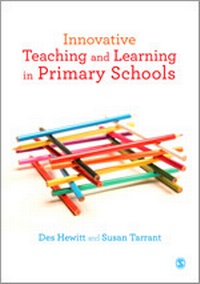
Innovative Teaching and Learning in Primary Schools
1st Edition
Published on 12. February 2015
216 pages
978-1-4739-1737-8 (ISBN)
Description

Innovation in the classroom is about empowering teachers to develop intelligent, creative and effective teaching methods that will challenge and engage learners.
Drawing on contemporary research and case studies from the UK and internationally, this book examines the theory behind innovative teaching and learning and its practical application in primary schools. Reflection points throughout the chapters encourage self-evaluation and development, giving students greater confidence to plan and deliver their own innovative teaching.
Topics covered include:
Creative approaches to learning in primary and early years education
Using different settings and technologies to develop thinking skills
Promoting positive classroom behaviour and inclusion
Innovation in planning and assessment
Drawing on contemporary research and case studies from the UK and internationally, this book examines the theory behind innovative teaching and learning and its practical application in primary schools. Reflection points throughout the chapters encourage self-evaluation and development, giving students greater confidence to plan and deliver their own innovative teaching.
Topics covered include:
Creative approaches to learning in primary and early years education
Using different settings and technologies to develop thinking skills
Promoting positive classroom behaviour and inclusion
Innovation in planning and assessment
Reviews / Votes
The authors present thought-provoking ideas and questions that should be discussed and considered carefully if we want to provide children with meaningful classroom experiences. I will be recommending this excellent book without hesitation. -- Fiona PatrickMore details
Language
English
Place of publication
London
United Kingdom
Target group
College/higher education
ISBN-13
978-1-4739-1737-8 (9781473917378)
Copyright in bibliographic data and cover images is held by Nielsen Book Services Limited or by the publishers or by their respective licensors: all rights reserved.
Schweitzer Classification
Other editions
Additional editions
Des Hewitt | Susan Tarrant
Innovative Teaching and Learning in Primary Schools
Book
02/2015
1st Edition
SAGE Publications Ltd
€76.30
Shipment within 15-20 days
Des Hewitt | Susan Tarrant
Innovative Teaching and Learning in Primary Schools
Book
02/2015
1st Edition
SAGE Publications Ltd
€142.50
Shipment within 15-20 days
Persons
As Head of Primary and Early Years Teacher Education at the University of Warwick, Des Hewitt places teaching and learning at the heart of his work. With over 25 years teaching experience in schools and Universities, he has been recognized for his national and international profile in Teacher Education. He was awarded a National Teaching Fellowship by the Higher Education Academy and is a Professorial Teaching Fellow at Warwick.
Des has experience of promoting and evolving the model of placements for trainee primary school teachers, in England and in other countries. He has also been involved in advising UK government organisations in developing English and reading for University ITT providers. He also has also lead Universities in developing practice in special education needs and disability. He also sat on a steering group in the Department for Children, Schools and Families, evaluating the impact of training for inclusion in teacher education.
Working with schools and the Teacher Education sector in Tanzania, has been a focus for Des in recent years. Collaborative projects with researchers and educators in Finland, Germany, India and Hungary have also provided the opportunity to share ideas about teacher education, partnership development and research skills, internationally. Des supports emerging researchers through the European Educational Research Association.
Publications include a focus on Innovation, EAL and Effective Learning, mental health and mindfulness, matching his research interests. Recently, he has lead research evaluation of educational practice in the Arts and a agricultural sectors. He is a Director of several Multi Academy Trusts. Through these he is able to support school improvement and the development of a good education for children and professionals. Des is always committed to working in partnership with others.
Susan Tarrant has worked for several years as a primary teacher during which time she was able to develop her passion for the effective use of ICT in learning and teaching in schools. Whilst mentoring student teachers from the University of Derby, Susan worked on projects using innovative ways of ICT to support learning. Now, as a University Teacher in primary education, she leads ICT (now Computing) across the B.Ed and PGCE programmes at the University of Derby.
Des has experience of promoting and evolving the model of placements for trainee primary school teachers, in England and in other countries. He has also been involved in advising UK government organisations in developing English and reading for University ITT providers. He also has also lead Universities in developing practice in special education needs and disability. He also sat on a steering group in the Department for Children, Schools and Families, evaluating the impact of training for inclusion in teacher education.
Working with schools and the Teacher Education sector in Tanzania, has been a focus for Des in recent years. Collaborative projects with researchers and educators in Finland, Germany, India and Hungary have also provided the opportunity to share ideas about teacher education, partnership development and research skills, internationally. Des supports emerging researchers through the European Educational Research Association.
Publications include a focus on Innovation, EAL and Effective Learning, mental health and mindfulness, matching his research interests. Recently, he has lead research evaluation of educational practice in the Arts and a agricultural sectors. He is a Director of several Multi Academy Trusts. Through these he is able to support school improvement and the development of a good education for children and professionals. Des is always committed to working in partnership with others.
Susan Tarrant has worked for several years as a primary teacher during which time she was able to develop her passion for the effective use of ICT in learning and teaching in schools. Whilst mentoring student teachers from the University of Derby, Susan worked on projects using innovative ways of ICT to support learning. Now, as a University Teacher in primary education, she leads ICT (now Computing) across the B.Ed and PGCE programmes at the University of Derby.
Content
What is Education for?
Teaching and Learning in Schools
How Do Children Learn in the Early Years?: Links to Theory and Innovation
The Development of Children's Thinking Skills: Links to Theory and Innovation
Where do Children Learn?
A Curriculum for Innovation
Innovative Learning Technologies
Working With Others as Part of a Team
Inclusion and Classroom Behaviour
Innovative Approaches to Educational Assessment and Planning
Innovation: Today and Tomorrow
Teaching and Learning in Schools
How Do Children Learn in the Early Years?: Links to Theory and Innovation
The Development of Children's Thinking Skills: Links to Theory and Innovation
Where do Children Learn?
A Curriculum for Innovation
Innovative Learning Technologies
Working With Others as Part of a Team
Inclusion and Classroom Behaviour
Innovative Approaches to Educational Assessment and Planning
Innovation: Today and Tomorrow
