

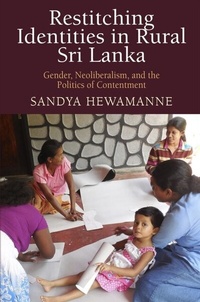
Restitching Identities in Rural Sri Lanka
Gender, Neoliberalism, and the Politics of Contentment
1st Edition
Published on 28. September 2020
224 pages
978-0-8122-9733-1 (ISBN)
Description

Sandya Hewamanne's Stitching Identities in a Free Trade Zone analyzed how female factory workers in Sri Lanka's free trade zones challenged conventional notions about marginalized women at the bottom of the global economy. In Restitching Identities in Rural Sri Lanka Hewamanne now follows many of these same women to explore the ways in which they negotiate their social and economic lives once back in their home villages. Drawing on ethnographic fieldwork conducted over fifteen years, the book explores how the former free-trade-zone workers manipulate varied forms of capital-social, cultural, and monetary- to become local entrepreneurs and community leaders, while simultaneously initiating gradual changes in rural social hierarchies and gender norms.
Free trade zones introduce Sri Lankan women to neoliberal ways of fashioning selves, Hewamanne contends. Her book illustrates how varied manifestations of neoliberal attitudes within local contexts result in new articulations of what it is to be an entrepreneur as well as a good woman. By focusing on how former workers decenter neoliberal market relations while using their entrepreneurial and civic activities to reimagine social life in ways more satisfying to them and their loved ones-what the author calls a politics of contentment-the book sheds light on new political possibilities in contexts where both reproduction of neoliberal economic relations and implementation of alternatives co-exist.
Free trade zones introduce Sri Lankan women to neoliberal ways of fashioning selves, Hewamanne contends. Her book illustrates how varied manifestations of neoliberal attitudes within local contexts result in new articulations of what it is to be an entrepreneur as well as a good woman. By focusing on how former workers decenter neoliberal market relations while using their entrepreneurial and civic activities to reimagine social life in ways more satisfying to them and their loved ones-what the author calls a politics of contentment-the book sheds light on new political possibilities in contexts where both reproduction of neoliberal economic relations and implementation of alternatives co-exist.
Reviews / Votes
"The book is an enjoyable read, in particular the narratives of the aspirations, successes, difficulties, relationships, and negotiations in the women's lives. This has much to do with Hewamanne's fieldwork, carried out over years of visits and drawing on research techniques and materials, interactions, and friendships that require time to build and the reflexivity that time can enable...[T]his is a substantial and worthwhile read for all those concerned with a gamut of themes related to gender, work and economic activity, neoliberal processes, migration, subjectivity, emotion, agency, and cultural negotiations." (American Journal of Sociology) "The value of Hewamanne's new book lies in the ethnographic detail of the 37 respondents that she follows, where initial friendships and connections morph into a research constituency... The book helps to better appreciate the ways in which gendered subjectivities manifest through ongoing societal transformation." (Progress in Development Studies) "What happens when women free-trade-zone factory workers retire and return to rural villages? Restitching Identities in Rural Sri Lanka provides one of the first studies to address this timely question as it offers a fascinating account of women's navigation of the competing gender cultural norms of factory and village." (Rhacel Salazar Parrenas, author of Servants of Globalization: Migration and Domestic Work) "Sandya Hewamanne is a superlative ethnographer of former free-trade-zone garment workers who return to their villages all over Sri Lanka with independent earnings and networking skills that they use to craft well-being for more than themselves. Hewamanne's depiction of their 'politics of contentment' is a powerful contribution to feminist political economy." (Ann Kingsolver, University of Kentucky) "Many scholars have studied labor migration and women's integration into industrial capitalism. Fewer, however, have taken the next step to follow the workers back to their homes. This original aspect of Sandya Hewamanne's book provides a significant contribution to scholarship in gender studies and economic anthropology. Connecting work in the international market with social change in rural villages is exciting and new." (Michele Gamburd, Portland State University) "This volume builds on the author's successful, and in many ways innovative, Stitching Identities in a Free Trade Zone. Fresh and original, the stories that unfold in the course of this book are vivid, surprising, and affecting." (Jonathan Spencer, Edinburgh University)More details
Series
Language
English
Place of publication
Pennsylvania
United States
Target group
College/higher education
File size
1,44 MB
ISBN-13
978-0-8122-9733-1 (9780812297331)
Copyright in bibliographic data and cover images is held by Nielsen Book Services Limited or by the publishers or by their respective licensors: all rights reserved.
Schweitzer Classification
Other editions
Additional editions
Sandya Hewamanne
Restitching Identities in Rural Sri Lanka
Gender, Neoliberalism, and the Politics of Contentment
Book
09/2020
University of Pennsylvania Press
€51.50
Shipment within 10-20 days
Person
Sandya Hewamanne is Senior Lecturer in the Department of Sociology at the University of Essex. She is the author of Sri Lanka's Global Factory Workers: (Un)Disciplined Desires and Sexual Struggles in a Post Colonial Society. Her Stitching Identities in a Free Trade Zone: Gender and Politics in Sri Lanka is also available from the University of Pennsylvania Press.
Content
- Cover
- Restitching Identities in Rural Sri Lanka
- Title
- Copyright
- Dedication
- CONTENTS
- Chapter 1. Global in the Villages: Politics of Contentment
- Chapter 2. Pure Girls! Don't Open the Door
- Chapter 3. Industrious and Obedient Daughters-in-Law
- Chapter 4. Superwomen and Lazy Lalies: Villages Adjusting to Successful Former Workers
- Chapter 5. Sex in the Village: Subversive Sexualities Abandoned?
- Chapter 6. The Strange, the Crazy, and the Stubborn
- Chapter 7. I Do Not Want to Be Rich and Lonely: Politics of Contentment
- Conclusion
- Notes
- Bibliography
- Index
- Acknowledgments
