

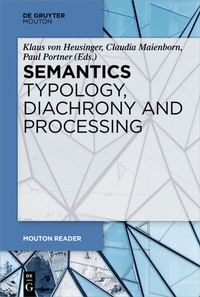
Semantics - Typology, Diachrony and Processing
Description

Now available in paperback for the first time since its original publication, the material in this book provides a broad, accessible guide to semantic typology, crosslinguistic semantics and diachronic semantics. Coming from a world-leading team of authors, the book also deals with the concept of meaning in psycholinguistics and neurolinguistics, and the understanding of semantics in computer science. It is packed with highly cited, expert guidance on the key topics in the field, making it a bookshelf essential for linguists, cognitive scientists, philosophers, and computer scientists working on natural language.
Reviews / Votes
"It's great news that this outstanding Handbook of Semantics is appearing in paperback, now accessible to individuals as well as to libraries. The Handbook is a masterful achievement, both broad and deep -- it has almost every topic you might want to learn about, in articles generally written by the people you would most want to learn from. A lasting reference work of the highest quality."
(Barbara H Partee, University of Massachusetts, Amherst)
More details
Other editions
Additional editions
Persons
Claudia Maienborn , Tübingen, Germany; Klaus von Heusinger , Köln, Germany; Paul Portner , Washington D.C., USA.
Content
- Intro
- Contents
- 1. Semantic types across languages
- 2. Count/mass distinctions across languages
- 3. Tense and aspect: Time across languages
- 4. The expression of space across languages
- 5. Theories of meaning change: An overview
- 6. Cognitive approaches to diachronic semantics
- 7. Grammaticalization and semantic reanalysis
- 8. Meaning in psycholinguistics
- 9. Meaning in first language acquisition
- 10. Meaning in second language acquisition
- 11. Conceptual knowledge, categorization, and meaning
- 12. Space in semantics and cognition
- 13. Semantic research in computational linguistics
- 14. Semantics in corpus linguistics
- 15. Semantics in computational lexicons
- 16. Web semantics
- 17. Semantic issues in machine translation
- Index
