

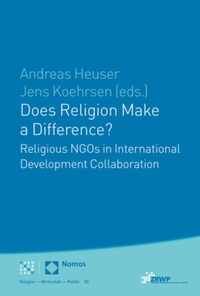
Does Religion Make a Difference?
Religious NGOs in International Development Collaboration
1st Edition
Published on 28. April 2020
364 pages
978-3-7489-0763-3 (ISBN)
Description

Religions are increasingly being regarded as relevant partners in international development cooperation due to their special attributes. However, to date there has been little research into what the special attributes of religious development agencies actually are or how such organisations employ them. What resources do religious NGOs draw on in development cooperation? How do such NGOs differ from other development agencies? Does their engagement make a considerable difference to collaborative development work? Using empirical case studies and theoretical analysis, the contributions in this book address these questions. In doing so, they examine different religions and their collaborative development work in various regions of the world, and chart the most recent changes in religions.
With contributions by
Jeffrey Haynes, Katherine Marshall, Andreas Heuser, Jens Koehrsen, Dena Freeman, Richard Friedli, Wilhelm Gräb, Ulrich Dehn, Marie Juul Petersen, Claudia Hoffmann, Sinah Theres Kloß, Yonatan N. Gez, Katrin Langewiesche, Suwarto Adi, Ido Benvenisti, Christine Schliesser, Leif H. Seibert, Philipp Öhlmann, Marie-Luise Frost, Adi Maya
More details
Other editions
Additional editions
Andreas Heuser | Jens Koehrsen
Does Religion Make a Difference?
Religious NGOs in International Development Collaboration
Book
05/2020
1st Edition
Nomos
€59.00
Shipment within 5-7 days
Persons
Content
- Cover
- From a Quiet Revolution to the Tolerance of Ambiguity: Religious NGOs in International Development Discourse
- A Quiet Revolution
- The Reluctant Discovery of Religion
- The Great Global Transformation
- RNGOs' Abilities in Sustainable Development
- Tolerance of Ambiguity
- Multireligious Case-Studies
- Outline of the Volume
- Section I: Religious NGOs and International Development Politics
- Religious Engagement in Development Work: A Continuing Journey
- Introduction: the "resurgence" of interest in religious matters
- Definition challenges
- Global agendas, religious involvement
- The religious landscape in development work
- A bumpy path to religious engagement
- Eight live topics to address on religious engagement
- Religion and violence
- Motivations and boundaries: the issue of Proselytizing
- Controversies on gender
- Coordination and harmonization
- Governance issues
- Instrumentalization debates
- Human rights
- Debates about models
- The United Nations and Development: What do Religious Actors Add to Debates about Achieving Better Outcomes?
- Introduction
- Development concerns at the United Nations
- The World Bank, the WCC and the MDGs
- The World Bank, the WCC and SDGs: Building Cooperation between Religious and Secular Development Actors
- Conclusion
- Transculturation Grammars in Secular and Religious Development NGOs
- 1 Introduction
- Development
- Religion
- Spirituality
- Secularity
- 2 The "balancing identity" skill
- 2.1 Elements of cultural anthropology and the sociology of religions
- 2.2 Elements of communication skills
- 3 The differentiation skill: "fundamentalist vs fundamental"
- 3.1 Conceptualizing religion
- 3.2 Fundamentalist and fundamental
- 3.3 Fundamentalism and fundamental options: sociology of comparative religions
- 3.4 The fundamentalist radicality
- i. Cognitive level: binary thinking
- ii. Social level: proselyte dynamism
- iii. Psychological aspects: hardening around morals
- iv. Strategic procedures: eradicating the stigmatised reality
- 3.5 The fundamental option
- i. Theological cognitive level: axiological difference between the "divine milieu" and subsequent socio-political manifestations
- ii. Social level: empathic availability
- iii. Psychological level: the right to difference
- iv. Strategic level: beauty of compromise
- 3.6 Findings on the "fundamentalist vs fundamental" shift
- 4 Development NGOs during the Rwandan genocidal processes
- 4.1 Fundamentalist Rwandan radicality
- i. A binary doctrinal argument
- ii. Socio-political consequences
- iii. Psychology hardening around morals
- iv. Police and military consequences
- 4.2 Fundamental options in the Rwandan context
- i. The encompassing "divine milieu"
- ii. Fundamental empathy
- iii. Solidarity in difference
- iv. Political level
- 5 Outcomes and new beginnings on development and religion issues
- Section II: Mapping RNGOs in Diverse Religious Traditions
- Islam and Development: International Muslim NGOs
- Introduction
- The Emergence of International Muslim NGOs
- International Muslim NGOs in the Post 9/11 Aid Field
- International Muslim NGOs and the Global War on Terror
- Religious NGOs in the Field of Development and Humanitarian Aid
- International Islamic Relief Organisation: 'It's all in Islam!'
- A dignified life and a strengthened umma
- "Islam is about the spiritual and social matters"
- "They don't have the same feeling of family as we have"
- Islamic Relief: "We have an understanding of religion that gives us an advantage"
- "Lasting routes out of poverty"
- The advantage of religion
- "They are perhaps not the most sophisticated"
- Bridgebuilders or defenders of Islam?
- Religious Philosophy, Social Work and Social Engagement of Buddhist and Hindu Movements
- Introduction
- Buddhist Peace Fellowship
- The International Network of Engaged Buddhists (INEB)
- Buddhist social thinkers
- Bhikkhu Buddhadasa
- Santikaro
- Robert Aitken
- Thich Nhat Hanh
- Maruyama Teruo
- Bhimrao Ramji Ambedkar
- Buddhist social action
- The Sarvodaya Movement in India and the Sarvodaya Shramadana Movement in Sri Lanka
- Concluding Remarks
- Tikkun Olam and Jewish Outreach within Jewish Faith-Based Organisations
- Introduction
- Jewish Engagement in Development
- Judaism as a Non-Evangelising Religion
- Tikkun Olam and Jewish Outreach
- Jewish Outreach
- Tikkun Olam
- Case Studies
- Case Study 1: Project TEN
- Case Study 2: Agahozo Shalom Youth Village
- Conclusion
- Section III: Inter-religious Contexts and Comparisons
- The Methadone of the People: Not all Theodicies are Sociodicies
- Introduction
- Religious conservativism
- From the church-sect dichotomy to religious field theory
- The ethos of religious peace builders
- Theodicy and sociodicy in postwar BiH
- Conclusion
- Performing 'Religiousness': Negotiations of Religion and the Formation of Identity in Guyanese Development Organisations
- Introduction
- Group Identity and the Identification of Development Organisations
- Religiousness and the Doing of Religion
- Conclusion
- Keep it Altar or Alter Community? Re-framing a Myth of Conversion in Indonesia
- Introduction
- GKJ Elang, IPSEM Foundation and Religious Entrepreneurship
- Church and Diaconia: Education for Children of Labour Family
- Transformation of the Church's Diaconal Programme
- The Development of Service: From Capacity Building to Peace Building
- Christian NGOs in Islamic Indonesia
- Concluding Remarks
- Section IV: Intra-religious Transformations and Changes within RNGOs
- Development as Transformation: Tearfund and the New Evangelical Approach to Holistic Change
- Introduction
- The Formation and Early Workings of Tearfund
- Development as Transformation: The Theology of Integral Mission
- Integral Mission for Development Agencies
- Conclusion
- Megachurches, Dominion Theology and Development
- Introduction: De-essentializing Pentecostal Theology
- "Africa Business and Kingdom Leadership Summit"
- A Dominion Theological Script
- "Greater Works"-and the Collapse of Capital Bank
- Public Debates and Irritations
- Whither Dominion Theology?
- Ahmadiyya and Development Aid in West Africa
- Introduction
- The Ahmadiyya Muslim Community: a transnational Muslim group among others
- Humanity First: history and current activities in Burkina Faso
- Conclusions
- Section V: RNGO Activities in Selected Fields of Sustainable Development
- Gender and Education
- Gender inequality hinders development
- How can gender equality be achieved?
- Case Study: Mission 21 and gender equality
- Mission 21's advocacy programme 2016 and beyond
- Basel Mission and gender equality
- Discussion
- Conclusion: How does religion make a difference?
- "You need to change the whole person" African Initiated Churches and Sustainable Development in South Africa
- Introduction
- Notions of sustainability: from sustainable development to transformation of life
- Elements of transformation
- Engaging transformation
- Healing and world view: transforming the individual
- Ethics and social capital: transforming the environment
- Transformation in action
- Conclusions
- Muslim NGOs and the Quest for Environmental Sustainability in the Context of the Sustainable Development Goals
- Introduction
- Faith Based Development: Towards a "Green" Agenda?
- Muslim NGOs
- Environmental Islam
- Islamic Environmental Teachings
- Empirical Insights into Muslim Environmentalism
- Global South
- Global North
- Discussion
- Conclusion
- On the Roles of Religious NGOs in the Context of Development and Peacebuilding: Christian Churches and Reconciliation in Post-Genocide Rwanda
- 1. Introduction
- 2. Some Problems with the Term "Religious" Violence
- 3. Religion and Peacebuilding: Resources and Productivity
- 3.1 Religious Peacebuilding in Post-Genocide Rwanda
- 3.2 Religious and Non-Religious Peacebuilding
- 4. Conclusion
