

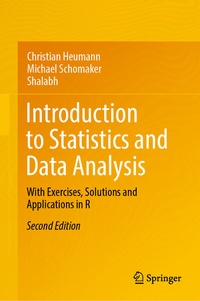
Introduction to Statistics and Data Analysis
Description

Now in its second edition, this introductory statistics textbook conveys the essential concepts and tools needed to develop and nurture statistical thinking. It presents descriptive, inductive and explorative statistical methods and guides the reader through the process of quantitative data analysis. This revised and extended edition features new chapters on logistic regression, simple random sampling, including bootstrapping, and causal inference.
The text is primarily intended for undergraduate students in disciplines such as business administration, the social sciences, medicine, politics, and macroeconomics. It features a wealth of examples, exercises and solutions with computer code in the statistical programming language R, as well as supplementary material that will enable the reader to quickly adapt the methods to their own applications.
More details
Other editions
Additional editions
Persons
Dr. Christian Heumann is a Professor at the Department of Statistics, LMU Munich, Germany, where he teaches students in both the Bachelor's and Master's programs. His research interests include statistical modeling, computational statistics and methods for missing data, also in connection with causal inference. Recently, he has begun exploring statistical methods in natural language processing.
Dr. Michael Schomaker is a Researcher and Heisenberg Fellow at the Department of Statistics, LMU Munich, Germany. He is an honorary Senior Lecturer at the University of Cape Town, South Africa and previously worked as an Associate Professor at UMIT - University for Health Sciences, Medical Informatics and Technology, Austria. For many years he has taught both undergraduate and post-graduate students from various disciplines, including the business and medical sciences, and has written contributions for various introductory textbooks. His research focuses on causal inference, missing data, model averaging, and HIV and public health.
Dr. Shalabh
is a Professor at the Indian Institute of Technology Kanpur, India. As a post-doctoral researcher he worked at the University of Pittsburgh, USA and LMU Munich, Germany. He has over twenty-five years of experience in teaching and research. His main research areas are linear models, regression analysis, econometrics, error-measurement models, missing data models and sampling theory.
Content
Part I Descriptive Statistics: Introduction and Framework.- Frequency Measures and Graphical Representation of Data.- Measures of Central Tendency and Dispersion.- Association of Two Variables.- Part I Probability Calculus: Combinatorics.- Elements of Probability Theory.- Random Variables.- Probability Distributions.- Part III Inductive Statistics: Inference.- Hypothesis Testing.- Linear Regression.- Logistic Regression.- Part IV Additional Topics Simple Random Sampling and Bootstrapping.- Causality.- Part V Appendices: Introduction to
R
.- Solutions to Exercises.- Technical Appendix.- Visual Summaries.
