

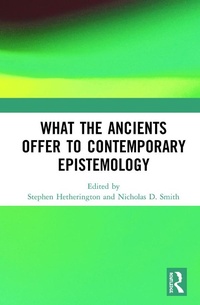
What the Ancients Offer to Contemporary Epistemology
1st Edition
Published on 30. September 2019
250 pages
978-1-000-69126-9 (ISBN)
Description

This book encourages renewed attention by contemporary epistemologists to an area most of them overlook: ancient philosophy. Readers are invited to revisit writings by Plato, Aristotle, Pyrrho, and others, and to ask what new insights might be gained from those philosophical ancestors. Are there ideas, questions, or lines of thought that were present in some ancient philosophy and that have subsequently been overlooked? Are there contemporary epistemological ideas, questions, or lines of thought that can be deepened by gazing back upon some ancient philosophy? The answers are 'yes' and 'yes', according to this book's 13 chapters, written by philosophers seeking to enrich contemporary epistemology through engaging with ancient epistemology.
Key features:
Blends ancient epistemology with contemporary epistemology, each reciprocally enriching each.
Conceptually sensitive chapters by scholars of ancient epistemology.
Historically sensitive chapters by scholars of contemporary epistemology.
Clearly written chapters, guiding readers at once through central elements both of ancient and of contemporary epistemology.
Key features:
Blends ancient epistemology with contemporary epistemology, each reciprocally enriching each.
Conceptually sensitive chapters by scholars of ancient epistemology.
Historically sensitive chapters by scholars of contemporary epistemology.
Clearly written chapters, guiding readers at once through central elements both of ancient and of contemporary epistemology.
Reviews / Votes
CHOICE 'Highly Recommended':"Students taking historically oriented philosophy courses frequently say they do not see how figures such as Plato and Aristotle matter to current philosophical problems. In the same spirit, contemporary epistemologists rarely refer back to the ancients for help with or insight into current issues. [Volume editors] Hetherington and Smith, both prolific authors, attempt to rectify this and show that both contemporary epistemology and ancient philosophy (specifically, ancient Greek epistemology) can develop new lines of thought and solve pressing problems by looking to the other. As one might expect, Plato and Aristotle dominate the collection (with seven and three essays, respectively), but there are also insightful essays on the Academics, Pyrrhonian skepticism, and understanding. Among the contemporary issues addressed are know-how, understanding, conceptions of knowledge, virtue epistemology, skepticism, and the so-called swamping problem. Revealing the value of the epistemology of ancient Greece, this volume is an ideal resource for courses in both ancient Greek philosophy and contemporary epistemology. Summing up: Highly recommended."
--J. McBain, in CHOICE
More details
Edition
1. Auflage
Language
English
Place of publication
London
United Kingdom
Publishing group
Taylor & Francis Ltd
Target group
College/higher education
Illustrations
1 Tables, black and white; 1 Line drawings, black and white; 1 Illustrations, black and white
ISBN-13
978-1-000-69126-9 (9781000691269)
Copyright in bibliographic data and cover images is held by Nielsen Book Services Limited or by the publishers or by their respective licensors: all rights reserved.
Schweitzer Classification
Other editions
Additional editions
Stephen Hetherington | Nicholas D. Smith
What the Ancients Offer to Contemporary Epistemology
Book
09/2019
1st Edition
Routledge
€205.60
Shipment within 15-20 days
Persons
Stephen Hetherington is Professor of Philosophy at the University of New South Wales, in Sydney, Australia, and Editor-in-Chief of the Australasian Journal of Philosophy. His publications include Epistemology's Paradox (1992), Good Knowledge, Bad Knowledge (2001), How to Know (2011), and Knowledge and the Gettier Problem (2016).
Nicholas D. Smith is the James F. Miller Professor of Humanities in the Departments of Classics and Philosophy at Lewis & Clark College in Portland, Oregon. His publications include Summoning Knowledge in Plato's Republic (2019), Knowledge (with Ian Evans) (2012), and Socratic Moral Psychology (with Thomas C. Brickhouse) (2010).
Nicholas D. Smith is the James F. Miller Professor of Humanities in the Departments of Classics and Philosophy at Lewis & Clark College in Portland, Oregon. His publications include Summoning Knowledge in Plato's Republic (2019), Knowledge (with Ian Evans) (2012), and Socratic Moral Psychology (with Thomas C. Brickhouse) (2010).
Content
Introduction: Ancient Epistemology's Potential Significance for Contemporary Epistemology 1. Socrates' Version of the Opacity Objection 2. Knowledge-Minimalism: Reinterpreting the Meno on Knowledge and True Belief 3. Plato on Veritism and Value 4. Forms, Exemplars, and Plato 5. Is Plato's Epistemology about Knowledge? 6. Plato's Ideal Epistemology 7. Plato on Having a Logos (Theaetetus 201c-210a) 8. Transmitting Understanding and Know-How 9. Aristotle's Disjunctivism 10. Aristotle's Virtue Epistemology 11. Aristotle and Scepticism 12. Pyrrhonian Scepticism and Human Agency 13. Academic Justifications of Assent
