

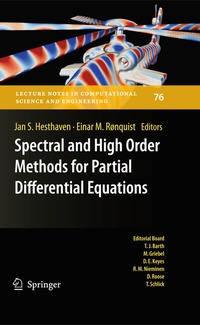
Spectral and High Order Methods for Partial Differential Equations
Selected papers from the ICOSAHOM '09 conference, June 22-26, Trondheim, Norway
1st Edition
Published on 29. October 2010
XI, 510 pages
978-3-642-15337-2 (ISBN)
Description

The book contains a selection of high quality papers, chosen among the best presentations during the International Conference on Spectral and High-Order Methods (2009), and provides an overview of the depth and breadth of the activities within this important research area. The carefully reviewed selection of the papers will provide the reader with a snapshot of state-of-the-art and help initiate new research directions through the extensive bibliography.
More details
Other editions
Additional editions

Jan S. Hesthaven | Einar M. Rønquist
Spectral and High Order Methods for Partial Differential Equations
Selected papers from the ICOSAHOM '09 conference, June 22-26, Trondheim, Norway
Book
01/2013
Springer
€160.49
Shipment within 7-9 days

Jan S. Hesthaven | Einar M. Rønquist
Spectral and High Order Methods for Partial Differential Equations
Selected papers from the ICOSAHOM '09 conference, June 22-26, Trondheim, Norway
Book
11/2010
1st Edition
Springer
€160.49
Shipment within 7-9 days
Content
1 - Foreword [Seite 6]
2 - Contents [Seite 8]
3 - hp-FEM for the Contact Problem with Tresca Friction in Linear Elasticity: The Primal Formulation [Seite 13]
3.1 - 1 Introduction [Seite 13]
3.2 - 2 Problem Formulation [Seite 14]
3.3 - 3 A Priori Error Estimates [Seite 16]
3.3.1 - 3.1 An Interpolation Error Estimate for B1/22,1-Functions [Seite 16]
3.3.2 - 3.2 A Polynomial Inverse Estimate [Seite 19]
3.3.3 - 3.3 Convergence Rates: Proof of Theorem 3.1 [Seite 21]
3.4 - 4 Numerical Experiments [Seite 25]
3.4.1 - 4.1 A Posteriori Error Estimation [Seite 25]
3.4.2 - 4.2 Numerical Examples [Seite 26]
3.5 - References [Seite 28]
4 - On Multivariate Chebyshev Polynomials and Spectral Approximations on Triangles [Seite 30]
4.1 - 1 Introduction [Seite 30]
4.2 - 2 Chebyshev Polynomials and Root Systems [Seite 33]
4.2.1 - 2.1 Root Systems [Seite 33]
4.2.2 - 2.2 Multivariate Chebyshev Polynomials [Seite 34]
4.2.3 - 2.3 The A2 Root System [Seite 36]
4.3 - 3 Computing Gradients [Seite 38]
4.3.1 - 3.1 Gradients in the A2 Root System [Seite 39]
4.4 - 4 Clenshaw-Curtis Quadrature [Seite 41]
4.4.1 - 4.1 Clenshaw-Curtis Quadrature in the A2 Root System [Seite 41]
4.5 - 5 Triangles [Seite 44]
4.5.1 - 5.1 Clenshaw-Curtis Quadrature Over a Triangle [Seite 44]
4.5.2 - 5.2 Nonlinear Transformations [Seite 46]
4.5.3 - 5.3 Linear Transformations [Seite 47]
4.6 - 6 Numerics [Seite 47]
4.7 - 7 Summary [Seite 50]
4.8 - References [Seite 51]
5 - Stochastic Spectral Galerkin and Collocation Methods for PDEs with Random Coefficients: A Numerical Comparison [Seite 53]
5.1 - 1 Introduction [Seite 53]
5.2 - 2 Problem Setting [Seite 55]
5.2.1 - 2.1 Finite Element Approximation in the Physical Space [Seite 57]
5.3 - 3 Polynomial Approximation in the Stochastic Dimension [Seite 57]
5.3.1 - 3.1 Stochastic Galerkin Approximation [Seite 59]
5.3.2 - 3.2 Stochastic Collocation Approximation on Sparse Grids [Seite 61]
5.4 - 4 Numerical Results [Seite 64]
5.4.1 - 4.1 Test Case 1: Isotropic Problem [Seite 64]
5.4.2 - 4.2 Test Case 2: Anisotropic Problem [Seite 68]
5.5 - References [Seite 71]
6 - Hybridizable Discontinuous Galerkin Methods [Seite 73]
6.1 - 1 Background [Seite 73]
6.2 - 2 The HDG Method [Seite 75]
6.2.1 - 2.1 The Convection-Diffusion Model Equation [Seite 75]
6.2.2 - 2.2 Mesh and Trace Operators [Seite 76]
6.2.3 - 2.3 Approximation Spaces [Seite 76]
6.2.4 - 2.4 HDG Formulation [Seite 77]
6.2.5 - 2.5 Characterization of the Numerical Trace [Seite 78]
6.2.6 - 2.6 Relation to Other DG Methods [Seite 79]
6.2.7 - 2.7 The Local Stabilization Parameter [Seite 81]
6.2.8 - 2.8 Local Postprocessing [Seite 81]
6.3 - 3 Extensions of the Basic Algorithm [Seite 83]
6.3.1 - 3.1 Time-Dependent Convection-Diffusion Problems [Seite 83]
6.3.2 - 3.2 Nonlinear Convection-Diffusion Problems [Seite 84]
6.3.3 - 3.3 Stokes Flows [Seite 85]
6.3.4 - 3.4 Incompressible Navier-Stokes Equations [Seite 88]
6.4 - 4 Numerical Results [Seite 90]
6.5 - 5 Conclusions [Seite 92]
6.6 - References [Seite 93]
7 - Multivariate Modified Fourier Expansions [Seite 95]
7.1 - 1 Introduction [Seite 95]
7.2 - 2 The d-Variate Cube [Seite 98]
7.3 - 3 The Hyperbolic Cross [Seite 98]
7.4 - 4 Accelerating Convergence [Seite 99]
7.4.1 - 4.1 The Lanczos Representation and Its Computation [Seite 99]
7.4.2 - 4.2 The Fourier Extension Problem [Seite 100]
7.5 - 5 The Non-Tensor Product Case [Seite 101]
7.6 - References [Seite 102]
8 - Constraint Oriented Spectral Element Method [Seite 103]
8.1 - 1 Introduction [Seite 103]
8.2 - 2 Constraint Oriented Polynomial Approximation [Seite 104]
8.2.1 - 2.1 Definition and Properties [Seite 104]
8.2.1.1 - 2.1.1 First Numerical Result [Seite 106]
8.2.2 - 2.2 Extension to Multidimensional Case [Seite 107]
8.3 - 3 The Constraint Oriented Effect [Seite 108]
8.3.1 - 3.1 Numerical Results [Seite 108]
8.4 - References [Seite 110]
9 - Convergence Rates of Sparse Tensor GPC FEM for Elliptic sPDEs [Seite 111]
9.1 - 1 Introduction [Seite 111]
9.2 - 2 Parametrization of the Model Problem [Seite 112]
9.2.1 - 2.1 Separation of Stochastic and Deterministic Variables [Seite 112]
9.2.2 - 2.2 Parametric Deterministic Problem [Seite 113]
9.3 - 3 Sparse Tensor Stochastic Galerkin Method [Seite 114]
9.3.1 - 3.1 Sparse Tensor Galerkin Formulation [Seite 114]
9.3.2 - 3.2 Hierarchic Discretization in L2() [Seite 115]
9.3.3 - 3.3 Hierarchic Discretization in D [Seite 116]
9.3.4 - 3.4 Convergence Rates of Sparse Tensor sGFEM [Seite 117]
9.4 - 4 Implementation and Numerical Examples [Seite 118]
9.4.1 - 4.1 Localization of Quasi-Best-N-Term Coefficients [Seite 118]
9.4.2 - 4.2 Numerical Example [Seite 118]
9.5 - References [Seite 119]
10 - A Conservative Spectral Element Method for Curvilinear Domains [Seite 121]
10.1 - 1 Introduction [Seite 121]
10.2 - 2 The Poisson Equation in Terms of Differential Forms [Seite 122]
10.3 - 3 Discretization of the Transformed Poisson Equation [Seite 123]
10.4 - 4 Results [Seite 127]
10.5 - 5 Concluding Remarks [Seite 128]
10.6 - References [Seite 128]
11 - An Efficient Control Variate Method for Parametrized Expectations [Seite 130]
11.1 - 1 A Control Variate Method for Parametrized Expectations [Seite 131]
11.1.1 - 1.1 Setting of the Problem [Seite 131]
11.1.2 - 1.2 The Control Variate Method [Seite 132]
11.1.3 - 1.3 A Practical Approach of the Control Variate Method Deduced from Parallels with the Standard Reduced-Basis Method [Seite 133]
11.2 - 2 Open Questions [Seite 136]
11.2.1 - 2.1 Rigorous Certification of the Variance Reduction? [Seite 136]
11.2.2 - 2.2 Computational Efficiency: Optimize MC Estimations? [Seite 137]
11.3 - References [Seite 139]
12 - A Proof, Based on the Euler Sum Acceleration, of the Recovery of an Exponential (Geometric) Rate of Convergence for the Fourier Series of a Function with Gibbs Phenomenon [Seite 140]
12.1 - 1 Introduction [Seite 140]
12.2 - 2 Acceleration by Conformal Mapping [Seite 142]
12.2.1 - 2.1 Abel Extension and Conformal Mapping [Seite 142]
12.2.2 - 2.2 Möbius Transformation and Euler Acceleration [Seite 143]
12.3 - 3 Accelerating a Fourier Series [Seite 144]
12.4 - 4 Numerical Illustration of Geometric Convergence [Seite 146]
12.5 - 5 Summary [Seite 147]
12.6 - References [Seite 147]
13 - A Seamless Reduced Basis Element Method for 2D Maxwell's Problem: An Introduction [Seite 149]
13.1 - 1 Introduction [Seite 150]
13.2 - 2 Reduced Basis Element Method [Seite 151]
13.2.1 - 2.1 Reduced Basis Method with Geometry As a Parameter [Seite 151]
13.2.2 - 2.2 Reduced Basis Element Method: Formulation [Seite 155]
13.2.3 - 2.3 Reduced Basis Element Method: Error Estimate [Seite 156]
13.3 - 3 Numerical Results [Seite 156]
13.3.1 - 3.1 Two-Parameter Case [Seite 157]
13.3.2 - 3.2 Three-Parameter Case [Seite 157]
13.4 - 4 Concluding Remarks [Seite 159]
13.5 - References [Seite 159]
14 - An hp-Nitsche's Method for Interface Problems with Nonconforming Unstructured Finite Element Meshes [Seite 161]
14.1 - 1 Introduction [Seite 161]
14.2 - 2 Discretization and Notations [Seite 162]
14.3 - 3 hp-Nitsche's Method [Seite 164]
14.4 - 4 Quasi-Optimal Convergence [Seite 166]
14.5 - References [Seite 169]
15 - Hybrid Explicit-Implicit Time Integration for Grid-Induced Stiffness in a DGTD Method for Time Domain Electromagnetics [Seite 170]
15.1 - 1 Introduction [Seite 170]
15.2 - 2 Continuous Problem [Seite 171]
15.3 - 3 Discretization in Space [Seite 172]
15.4 - 4 Time Discretization [Seite 172]
15.4.1 - 4.1 Explicit and Implicit Time Schemes [Seite 173]
15.4.2 - 4.2 Hybrid Explicit-Implicit Time Scheme [Seite 174]
15.5 - 5 Numerical Results [Seite 175]
15.6 - 6 Conclusions [Seite 177]
15.7 - References [Seite 177]
16 - High-Order Quasi-Uniform Approximation on the Sphere Using Fourier-Finite-Elements [Seite 178]
16.1 - 1 Introduction [Seite 178]
16.2 - 2 Quasi-Uniform Approximation of Scalar Fields by Fourier-Finite Elements [Seite 179]
16.3 - 3 Rotating Shallow-Water Equations [Seite 182]
16.4 - 4 Discussion [Seite 184]
16.5 - References [Seite 185]
17 - An hp Certified Reduced Basis Method for Parametrized Parabolic Partial Differential Equations [Seite 186]
17.1 - 1 Introduction [Seite 186]
17.2 - 2 The hp Reduced Basis Method [Seite 188]
17.3 - 3 A Convection-Diffusion Model Problem [Seite 191]
17.4 - References [Seite 193]
18 - Highly Accurate Discretization of the Navier-Stokes Equations in Streamfunction Formulation [Seite 195]
18.1 - 1 Fourth Order Scheme for the Navier-Stokes Equations in Two Dimensions [Seite 195]
18.2 - 2 The Pure Streamfunction Formulation in Three Dimensions [Seite 197]
18.3 - 3 The Numerical Scheme [Seite 199]
18.4 - References [Seite 202]
19 - Edge Functions for Spectral Element Methods [Seite 204]
19.1 - 1 Introduction [Seite 204]
19.2 - 2 The Edge Functions [Seite 205]
19.3 - 3 Application of Edge Functions to grad, curl and div [Seite 209]
19.4 - 4 Transformations [Seite 210]
19.5 - 5 Concluding Remarks [Seite 211]
19.6 - References [Seite 212]
20 - Modeling Effects of Electromagnetic Waves on Thin Wires with a High-Order Discontinuous Galerkin Method [Seite 213]
20.1 - 1 Introduction [Seite 213]
20.2 - 2 DG-FEM Discretization of Maxwell's Equations [Seite 214]
20.3 - 3 Thin Wire Equations and DG-FEM Discretization [Seite 215]
20.4 - 4 Field to Wire Coupling [Seite 216]
20.5 - 5 Wire to Field Coupling [Seite 217]
20.6 - 6 Full Field to Wire coupling [Seite 219]
20.7 - 7 Conclusion and Outlook [Seite 221]
20.8 - References [Seite 221]
21 - A Hybrid Method for the Resolution of the Gibbs Phenomenon [Seite 223]
21.1 - 1 Introduction [Seite 223]
21.2 - 2 The Inverse and Statistical Filter Methods [Seite 224]
21.2.1 - 2.1 Inverse Polynomial Reconstruction Method [Seite 224]
21.2.2 - 2.2 Statistical Filter Method [Seite 225]
21.3 - 3 Convergence, Accuracy and Exactness [Seite 226]
21.3.1 - 3.1 Convergence [Seite 226]
21.3.2 - 3.2 Covariance Matrix [Seite 227]
21.3.3 - 3.3 Spectral Accuracy and Exactness [Seite 228]
21.3.4 - 3.4 Numerical Convergence with Round-Off Errors [Seite 228]
21.4 - 4 A Hybrid IPRM and SF Method: Numerical Results [Seite 229]
21.5 - 5 Conclusions [Seite 230]
21.6 - References [Seite 230]
22 - Numerical Simulation of Fluid-Structure Interaction in Human Phonation: Verification of Structure Part [Seite 232]
22.1 - 1 Introduction [Seite 232]
22.2 - 2 Theory [Seite 233]
22.3 - 3 Summation by Parts Operators [Seite 234]
22.4 - 4 Application to Elastic Wave Equation [Seite 235]
22.5 - 5 Discretization [Seite 236]
22.6 - 6 Numerical Experiment [Seite 237]
22.7 - 7 Conclusions [Seite 239]
22.8 - References [Seite 239]
23 - A New Spectral Method on Triangles [Seite 240]
23.1 - 1 Introduction [Seite 240]
23.2 - 2 Rectangle-to-Triangle Mapping and Nodal Basis [Seite 241]
23.3 - 3 Implementations and Numerical Results [Seite 245]
23.4 - 4 Extensions and Discussions [Seite 247]
23.5 - References [Seite 248]
24 - The Reduced Basis Element Method: Offline-Online Decomposition in the Nonconforming, Nonaffine Case [Seite 250]
24.1 - 1 Introduction [Seite 250]
24.2 - 2 Offline-Online Decomposition [Seite 251]
24.3 - 3 A Posteriori Error Estimation [Seite 254]
24.4 - 4 Numerical Experiment [Seite 255]
24.5 - References [Seite 257]
25 - The Challenges of High Order Methods in Numerical Weather Prediction [Seite 258]
25.1 - 1 Introduction [Seite 258]
25.2 - 2 Overview of Atmospheric Modeling Challenges and Status [Seite 260]
25.3 - 3 Challenges [Seite 266]
25.3.1 - 3.1 Where High Order Holds Promise [Seite 266]
25.3.2 - 3.2 Where High Order Instills Doubts [Seite 266]
25.3.3 - 3.3 Recommendations [Seite 267]
25.4 - 4 Conclusions [Seite 267]
25.5 - References [Seite 268]
26 - GMRES for Oscillatory Matrix-Valued Differential Equations [Seite 270]
26.1 - 1 Introduction [Seite 270]
26.2 - 2 Oscillatory Integrals [Seite 272]
26.3 - 3 Oscillatory Differential Equations [Seite 274]
26.4 - 4 Example: Mathieu Functions [Seite 276]
26.5 - References [Seite 277]
27 - Sensitivity Analysis of Heat Exchangers Using Perturbative Methods [Seite 278]
27.1 - 1 Introduction [Seite 278]
27.2 - 2 The One-Dimensional Horizontal Heat Exchanger Problem [Seite 279]
27.3 - 3 Reference Case [Seite 281]
27.4 - 4 Sensitivity Analysis Results [Seite 282]
27.5 - 5 Sensitivity Analysis Accuracy [Seite 283]
27.6 - 6 Conclusions [Seite 284]
27.7 - References [Seite 285]
28 - Spectral Element Approximation of the Hodge- Operator in Curved Elements [Seite 286]
28.1 - 1 Introduction [Seite 286]
28.2 - 2 Mimetic Approaches for the 2D Poisson Equation [Seite 287]
28.3 - 3 Weak Material Laws: The Role of Least-Squares [Seite 288]
28.4 - 4 Application to the 2D Poisson Equation [Seite 289]
28.4.1 - 4.1 Straight Elements [Seite 289]
28.4.2 - 4.2 Curved Elements [Seite 289]
28.4.2.1 - 4.2.1 The Inner Product [Seite 290]
28.4.2.2 - 4.2.2 The Hodge- Operator [Seite 291]
28.4.2.3 - 4.2.3 The Least-Squares Residual [Seite 292]
28.5 - 5 Concluding Remarks [Seite 292]
28.6 - References [Seite 293]
29 - Uncertainty Propagation for Systems of Conservation Laws, High Order Stochastic Spectral Methods [Seite 295]
29.1 - 1 Mathematical Framework [Seite 296]
29.1.1 - 1.1 SLC in a Nutshell [Seite 296]
29.1.2 - 1.2 gPC in a Nutshell [Seite 296]
29.2 - 2 Application of sG-gPC to the p-System in Lagrangian Coordinates [Seite 297]
29.2.1 - 2.1 Closure of (6) or Treatment of Non Linearities [Seite 299]
29.2.2 - 2.2 Discontinuous Solutions and Gibbs Phenomenon [Seite 301]
29.3 - 3 The Intrusive Polynomial Moment Method (IPMM) [Seite 301]
29.3.1 - 3.1 Analogy with Kt and Mt for the Closure [Seite 302]
29.4 - 4 Numerical Tests [Seite 304]
29.4.1 - 4.1 Comparison Between sG-gPC and IPMM: Burgers [Seite 304]
29.4.2 - 4.2 Stochastic Riemann Problem: Euler System [Seite 305]
29.5 - 5 Conclusions [Seite 306]
29.6 - References [Seite 307]
30 - Reduced Basis Approximation for Shape Optimization in Thermal Flows with a Parametrized Polynomial Geometric Map [Seite 308]
30.1 - 1 Introduction [Seite 308]
30.2 - 2 Reduced Basis Approximation of Parametric Advection-Diffusion Equations [Seite 309]
30.3 - 3 Numerical Example [Seite 313]
30.4 - 4 Conclusions [Seite 314]
30.5 - References [Seite 315]
31 - Constrained Approximation in hp-FEM: Unsymmetric Subdivisions and Multi-Level Hanging Nodes [Seite 317]
31.1 - 1 Introduction [Seite 317]
31.2 - 2 Tensor Product Shape Functions of Legendre Type [Seite 318]
31.3 - 3 Constraints Coefficients and Multi-Level Hanging Nodes [Seite 321]
31.4 - 4 Numerical Results [Seite 323]
31.5 - References [Seite 324]
32 - High Order Filter Methods for Wide Range of Compressible Flow Speeds [Seite 326]
32.1 - 1 Original High Order Filter Method [Seite 326]
32.2 - 2 Improved High Order Filter Method [Seite 328]
32.3 - 3 Numerical Results [Seite 330]
32.3.1 - 3.1 1-D Shock/Turbulence Interaction Problem [Seite 331]
32.3.2 - 3.2 Taylor-Green Vortex [Seite 332]
32.3.3 - 3.3 Compressible Isotropic Turbulence with Shocklets [Seite 333]
32.4 - 4 New Flow Sensor for a Wide Spectrum of Flow Speedand Shock Strength [Seite 334]
32.5 - References [Seite 335]
33 - hp-Adaptive CEM in Practical Applications [Seite 337]
33.1 - 1 Introduction [Seite 337]
33.2 - 2 The Scattering Matrix Based Approach [Seite 338]
33.3 - 3 Results [Seite 340]
33.3.1 - 3.1 Fully Coupled Interior and Exterior Model [Seite 340]
33.3.2 - 3.2 Scattering Matrix Based Interior Only Model [Seite 342]
33.4 - References [Seite 344]
34 - Anchor Points Matter in ANOVA Decomposition [Seite 345]
34.1 - 1 Introduction [Seite 345]
34.2 - 2 Weights and Effective Dimension [Seite 346]
34.3 - 3 Numerical Examples [Seite 351]
34.4 - References [Seite 353]
35 - An Explicit Discontinuous Galerkin Scheme with Divergence Cleaning for Magnetohydrodynamics [Seite 354]
35.1 - 1 Introduction [Seite 354]
35.2 - 2 STE-DG Discretization [Seite 355]
35.2.1 - 2.1 Space-Time Expansion [Seite 355]
35.2.2 - 2.2 Local Time Stepping [Seite 356]
35.3 - 3 Divergence Correction and Local Time Stepping [Seite 356]
35.4 - 4 Numerical Results [Seite 359]
35.4.1 - 4.1 Convergence Test [Seite 359]
35.4.2 - 4.2 Orszag-Tang Vortex [Seite 359]
35.5 - 5 Conclusions [Seite 360]
35.6 - References [Seite 361]
36 - High Order Polynomial Interpolation of Parameterized Curves [Seite 362]
36.1 - 1 Introduction [Seite 362]
36.2 - 2 Interpolation Methods for Plane Curves [Seite 363]
36.2.1 - 2.1 Common Interpolation Methods [Seite 364]
36.2.2 - 2.2 The L2-Method [Seite 364]
36.2.3 - 2.3 The Equal-Tangent Method [Seite 365]
36.2.4 - 2.4 Numerical Results [Seite 365]
36.3 - 3 Interpolation of Space Curves [Seite 366]
36.3.1 - 3.1 The L2-Method [Seite 366]
36.3.2 - 3.2 The Equal-Tangent Method [Seite 367]
36.3.3 - 3.3 Numerical Results [Seite 367]
36.4 - 4 Conclusions and Future Work [Seite 368]
36.5 - References [Seite 369]
37 - A New Discontinuous Galerkin Method for the Navier-Stokes Equations [Seite 370]
37.1 - 1 Introduction [Seite 370]
37.2 - 2 Numerical Discretization [Seite 371]
37.2.1 - 2.1 DG Formulation and Time Stepping [Seite 371]
37.2.2 - 2.2 The Elastoplast Method (EDG) [Seite 372]
37.2.2.1 - 2.2.1 DG Basis and Implementation [Seite 373]
37.3 - 3 Numerical Results [Seite 373]
37.3.1 - 3.1 1D Diffusion [Seite 374]
37.3.2 - 3.2 Couette Thermal Flow [Seite 374]
37.3.3 - 3.3 Blasius Boundary Layer [Seite 375]
37.3.4 - 3.4 Supersonic Mixing Layer [Seite 376]
37.4 - 4 Conclusions [Seite 377]
37.5 - References [Seite 377]
38 - A Pn,-Based Method for Linear Nonconstant Coefficients High Order Eigenvalue Problems [Seite 379]
38.1 - 1 Introduction [Seite 379]
38.2 - 2 Physical and Mathematical Preliminaries [Seite 381]
38.3 - 3 Numerical Results [Seite 383]
38.3.1 - 3.1 The Rigid Boundaries Case [Seite 383]
38.3.2 - 3.2 The Free Boundary Case [Seite 384]
38.4 - 4 Conclusions [Seite 386]
38.5 - References [Seite 387]
39 - Spectral Element Discretization of Optimal Control Problems [Seite 388]
39.1 - 1 Linear Optimal Control Problem [Seite 389]
39.2 - 2 SEM Discretization [Seite 390]
39.3 - 3 Iteration and Discretization Error Estimates [Seite 392]
39.4 - 4 Numerical Results [Seite 394]
39.5 - 5 Conclusions [Seite 394]
39.6 - References [Seite 396]
40 - Applications of High Order Methods to Vortex Instability Calculations [Seite 397]
40.1 - 1 Introduction [Seite 397]
40.2 - 2 Theory [Seite 399]
40.2.1 - 2.1 The Basic Flows [Seite 399]
40.2.2 - 2.2 The BiGlobal Eigenvalue Problem (EVP) [Seite 400]
40.3 - 3 Results [Seite 401]
40.3.1 - 3.1 Basic Flow [Seite 401]
40.3.2 - 3.2 Instability Analyses [Seite 401]
40.4 - 4 Conclusions and Outlook [Seite 403]
40.5 - References [Seite 404]
41 - Entropy Viscosity Method for High-Order Approximations of Conservation Laws [Seite 405]
41.1 - 1 Introduction [Seite 405]
41.2 - 2 The Entropy Viscosity Method [Seite 406]
41.3 - 3 2D Burgers (Fourier) [Seite 408]
41.4 - 4 KPP Rotating Wave (SEM) [Seite 409]
41.5 - 5 2D Euler System (Fourier) [Seite 411]
41.6 - References [Seite 412]
42 - High-Order Accurate Numerical Solution of Incompressible Slip Flow and Heat Transfer in Microchannels [Seite 413]
42.1 - 1 Introduction [Seite 413]
42.2 - 2 Problem Formulation [Seite 414]
42.3 - 3 Wall Boundary Conditions [Seite 415]
42.4 - 4 Numerical Procedure [Seite 415]
42.5 - 5 Numerical Results and Discussion [Seite 416]
42.6 - 6 Concluding Remarks [Seite 420]
42.7 - References [Seite 421]
43 - Spectral Methods for Time-Dependent Variable-Coefficient PDE Based on Block Gaussian Quadrature [Seite 422]
43.1 - 1 Introduction [Seite 422]
43.2 - 2 Krylov Subspace Spectral Methods [Seite 423]
43.3 - 3 Implementation [Seite 426]
43.4 - 4 Application to Maxwell's Equations [Seite 426]
43.5 - 5 Numerical Results [Seite 428]
43.5.1 - 5.1 Parabolic Problems [Seite 428]
43.5.2 - 5.2 Maxwell's Equations [Seite 429]
43.6 - 6 Summary and Future Work [Seite 431]
43.7 - References [Seite 431]
44 - The Spectral Element Method Used to Assess the Quality of a Global C1 Map [Seite 433]
44.1 - 1 Introduction [Seite 433]
44.2 - 2 Methods [Seite 434]
44.3 - 3 Regularity [Seite 439]
44.4 - References [Seite 440]
45 - Stabilization of the Spectral-Element Method in Turbulent Flow Simulations [Seite 441]
45.1 - 1 Introduction [Seite 441]
45.2 - 2 Equations and Discretization [Seite 442]
45.3 - 3 Stabilization of Turbulent Flow Simulations [Seite 443]
45.4 - 4 Analysis of Model Problems [Seite 443]
45.4.1 - 4.1 1D: Stabilization of the Burgers' Equation [Seite 443]
45.4.2 - 4.2 2D: Recovery of Skew-Symmetry for the SEM Convection Operator in the Scalar Transport Equation [Seite 445]
45.5 - 5 Application to the Navier-Stokes Equations [Seite 446]
45.5.1 - 5.1 3D: Subcritical K-type Transition Simulations [Seite 447]
45.5.2 - 5.2 3D: Fully Turbulent Channel Flow Simulationsat Re = 590 [Seite 448]
45.6 - 6 Conclusions [Seite 449]
45.7 - References [Seite 449]
46 - The Spectral-Element and Pseudo-Spectral Methods: A Comparative Study [Seite 451]
46.1 - 1 Introduction [Seite 451]
46.2 - 2 Study Setup [Seite 452]
46.3 - 3 Results [Seite 453]
46.3.1 - 3.1 Part A: Efficiency [Seite 453]
46.3.2 - 3.2 Part B: Accuracy in Transitional Flow Simulations [Seite 454]
46.3.3 - 3.3 Part B: Accuracy in Turbulent Flow Simulations [Seite 455]
46.4 - 4 Conclusions [Seite 457]
46.5 - References [Seite 458]
47 - Adaptive Spectral Filtering and Digital Total Variation Postprocessing for the DG Method on Triangular Grids: Application to the Euler Equations [Seite 460]
47.1 - 1 Introduction [Seite 460]
47.2 - 2 The Discontinuous Galerkin Scheme with Spectral Filtering [Seite 461]
47.3 - 3 The Digital Total Variation Filter [Seite 462]
47.4 - 4 Numerical Experiments [Seite 463]
47.5 - References [Seite 467]
48 - BDDC and FETI-DP Preconditioners for Spectral Element Discretizations of Almost Incompressible Elasticity [Seite 469]
48.1 - 1 Introduction [Seite 469]
48.2 - 2 Almost Incompressible Elasticity and Spectral Elements [Seite 469]
48.3 - 3 The BDDC Algorithm [Seite 471]
48.4 - 4 Numerical Results in the Plane [Seite 474]
48.5 - References [Seite 475]
49 - A Two-Dimensional DG-SEM Approach to Investigate Resonance Frequencies and Sound Radiation of Woodwind Instruments [Seite 477]
49.1 - 1 Introduction [Seite 477]
49.2 - 2 Discontinuous Galerkin Method for the Euler Equations [Seite 479]
49.2.1 - 2.1 Conservation Equations [Seite 479]
49.2.2 - 2.2 Numerical Scheme [Seite 479]
49.3 - 3 The Influence of the Vocal Tract on the Recorder [Seite 480]
49.3.1 - 3.1 Problem Description [Seite 480]
49.3.2 - 3.2 Influence of the Vocal Tract [Seite 481]
49.4 - 4 Sound Radiation of the Bassoon [Seite 482]
49.5 - 5 Conclusions [Seite 484]
49.6 - References [Seite 484]
50 - Spectral Properties of Discontinuous Galerkin Space Operators on Curved Meshes [Seite 485]
50.1 - 1 Introduction [Seite 485]
50.2 - 2 Method [Seite 486]
50.2.1 - 2.1 Discontinuous Galerkin Method [Seite 486]
50.2.2 - 2.2 Stability Analysis [Seite 487]
50.3 - 3 Results [Seite 488]
50.3.1 - 3.1 Qualitative Results in 2D [Seite 489]
50.3.2 - 3.2 Dependence on the Local Jacobian in 1D [Seite 490]
50.3.3 - 3.3 Estimation Based on Integration Matrices in 1D [Seite 491]
50.4 - 4 Conclusions [Seite 491]
50.5 - References [Seite 492]
51 - Post-Processing of Marginally Resolved Spectral Element Data [Seite 493]
51.1 - 1 Introduction [Seite 493]
51.2 - 2 Numerical Test Problems [Seite 494]
51.2.1 - 2.1 An Analytical Example [Seite 494]
51.2.2 - 2.2 Turbulent Channel Flow [Seite 494]
51.3 - 3 Interface Averaging [Seite 495]
51.4 - 4 Improved Interface Treatment [Seite 497]
51.4.1 - 4.1 Polynomial Interpolation [Seite 497]
51.4.2 - 4.2 Filtering [Seite 499]
51.5 - 5 Conclusions [Seite 499]
51.6 - References [Seite 500]
52 - Editorial Policy [Seite 501]
53 - Lecture Notes in Computational Science and Engineering [Seite 503]
54 - Monographs in Computational Science and Engineering [Seite 507]
55 - Texts in Computational Science and Engineering [Seite 507]
2 - Contents [Seite 8]
3 - hp-FEM for the Contact Problem with Tresca Friction in Linear Elasticity: The Primal Formulation [Seite 13]
3.1 - 1 Introduction [Seite 13]
3.2 - 2 Problem Formulation [Seite 14]
3.3 - 3 A Priori Error Estimates [Seite 16]
3.3.1 - 3.1 An Interpolation Error Estimate for B1/22,1-Functions [Seite 16]
3.3.2 - 3.2 A Polynomial Inverse Estimate [Seite 19]
3.3.3 - 3.3 Convergence Rates: Proof of Theorem 3.1 [Seite 21]
3.4 - 4 Numerical Experiments [Seite 25]
3.4.1 - 4.1 A Posteriori Error Estimation [Seite 25]
3.4.2 - 4.2 Numerical Examples [Seite 26]
3.5 - References [Seite 28]
4 - On Multivariate Chebyshev Polynomials and Spectral Approximations on Triangles [Seite 30]
4.1 - 1 Introduction [Seite 30]
4.2 - 2 Chebyshev Polynomials and Root Systems [Seite 33]
4.2.1 - 2.1 Root Systems [Seite 33]
4.2.2 - 2.2 Multivariate Chebyshev Polynomials [Seite 34]
4.2.3 - 2.3 The A2 Root System [Seite 36]
4.3 - 3 Computing Gradients [Seite 38]
4.3.1 - 3.1 Gradients in the A2 Root System [Seite 39]
4.4 - 4 Clenshaw-Curtis Quadrature [Seite 41]
4.4.1 - 4.1 Clenshaw-Curtis Quadrature in the A2 Root System [Seite 41]
4.5 - 5 Triangles [Seite 44]
4.5.1 - 5.1 Clenshaw-Curtis Quadrature Over a Triangle [Seite 44]
4.5.2 - 5.2 Nonlinear Transformations [Seite 46]
4.5.3 - 5.3 Linear Transformations [Seite 47]
4.6 - 6 Numerics [Seite 47]
4.7 - 7 Summary [Seite 50]
4.8 - References [Seite 51]
5 - Stochastic Spectral Galerkin and Collocation Methods for PDEs with Random Coefficients: A Numerical Comparison [Seite 53]
5.1 - 1 Introduction [Seite 53]
5.2 - 2 Problem Setting [Seite 55]
5.2.1 - 2.1 Finite Element Approximation in the Physical Space [Seite 57]
5.3 - 3 Polynomial Approximation in the Stochastic Dimension [Seite 57]
5.3.1 - 3.1 Stochastic Galerkin Approximation [Seite 59]
5.3.2 - 3.2 Stochastic Collocation Approximation on Sparse Grids [Seite 61]
5.4 - 4 Numerical Results [Seite 64]
5.4.1 - 4.1 Test Case 1: Isotropic Problem [Seite 64]
5.4.2 - 4.2 Test Case 2: Anisotropic Problem [Seite 68]
5.5 - References [Seite 71]
6 - Hybridizable Discontinuous Galerkin Methods [Seite 73]
6.1 - 1 Background [Seite 73]
6.2 - 2 The HDG Method [Seite 75]
6.2.1 - 2.1 The Convection-Diffusion Model Equation [Seite 75]
6.2.2 - 2.2 Mesh and Trace Operators [Seite 76]
6.2.3 - 2.3 Approximation Spaces [Seite 76]
6.2.4 - 2.4 HDG Formulation [Seite 77]
6.2.5 - 2.5 Characterization of the Numerical Trace [Seite 78]
6.2.6 - 2.6 Relation to Other DG Methods [Seite 79]
6.2.7 - 2.7 The Local Stabilization Parameter [Seite 81]
6.2.8 - 2.8 Local Postprocessing [Seite 81]
6.3 - 3 Extensions of the Basic Algorithm [Seite 83]
6.3.1 - 3.1 Time-Dependent Convection-Diffusion Problems [Seite 83]
6.3.2 - 3.2 Nonlinear Convection-Diffusion Problems [Seite 84]
6.3.3 - 3.3 Stokes Flows [Seite 85]
6.3.4 - 3.4 Incompressible Navier-Stokes Equations [Seite 88]
6.4 - 4 Numerical Results [Seite 90]
6.5 - 5 Conclusions [Seite 92]
6.6 - References [Seite 93]
7 - Multivariate Modified Fourier Expansions [Seite 95]
7.1 - 1 Introduction [Seite 95]
7.2 - 2 The d-Variate Cube [Seite 98]
7.3 - 3 The Hyperbolic Cross [Seite 98]
7.4 - 4 Accelerating Convergence [Seite 99]
7.4.1 - 4.1 The Lanczos Representation and Its Computation [Seite 99]
7.4.2 - 4.2 The Fourier Extension Problem [Seite 100]
7.5 - 5 The Non-Tensor Product Case [Seite 101]
7.6 - References [Seite 102]
8 - Constraint Oriented Spectral Element Method [Seite 103]
8.1 - 1 Introduction [Seite 103]
8.2 - 2 Constraint Oriented Polynomial Approximation [Seite 104]
8.2.1 - 2.1 Definition and Properties [Seite 104]
8.2.1.1 - 2.1.1 First Numerical Result [Seite 106]
8.2.2 - 2.2 Extension to Multidimensional Case [Seite 107]
8.3 - 3 The Constraint Oriented Effect [Seite 108]
8.3.1 - 3.1 Numerical Results [Seite 108]
8.4 - References [Seite 110]
9 - Convergence Rates of Sparse Tensor GPC FEM for Elliptic sPDEs [Seite 111]
9.1 - 1 Introduction [Seite 111]
9.2 - 2 Parametrization of the Model Problem [Seite 112]
9.2.1 - 2.1 Separation of Stochastic and Deterministic Variables [Seite 112]
9.2.2 - 2.2 Parametric Deterministic Problem [Seite 113]
9.3 - 3 Sparse Tensor Stochastic Galerkin Method [Seite 114]
9.3.1 - 3.1 Sparse Tensor Galerkin Formulation [Seite 114]
9.3.2 - 3.2 Hierarchic Discretization in L2() [Seite 115]
9.3.3 - 3.3 Hierarchic Discretization in D [Seite 116]
9.3.4 - 3.4 Convergence Rates of Sparse Tensor sGFEM [Seite 117]
9.4 - 4 Implementation and Numerical Examples [Seite 118]
9.4.1 - 4.1 Localization of Quasi-Best-N-Term Coefficients [Seite 118]
9.4.2 - 4.2 Numerical Example [Seite 118]
9.5 - References [Seite 119]
10 - A Conservative Spectral Element Method for Curvilinear Domains [Seite 121]
10.1 - 1 Introduction [Seite 121]
10.2 - 2 The Poisson Equation in Terms of Differential Forms [Seite 122]
10.3 - 3 Discretization of the Transformed Poisson Equation [Seite 123]
10.4 - 4 Results [Seite 127]
10.5 - 5 Concluding Remarks [Seite 128]
10.6 - References [Seite 128]
11 - An Efficient Control Variate Method for Parametrized Expectations [Seite 130]
11.1 - 1 A Control Variate Method for Parametrized Expectations [Seite 131]
11.1.1 - 1.1 Setting of the Problem [Seite 131]
11.1.2 - 1.2 The Control Variate Method [Seite 132]
11.1.3 - 1.3 A Practical Approach of the Control Variate Method Deduced from Parallels with the Standard Reduced-Basis Method [Seite 133]
11.2 - 2 Open Questions [Seite 136]
11.2.1 - 2.1 Rigorous Certification of the Variance Reduction? [Seite 136]
11.2.2 - 2.2 Computational Efficiency: Optimize MC Estimations? [Seite 137]
11.3 - References [Seite 139]
12 - A Proof, Based on the Euler Sum Acceleration, of the Recovery of an Exponential (Geometric) Rate of Convergence for the Fourier Series of a Function with Gibbs Phenomenon [Seite 140]
12.1 - 1 Introduction [Seite 140]
12.2 - 2 Acceleration by Conformal Mapping [Seite 142]
12.2.1 - 2.1 Abel Extension and Conformal Mapping [Seite 142]
12.2.2 - 2.2 Möbius Transformation and Euler Acceleration [Seite 143]
12.3 - 3 Accelerating a Fourier Series [Seite 144]
12.4 - 4 Numerical Illustration of Geometric Convergence [Seite 146]
12.5 - 5 Summary [Seite 147]
12.6 - References [Seite 147]
13 - A Seamless Reduced Basis Element Method for 2D Maxwell's Problem: An Introduction [Seite 149]
13.1 - 1 Introduction [Seite 150]
13.2 - 2 Reduced Basis Element Method [Seite 151]
13.2.1 - 2.1 Reduced Basis Method with Geometry As a Parameter [Seite 151]
13.2.2 - 2.2 Reduced Basis Element Method: Formulation [Seite 155]
13.2.3 - 2.3 Reduced Basis Element Method: Error Estimate [Seite 156]
13.3 - 3 Numerical Results [Seite 156]
13.3.1 - 3.1 Two-Parameter Case [Seite 157]
13.3.2 - 3.2 Three-Parameter Case [Seite 157]
13.4 - 4 Concluding Remarks [Seite 159]
13.5 - References [Seite 159]
14 - An hp-Nitsche's Method for Interface Problems with Nonconforming Unstructured Finite Element Meshes [Seite 161]
14.1 - 1 Introduction [Seite 161]
14.2 - 2 Discretization and Notations [Seite 162]
14.3 - 3 hp-Nitsche's Method [Seite 164]
14.4 - 4 Quasi-Optimal Convergence [Seite 166]
14.5 - References [Seite 169]
15 - Hybrid Explicit-Implicit Time Integration for Grid-Induced Stiffness in a DGTD Method for Time Domain Electromagnetics [Seite 170]
15.1 - 1 Introduction [Seite 170]
15.2 - 2 Continuous Problem [Seite 171]
15.3 - 3 Discretization in Space [Seite 172]
15.4 - 4 Time Discretization [Seite 172]
15.4.1 - 4.1 Explicit and Implicit Time Schemes [Seite 173]
15.4.2 - 4.2 Hybrid Explicit-Implicit Time Scheme [Seite 174]
15.5 - 5 Numerical Results [Seite 175]
15.6 - 6 Conclusions [Seite 177]
15.7 - References [Seite 177]
16 - High-Order Quasi-Uniform Approximation on the Sphere Using Fourier-Finite-Elements [Seite 178]
16.1 - 1 Introduction [Seite 178]
16.2 - 2 Quasi-Uniform Approximation of Scalar Fields by Fourier-Finite Elements [Seite 179]
16.3 - 3 Rotating Shallow-Water Equations [Seite 182]
16.4 - 4 Discussion [Seite 184]
16.5 - References [Seite 185]
17 - An hp Certified Reduced Basis Method for Parametrized Parabolic Partial Differential Equations [Seite 186]
17.1 - 1 Introduction [Seite 186]
17.2 - 2 The hp Reduced Basis Method [Seite 188]
17.3 - 3 A Convection-Diffusion Model Problem [Seite 191]
17.4 - References [Seite 193]
18 - Highly Accurate Discretization of the Navier-Stokes Equations in Streamfunction Formulation [Seite 195]
18.1 - 1 Fourth Order Scheme for the Navier-Stokes Equations in Two Dimensions [Seite 195]
18.2 - 2 The Pure Streamfunction Formulation in Three Dimensions [Seite 197]
18.3 - 3 The Numerical Scheme [Seite 199]
18.4 - References [Seite 202]
19 - Edge Functions for Spectral Element Methods [Seite 204]
19.1 - 1 Introduction [Seite 204]
19.2 - 2 The Edge Functions [Seite 205]
19.3 - 3 Application of Edge Functions to grad, curl and div [Seite 209]
19.4 - 4 Transformations [Seite 210]
19.5 - 5 Concluding Remarks [Seite 211]
19.6 - References [Seite 212]
20 - Modeling Effects of Electromagnetic Waves on Thin Wires with a High-Order Discontinuous Galerkin Method [Seite 213]
20.1 - 1 Introduction [Seite 213]
20.2 - 2 DG-FEM Discretization of Maxwell's Equations [Seite 214]
20.3 - 3 Thin Wire Equations and DG-FEM Discretization [Seite 215]
20.4 - 4 Field to Wire Coupling [Seite 216]
20.5 - 5 Wire to Field Coupling [Seite 217]
20.6 - 6 Full Field to Wire coupling [Seite 219]
20.7 - 7 Conclusion and Outlook [Seite 221]
20.8 - References [Seite 221]
21 - A Hybrid Method for the Resolution of the Gibbs Phenomenon [Seite 223]
21.1 - 1 Introduction [Seite 223]
21.2 - 2 The Inverse and Statistical Filter Methods [Seite 224]
21.2.1 - 2.1 Inverse Polynomial Reconstruction Method [Seite 224]
21.2.2 - 2.2 Statistical Filter Method [Seite 225]
21.3 - 3 Convergence, Accuracy and Exactness [Seite 226]
21.3.1 - 3.1 Convergence [Seite 226]
21.3.2 - 3.2 Covariance Matrix [Seite 227]
21.3.3 - 3.3 Spectral Accuracy and Exactness [Seite 228]
21.3.4 - 3.4 Numerical Convergence with Round-Off Errors [Seite 228]
21.4 - 4 A Hybrid IPRM and SF Method: Numerical Results [Seite 229]
21.5 - 5 Conclusions [Seite 230]
21.6 - References [Seite 230]
22 - Numerical Simulation of Fluid-Structure Interaction in Human Phonation: Verification of Structure Part [Seite 232]
22.1 - 1 Introduction [Seite 232]
22.2 - 2 Theory [Seite 233]
22.3 - 3 Summation by Parts Operators [Seite 234]
22.4 - 4 Application to Elastic Wave Equation [Seite 235]
22.5 - 5 Discretization [Seite 236]
22.6 - 6 Numerical Experiment [Seite 237]
22.7 - 7 Conclusions [Seite 239]
22.8 - References [Seite 239]
23 - A New Spectral Method on Triangles [Seite 240]
23.1 - 1 Introduction [Seite 240]
23.2 - 2 Rectangle-to-Triangle Mapping and Nodal Basis [Seite 241]
23.3 - 3 Implementations and Numerical Results [Seite 245]
23.4 - 4 Extensions and Discussions [Seite 247]
23.5 - References [Seite 248]
24 - The Reduced Basis Element Method: Offline-Online Decomposition in the Nonconforming, Nonaffine Case [Seite 250]
24.1 - 1 Introduction [Seite 250]
24.2 - 2 Offline-Online Decomposition [Seite 251]
24.3 - 3 A Posteriori Error Estimation [Seite 254]
24.4 - 4 Numerical Experiment [Seite 255]
24.5 - References [Seite 257]
25 - The Challenges of High Order Methods in Numerical Weather Prediction [Seite 258]
25.1 - 1 Introduction [Seite 258]
25.2 - 2 Overview of Atmospheric Modeling Challenges and Status [Seite 260]
25.3 - 3 Challenges [Seite 266]
25.3.1 - 3.1 Where High Order Holds Promise [Seite 266]
25.3.2 - 3.2 Where High Order Instills Doubts [Seite 266]
25.3.3 - 3.3 Recommendations [Seite 267]
25.4 - 4 Conclusions [Seite 267]
25.5 - References [Seite 268]
26 - GMRES for Oscillatory Matrix-Valued Differential Equations [Seite 270]
26.1 - 1 Introduction [Seite 270]
26.2 - 2 Oscillatory Integrals [Seite 272]
26.3 - 3 Oscillatory Differential Equations [Seite 274]
26.4 - 4 Example: Mathieu Functions [Seite 276]
26.5 - References [Seite 277]
27 - Sensitivity Analysis of Heat Exchangers Using Perturbative Methods [Seite 278]
27.1 - 1 Introduction [Seite 278]
27.2 - 2 The One-Dimensional Horizontal Heat Exchanger Problem [Seite 279]
27.3 - 3 Reference Case [Seite 281]
27.4 - 4 Sensitivity Analysis Results [Seite 282]
27.5 - 5 Sensitivity Analysis Accuracy [Seite 283]
27.6 - 6 Conclusions [Seite 284]
27.7 - References [Seite 285]
28 - Spectral Element Approximation of the Hodge- Operator in Curved Elements [Seite 286]
28.1 - 1 Introduction [Seite 286]
28.2 - 2 Mimetic Approaches for the 2D Poisson Equation [Seite 287]
28.3 - 3 Weak Material Laws: The Role of Least-Squares [Seite 288]
28.4 - 4 Application to the 2D Poisson Equation [Seite 289]
28.4.1 - 4.1 Straight Elements [Seite 289]
28.4.2 - 4.2 Curved Elements [Seite 289]
28.4.2.1 - 4.2.1 The Inner Product [Seite 290]
28.4.2.2 - 4.2.2 The Hodge- Operator [Seite 291]
28.4.2.3 - 4.2.3 The Least-Squares Residual [Seite 292]
28.5 - 5 Concluding Remarks [Seite 292]
28.6 - References [Seite 293]
29 - Uncertainty Propagation for Systems of Conservation Laws, High Order Stochastic Spectral Methods [Seite 295]
29.1 - 1 Mathematical Framework [Seite 296]
29.1.1 - 1.1 SLC in a Nutshell [Seite 296]
29.1.2 - 1.2 gPC in a Nutshell [Seite 296]
29.2 - 2 Application of sG-gPC to the p-System in Lagrangian Coordinates [Seite 297]
29.2.1 - 2.1 Closure of (6) or Treatment of Non Linearities [Seite 299]
29.2.2 - 2.2 Discontinuous Solutions and Gibbs Phenomenon [Seite 301]
29.3 - 3 The Intrusive Polynomial Moment Method (IPMM) [Seite 301]
29.3.1 - 3.1 Analogy with Kt and Mt for the Closure [Seite 302]
29.4 - 4 Numerical Tests [Seite 304]
29.4.1 - 4.1 Comparison Between sG-gPC and IPMM: Burgers [Seite 304]
29.4.2 - 4.2 Stochastic Riemann Problem: Euler System [Seite 305]
29.5 - 5 Conclusions [Seite 306]
29.6 - References [Seite 307]
30 - Reduced Basis Approximation for Shape Optimization in Thermal Flows with a Parametrized Polynomial Geometric Map [Seite 308]
30.1 - 1 Introduction [Seite 308]
30.2 - 2 Reduced Basis Approximation of Parametric Advection-Diffusion Equations [Seite 309]
30.3 - 3 Numerical Example [Seite 313]
30.4 - 4 Conclusions [Seite 314]
30.5 - References [Seite 315]
31 - Constrained Approximation in hp-FEM: Unsymmetric Subdivisions and Multi-Level Hanging Nodes [Seite 317]
31.1 - 1 Introduction [Seite 317]
31.2 - 2 Tensor Product Shape Functions of Legendre Type [Seite 318]
31.3 - 3 Constraints Coefficients and Multi-Level Hanging Nodes [Seite 321]
31.4 - 4 Numerical Results [Seite 323]
31.5 - References [Seite 324]
32 - High Order Filter Methods for Wide Range of Compressible Flow Speeds [Seite 326]
32.1 - 1 Original High Order Filter Method [Seite 326]
32.2 - 2 Improved High Order Filter Method [Seite 328]
32.3 - 3 Numerical Results [Seite 330]
32.3.1 - 3.1 1-D Shock/Turbulence Interaction Problem [Seite 331]
32.3.2 - 3.2 Taylor-Green Vortex [Seite 332]
32.3.3 - 3.3 Compressible Isotropic Turbulence with Shocklets [Seite 333]
32.4 - 4 New Flow Sensor for a Wide Spectrum of Flow Speedand Shock Strength [Seite 334]
32.5 - References [Seite 335]
33 - hp-Adaptive CEM in Practical Applications [Seite 337]
33.1 - 1 Introduction [Seite 337]
33.2 - 2 The Scattering Matrix Based Approach [Seite 338]
33.3 - 3 Results [Seite 340]
33.3.1 - 3.1 Fully Coupled Interior and Exterior Model [Seite 340]
33.3.2 - 3.2 Scattering Matrix Based Interior Only Model [Seite 342]
33.4 - References [Seite 344]
34 - Anchor Points Matter in ANOVA Decomposition [Seite 345]
34.1 - 1 Introduction [Seite 345]
34.2 - 2 Weights and Effective Dimension [Seite 346]
34.3 - 3 Numerical Examples [Seite 351]
34.4 - References [Seite 353]
35 - An Explicit Discontinuous Galerkin Scheme with Divergence Cleaning for Magnetohydrodynamics [Seite 354]
35.1 - 1 Introduction [Seite 354]
35.2 - 2 STE-DG Discretization [Seite 355]
35.2.1 - 2.1 Space-Time Expansion [Seite 355]
35.2.2 - 2.2 Local Time Stepping [Seite 356]
35.3 - 3 Divergence Correction and Local Time Stepping [Seite 356]
35.4 - 4 Numerical Results [Seite 359]
35.4.1 - 4.1 Convergence Test [Seite 359]
35.4.2 - 4.2 Orszag-Tang Vortex [Seite 359]
35.5 - 5 Conclusions [Seite 360]
35.6 - References [Seite 361]
36 - High Order Polynomial Interpolation of Parameterized Curves [Seite 362]
36.1 - 1 Introduction [Seite 362]
36.2 - 2 Interpolation Methods for Plane Curves [Seite 363]
36.2.1 - 2.1 Common Interpolation Methods [Seite 364]
36.2.2 - 2.2 The L2-Method [Seite 364]
36.2.3 - 2.3 The Equal-Tangent Method [Seite 365]
36.2.4 - 2.4 Numerical Results [Seite 365]
36.3 - 3 Interpolation of Space Curves [Seite 366]
36.3.1 - 3.1 The L2-Method [Seite 366]
36.3.2 - 3.2 The Equal-Tangent Method [Seite 367]
36.3.3 - 3.3 Numerical Results [Seite 367]
36.4 - 4 Conclusions and Future Work [Seite 368]
36.5 - References [Seite 369]
37 - A New Discontinuous Galerkin Method for the Navier-Stokes Equations [Seite 370]
37.1 - 1 Introduction [Seite 370]
37.2 - 2 Numerical Discretization [Seite 371]
37.2.1 - 2.1 DG Formulation and Time Stepping [Seite 371]
37.2.2 - 2.2 The Elastoplast Method (EDG) [Seite 372]
37.2.2.1 - 2.2.1 DG Basis and Implementation [Seite 373]
37.3 - 3 Numerical Results [Seite 373]
37.3.1 - 3.1 1D Diffusion [Seite 374]
37.3.2 - 3.2 Couette Thermal Flow [Seite 374]
37.3.3 - 3.3 Blasius Boundary Layer [Seite 375]
37.3.4 - 3.4 Supersonic Mixing Layer [Seite 376]
37.4 - 4 Conclusions [Seite 377]
37.5 - References [Seite 377]
38 - A Pn,-Based Method for Linear Nonconstant Coefficients High Order Eigenvalue Problems [Seite 379]
38.1 - 1 Introduction [Seite 379]
38.2 - 2 Physical and Mathematical Preliminaries [Seite 381]
38.3 - 3 Numerical Results [Seite 383]
38.3.1 - 3.1 The Rigid Boundaries Case [Seite 383]
38.3.2 - 3.2 The Free Boundary Case [Seite 384]
38.4 - 4 Conclusions [Seite 386]
38.5 - References [Seite 387]
39 - Spectral Element Discretization of Optimal Control Problems [Seite 388]
39.1 - 1 Linear Optimal Control Problem [Seite 389]
39.2 - 2 SEM Discretization [Seite 390]
39.3 - 3 Iteration and Discretization Error Estimates [Seite 392]
39.4 - 4 Numerical Results [Seite 394]
39.5 - 5 Conclusions [Seite 394]
39.6 - References [Seite 396]
40 - Applications of High Order Methods to Vortex Instability Calculations [Seite 397]
40.1 - 1 Introduction [Seite 397]
40.2 - 2 Theory [Seite 399]
40.2.1 - 2.1 The Basic Flows [Seite 399]
40.2.2 - 2.2 The BiGlobal Eigenvalue Problem (EVP) [Seite 400]
40.3 - 3 Results [Seite 401]
40.3.1 - 3.1 Basic Flow [Seite 401]
40.3.2 - 3.2 Instability Analyses [Seite 401]
40.4 - 4 Conclusions and Outlook [Seite 403]
40.5 - References [Seite 404]
41 - Entropy Viscosity Method for High-Order Approximations of Conservation Laws [Seite 405]
41.1 - 1 Introduction [Seite 405]
41.2 - 2 The Entropy Viscosity Method [Seite 406]
41.3 - 3 2D Burgers (Fourier) [Seite 408]
41.4 - 4 KPP Rotating Wave (SEM) [Seite 409]
41.5 - 5 2D Euler System (Fourier) [Seite 411]
41.6 - References [Seite 412]
42 - High-Order Accurate Numerical Solution of Incompressible Slip Flow and Heat Transfer in Microchannels [Seite 413]
42.1 - 1 Introduction [Seite 413]
42.2 - 2 Problem Formulation [Seite 414]
42.3 - 3 Wall Boundary Conditions [Seite 415]
42.4 - 4 Numerical Procedure [Seite 415]
42.5 - 5 Numerical Results and Discussion [Seite 416]
42.6 - 6 Concluding Remarks [Seite 420]
42.7 - References [Seite 421]
43 - Spectral Methods for Time-Dependent Variable-Coefficient PDE Based on Block Gaussian Quadrature [Seite 422]
43.1 - 1 Introduction [Seite 422]
43.2 - 2 Krylov Subspace Spectral Methods [Seite 423]
43.3 - 3 Implementation [Seite 426]
43.4 - 4 Application to Maxwell's Equations [Seite 426]
43.5 - 5 Numerical Results [Seite 428]
43.5.1 - 5.1 Parabolic Problems [Seite 428]
43.5.2 - 5.2 Maxwell's Equations [Seite 429]
43.6 - 6 Summary and Future Work [Seite 431]
43.7 - References [Seite 431]
44 - The Spectral Element Method Used to Assess the Quality of a Global C1 Map [Seite 433]
44.1 - 1 Introduction [Seite 433]
44.2 - 2 Methods [Seite 434]
44.3 - 3 Regularity [Seite 439]
44.4 - References [Seite 440]
45 - Stabilization of the Spectral-Element Method in Turbulent Flow Simulations [Seite 441]
45.1 - 1 Introduction [Seite 441]
45.2 - 2 Equations and Discretization [Seite 442]
45.3 - 3 Stabilization of Turbulent Flow Simulations [Seite 443]
45.4 - 4 Analysis of Model Problems [Seite 443]
45.4.1 - 4.1 1D: Stabilization of the Burgers' Equation [Seite 443]
45.4.2 - 4.2 2D: Recovery of Skew-Symmetry for the SEM Convection Operator in the Scalar Transport Equation [Seite 445]
45.5 - 5 Application to the Navier-Stokes Equations [Seite 446]
45.5.1 - 5.1 3D: Subcritical K-type Transition Simulations [Seite 447]
45.5.2 - 5.2 3D: Fully Turbulent Channel Flow Simulationsat Re = 590 [Seite 448]
45.6 - 6 Conclusions [Seite 449]
45.7 - References [Seite 449]
46 - The Spectral-Element and Pseudo-Spectral Methods: A Comparative Study [Seite 451]
46.1 - 1 Introduction [Seite 451]
46.2 - 2 Study Setup [Seite 452]
46.3 - 3 Results [Seite 453]
46.3.1 - 3.1 Part A: Efficiency [Seite 453]
46.3.2 - 3.2 Part B: Accuracy in Transitional Flow Simulations [Seite 454]
46.3.3 - 3.3 Part B: Accuracy in Turbulent Flow Simulations [Seite 455]
46.4 - 4 Conclusions [Seite 457]
46.5 - References [Seite 458]
47 - Adaptive Spectral Filtering and Digital Total Variation Postprocessing for the DG Method on Triangular Grids: Application to the Euler Equations [Seite 460]
47.1 - 1 Introduction [Seite 460]
47.2 - 2 The Discontinuous Galerkin Scheme with Spectral Filtering [Seite 461]
47.3 - 3 The Digital Total Variation Filter [Seite 462]
47.4 - 4 Numerical Experiments [Seite 463]
47.5 - References [Seite 467]
48 - BDDC and FETI-DP Preconditioners for Spectral Element Discretizations of Almost Incompressible Elasticity [Seite 469]
48.1 - 1 Introduction [Seite 469]
48.2 - 2 Almost Incompressible Elasticity and Spectral Elements [Seite 469]
48.3 - 3 The BDDC Algorithm [Seite 471]
48.4 - 4 Numerical Results in the Plane [Seite 474]
48.5 - References [Seite 475]
49 - A Two-Dimensional DG-SEM Approach to Investigate Resonance Frequencies and Sound Radiation of Woodwind Instruments [Seite 477]
49.1 - 1 Introduction [Seite 477]
49.2 - 2 Discontinuous Galerkin Method for the Euler Equations [Seite 479]
49.2.1 - 2.1 Conservation Equations [Seite 479]
49.2.2 - 2.2 Numerical Scheme [Seite 479]
49.3 - 3 The Influence of the Vocal Tract on the Recorder [Seite 480]
49.3.1 - 3.1 Problem Description [Seite 480]
49.3.2 - 3.2 Influence of the Vocal Tract [Seite 481]
49.4 - 4 Sound Radiation of the Bassoon [Seite 482]
49.5 - 5 Conclusions [Seite 484]
49.6 - References [Seite 484]
50 - Spectral Properties of Discontinuous Galerkin Space Operators on Curved Meshes [Seite 485]
50.1 - 1 Introduction [Seite 485]
50.2 - 2 Method [Seite 486]
50.2.1 - 2.1 Discontinuous Galerkin Method [Seite 486]
50.2.2 - 2.2 Stability Analysis [Seite 487]
50.3 - 3 Results [Seite 488]
50.3.1 - 3.1 Qualitative Results in 2D [Seite 489]
50.3.2 - 3.2 Dependence on the Local Jacobian in 1D [Seite 490]
50.3.3 - 3.3 Estimation Based on Integration Matrices in 1D [Seite 491]
50.4 - 4 Conclusions [Seite 491]
50.5 - References [Seite 492]
51 - Post-Processing of Marginally Resolved Spectral Element Data [Seite 493]
51.1 - 1 Introduction [Seite 493]
51.2 - 2 Numerical Test Problems [Seite 494]
51.2.1 - 2.1 An Analytical Example [Seite 494]
51.2.2 - 2.2 Turbulent Channel Flow [Seite 494]
51.3 - 3 Interface Averaging [Seite 495]
51.4 - 4 Improved Interface Treatment [Seite 497]
51.4.1 - 4.1 Polynomial Interpolation [Seite 497]
51.4.2 - 4.2 Filtering [Seite 499]
51.5 - 5 Conclusions [Seite 499]
51.6 - References [Seite 500]
52 - Editorial Policy [Seite 501]
53 - Lecture Notes in Computational Science and Engineering [Seite 503]
54 - Monographs in Computational Science and Engineering [Seite 507]
55 - Texts in Computational Science and Engineering [Seite 507]
