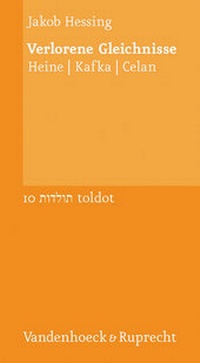
Verlorene Gleichnisse
Heine, Kafka, Celan
Jakob Hessing(Author)
Vandenhoeck & Ruprecht (Publisher)
1st Edition
Published on 20. April 2011
147 pages
978-3-647-35086-8 (ISBN)
System requirements
for PDF without DRM
E-Book Single Licence
You are acquiring a single user licence for this eBook, which you might not transfer. [L]
Available for download
Description
Alles über E-Books | Antworten auf Fragen rund um E-Books, Kopierschutz und Dateiformate finden Sie in unserem Info- & Hilfebereich.
Der israelische Germanist und Autor Jakob Hessing widmet sich in seinem Buch den Übergängen vom heiligen zum säkularen Text in der Moderne. Im Zentrum stehen Texte aus drei unterschiedlichen zeitlichen und räumlichen Entstehungszusammenhängen: die Werke Heinrich Heines, Franz Kafkas und Paul Celans. Der Autor deutet diese vor dem Hintergrund der Verwandlung religiöser Substanz in neue Freiheitsräume des Individuums, die seit Moses Mendelssohn den Eintritt der Juden in die deutsche Kultur begleitet hat. Dabei nimmt er vor allem das Gleichnis als eine sprachliche Konfiguration in den Blick, an der sich jener Wandlungsprozess am deutlichsten nachvollziehen lässt.
More details
Series
010
Language
German
Place of publication
Göttingen
Germany
File size
0,53 MB
ISBN-13
978-3-647-35086-8 (9783647350868)
DOI
10.13109/9783647350868
Schweitzer Classification
Other editions
Additional editions

Book
04/2011
1st Edition
Vandenhoeck & Ruprecht
€23.00
Shipment within 5-7 days
Person
Jakob Hessing ist Professor für Germanistik an der Hebräischen Universität Jerusalem.
Content
- Cover
- Title Page
- Copyright
- Table of Contents
- Body
- Vorwort
- Vom Verlust der Gleichnisse
- Ein besseres Lied Heinrich Heine
- Vater und Sohn Franz Kafka
- Nicht wissen, was gilt Paul Celan
- Quellen und Literatur
- Zum Autor

System requirements
File format: PDF
Copy protection: without DRM (Digital Rights Management)
System requirements:
- Computer (Windows; MacOS X; Linux): Use the free software Adobe Reader, Adobe Digital Editions, or any other PDF viewer of your choice (see eBook Help).
- Tablet/Smartphone (Android; iOS): Install the free app Adobe Digital Editions or another reading app for eBooks, e.g., PocketBook (see eBook Help).
- E-reader: Bookeen, Kobo, Pocketbook, Sony, Tolino and many more (only limited: Kindle).
The file format PDF always displays a book page identically on any hardware. This makes PDF suitable for complex layouts such as those used in textbooks and reference books (images, tables, columns, footnotes). Unfortunately, on the small screens of e-readers or smartphones, PDFs are rather annoying, requiring too much scrolling.
This eBook does not use copy protection or Digital Rights Management.
For more information, see our eBook Help page.