

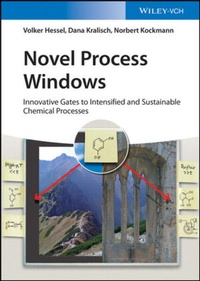
Novel Process Windows
Innovative Gates to Intensified and Sustainable Chemical Processes
1st Edition
Published on 18. December 2014
XXVI, 314 pages
978-3-527-65485-7 (ISBN)
Description

This book introduces the concept of novel process windows, focusing on cost improvements, safety, energy and eco-efficiency throughout each step of the process.
The first part presents the new reactor and process-related technologies, introducing the potential and benefit analysis. The core of the book details scenarios for unusual parameter sets and the new holistic and systemic approach to processing, while the final part analyses the implications for green and cost-efficient processing.
With its practical approach, this is invaluable reading for those working in the pharmaceutical, fine chemicals, fuels and oils industries.
The first part presents the new reactor and process-related technologies, introducing the potential and benefit analysis. The core of the book details scenarios for unusual parameter sets and the new holistic and systemic approach to processing, while the final part analyses the implications for green and cost-efficient processing.
With its practical approach, this is invaluable reading for those working in the pharmaceutical, fine chemicals, fuels and oils industries.
More details
Other editions
Additional editions
Volker Hessel | Dana Kralisch | Norbert Kockmann
Novel Process Windows
Innovative Gates to Intensified and Sustainable Chemical Processes
Book
02/2015
Wiley-VCH
€145.00
Article exhausted; check different version
Volker Hessel | Dana Kralisch | Norbert Kockmann
Novel Process Windows - Innovative Gates to Intensified and Sustainable Chemical Processes
Software
01/2015
Wiley-VCH
€198.26
No shipping information available
Persons
Volker Hessel, born 1964, is the Director of R&D and Head of the Chemical Process Technology Department at the Institute for Microtechnology Mainz GmbH (IMM), Germany. His department focuses on mixing, fine chemistry, and energy generation by fuel processing using microstructured reactors. He was awarded his Ph.D. from the University of Mainz in organic chemistry in 1993, investigating structure-property relations of supramolecular structures. After having been appointed Group Leader for Microreaction Technology at the IMM in 1996, he became head of the newly founded Department of Microreaction Technology in 1999. He is author of more than 150 peer-reviewed publications in the fields of organic chemistry and chemical micro process engineering, 200 papers in total, five books and 15 patents. In July 2005, Prof. Dr. Hessel was appointed as part-time professor for the chair of Micro Process Engineering at Eindhoven University of Technology, TU/e. This professorship is under the umbrella of the Chemical Reactor Engineering group of Prof. Dr.ir. Jaap Schouten in the Department of Chemical Engineering and Chemistry. In September, 2009, he was appointed an honorary professorship at the Technical Chemistry Department at Technical University of Darmstadt.
Dr.-Ing. habil. Norbert Kockmann, born 1966, studied mechanical engineering at Technical University of Munich and received his diploma in 1991. Dr. Kockmann was awarded his doctorate thesis in 1996 on fouling in falling film evaporators and its mitigation from The University of Bremen. In 1997, Dr. Kockmann worked as a project engineer at Messer Griesheim, Germany and was project manager for air separation units and a syngas plant. After 5 years industrial experience, he formed a research group for micro process engineering at the IMTEK Albert-Ludwig University of Freiburg, and was awarded his habilitation in 2007 on transport phenomena in micro process engineering. Since October 2007, Dr. Kockmann is senior researcher at Lonza Ltd, Visp, Switzerland and responsible for microreactor development and continuous-flow reactor technology. His fields of research comprise micro process engineering for mixing, heat transfer, fine chemistry and pharmaceutics, and micro reactor development and fabrication. Dr. Kockmann is author or co-author of more than 30 journal publications and 65 conference contributions, five book chapters, and two books. In 2009, Dr. Kockmann received the ASME award ICNMM09 Outstanding Researcher in Transport Phenomena in Microchannels.
Dana Kralisch, born in 1973, studied environmental chemistry at the Friedrich-Schiller-University (FSU), Jena, Germany. After two years consulting in environmental analytics at the Agency for Agriculture of the Federal State of Thuringia, she started to work as a research assistant at the Institute of Technical and Environmental Chemistry (FSU) in 2002. In her work she concentrated on the integration of sustainability criteria into chemical process development with a focus on micro reaction technology and ionic liquids. In 2006, she was awarded her PhD from the School of Chemical and Earth Sciences (FSU).Since 2007, she is leading the Green Process Engineering and Evaluation Research Group at the Institute of Technical and Environmental Chemistry. She is currently working on the coupling of life cycle assessment and green chemical process design in the framework of the German Novel Process Windows cluster and in the context of nanocellulose research. Dr. Kralisch is author or co-author of 13 per-reviewed publications, 4 book chapters, 27 conference contributions and two patents.
Dr.-Ing. habil. Norbert Kockmann, born 1966, studied mechanical engineering at Technical University of Munich and received his diploma in 1991. Dr. Kockmann was awarded his doctorate thesis in 1996 on fouling in falling film evaporators and its mitigation from The University of Bremen. In 1997, Dr. Kockmann worked as a project engineer at Messer Griesheim, Germany and was project manager for air separation units and a syngas plant. After 5 years industrial experience, he formed a research group for micro process engineering at the IMTEK Albert-Ludwig University of Freiburg, and was awarded his habilitation in 2007 on transport phenomena in micro process engineering. Since October 2007, Dr. Kockmann is senior researcher at Lonza Ltd, Visp, Switzerland and responsible for microreactor development and continuous-flow reactor technology. His fields of research comprise micro process engineering for mixing, heat transfer, fine chemistry and pharmaceutics, and micro reactor development and fabrication. Dr. Kockmann is author or co-author of more than 30 journal publications and 65 conference contributions, five book chapters, and two books. In 2009, Dr. Kockmann received the ASME award ICNMM09 Outstanding Researcher in Transport Phenomena in Microchannels.
Dana Kralisch, born in 1973, studied environmental chemistry at the Friedrich-Schiller-University (FSU), Jena, Germany. After two years consulting in environmental analytics at the Agency for Agriculture of the Federal State of Thuringia, she started to work as a research assistant at the Institute of Technical and Environmental Chemistry (FSU) in 2002. In her work she concentrated on the integration of sustainability criteria into chemical process development with a focus on micro reaction technology and ionic liquids. In 2006, she was awarded her PhD from the School of Chemical and Earth Sciences (FSU).Since 2007, she is leading the Green Process Engineering and Evaluation Research Group at the Institute of Technical and Environmental Chemistry. She is currently working on the coupling of life cycle assessment and green chemical process design in the framework of the German Novel Process Windows cluster and in the context of nanocellulose research. Dr. Kralisch is author or co-author of 13 per-reviewed publications, 4 book chapters, 27 conference contributions and two patents.
Content
FROM GREEN CHEMISTRY TO GREEN ENGINEERING - FOSTERED BY NOVEL PROCESS WINDOWS EXPLORED IN MICRO-PROCESS ENGINEERING/FLOW CHEMISTRY
Prelude - Potential for Green Chemistry and Engineering
Green Chemistry
Green Engineering
Micro- and Milli-Process Technologies
Flow Chemistry
Two Missing Links - Cross-Related
NOVEL PROCESS WINDOWS
Transport Identification - The Potential of Reaction Engineering
Chemical Reactivity in Match or Mismatch to Intensified Engineering
Chemical Intensification through Harsh Conditions - Novel Process Windows
Flash Chemistry
Process-Design Intensifiaction
CHEMICAL INTENSIFICATION
Length Scale
Time Scale
Length and Time Scale of Chemical Reactions
Temperature Intensification
Pressure Intensification
MAKING USE OF THE "FORBIDDEN" - EX-REGIME/HIGH SAFETY PROCESSING
Hazardous Reactants and Intermediates
Ex-Regime and Thermal Runaway Processing
EXPLORING NEW PATHS - NEW CHEMICAL TRANSFORMATIONS
Direct Syntheses via One Step
Direct Syntheses via Multicomponent Reactions
Multistep One-Flow Syntheses
Multistep Syntheses in One Microreactor/Chip
Multistep Syntheses in Coupled Microreactors/Chips
ACTIVATE - HIGH-T PROCESSING
Tailored High-T Microreactor Design and Fabrication
Cryogenic to Ambient - Allowing Fast Reactions to be Fast
From Reflux to Superheated - Speeding-Up Reactions
Solvent-Scope Widening by Virtue of Pressurizing Existing High-T Reactions
New Temperature Field for Product and Material Control
Energy Activation Other than Temperature - Photo, Electrochemical, Plasma
PRESS - HIGH-p PROCESSING
Tailored High-p Microreactor Design and Fabrication
High Pressure to Intensify Interfacial Transport in Gas-Liquid Reactions
Pressure as Direct Means - Activation Volume Effects and More
Pressure for Advanced Fluidic Studies - to be Used for Shaping Materials and More
COLLIDE AND SLIDE - HIGH-c AND TAILORED-SOLVENT PROCESSING
Batch Process-Based Inspirations for High-c Flow Processes
Solvent-Free or Solvent-Less Operation - "Highest-c"
Supercritical Fluids to Combine the Former Separated - Mass Transfer Boost
DOING MORE BY COMBINING - PROCESS INTEGRATION
Integration of Reaction and Cooling/Heating, Separation, or Other
Integration of Process Control and Sensing
Thermal Integration on a Process Level
Integration of Units on Racks, Backbones, Frames, Interfaces, or Similar Level
Fully Intensified/Flow Process Development
DOING THE SAME WITH LESS - PROCESS SIMPLIFICATION
Omitting the Use of a Catalyst
Simplifying Separation
IMPLICATIONS OF NPW TO GREEN AND COST EFFICIENT PROCESSING
Introduction
Knowledge-Based Design of Future Chemistry - Coupling the Implementation of NPW with Evaluation and Decision Support Tools
Evaluation Methods
Evaluation of the NPW Concept Impact on Sustainability
Future Environmental and Economic Sustainability Evaluation in the Context of Flow-Chemistry under NPW Conditions
FROM MILLIGRAMS TO KILOGRAMS - SCALE-UP IN MODULAR FLOW REACTORS
Reactor Types
Scale-Up Parameters
Numbering-Up
Single-Channel Operation
Methodology for Continuous-Flow Process Development
Conclusions
EVOLUTION OF NOVEL PROCESS WINDOWS
Multifaceted Novel Process Windows: Evolution
High-p,T Commerical Flow Chemistry Equipment
Funding Agency Initiatives
SCIENTIFIC DISSEMINATION OF NOVEL PROCESS WINDOWS
Literature Share for Chemical Intensification
Literature Share for Process-Design Intensification
OUTLOOK
Process Automation
Means of Activation Other than High-Temperature, High-Pressure, High-Concentration, and High-Solvent
Index
Prelude - Potential for Green Chemistry and Engineering
Green Chemistry
Green Engineering
Micro- and Milli-Process Technologies
Flow Chemistry
Two Missing Links - Cross-Related
NOVEL PROCESS WINDOWS
Transport Identification - The Potential of Reaction Engineering
Chemical Reactivity in Match or Mismatch to Intensified Engineering
Chemical Intensification through Harsh Conditions - Novel Process Windows
Flash Chemistry
Process-Design Intensifiaction
CHEMICAL INTENSIFICATION
Length Scale
Time Scale
Length and Time Scale of Chemical Reactions
Temperature Intensification
Pressure Intensification
MAKING USE OF THE "FORBIDDEN" - EX-REGIME/HIGH SAFETY PROCESSING
Hazardous Reactants and Intermediates
Ex-Regime and Thermal Runaway Processing
EXPLORING NEW PATHS - NEW CHEMICAL TRANSFORMATIONS
Direct Syntheses via One Step
Direct Syntheses via Multicomponent Reactions
Multistep One-Flow Syntheses
Multistep Syntheses in One Microreactor/Chip
Multistep Syntheses in Coupled Microreactors/Chips
ACTIVATE - HIGH-T PROCESSING
Tailored High-T Microreactor Design and Fabrication
Cryogenic to Ambient - Allowing Fast Reactions to be Fast
From Reflux to Superheated - Speeding-Up Reactions
Solvent-Scope Widening by Virtue of Pressurizing Existing High-T Reactions
New Temperature Field for Product and Material Control
Energy Activation Other than Temperature - Photo, Electrochemical, Plasma
PRESS - HIGH-p PROCESSING
Tailored High-p Microreactor Design and Fabrication
High Pressure to Intensify Interfacial Transport in Gas-Liquid Reactions
Pressure as Direct Means - Activation Volume Effects and More
Pressure for Advanced Fluidic Studies - to be Used for Shaping Materials and More
COLLIDE AND SLIDE - HIGH-c AND TAILORED-SOLVENT PROCESSING
Batch Process-Based Inspirations for High-c Flow Processes
Solvent-Free or Solvent-Less Operation - "Highest-c"
Supercritical Fluids to Combine the Former Separated - Mass Transfer Boost
DOING MORE BY COMBINING - PROCESS INTEGRATION
Integration of Reaction and Cooling/Heating, Separation, or Other
Integration of Process Control and Sensing
Thermal Integration on a Process Level
Integration of Units on Racks, Backbones, Frames, Interfaces, or Similar Level
Fully Intensified/Flow Process Development
DOING THE SAME WITH LESS - PROCESS SIMPLIFICATION
Omitting the Use of a Catalyst
Simplifying Separation
IMPLICATIONS OF NPW TO GREEN AND COST EFFICIENT PROCESSING
Introduction
Knowledge-Based Design of Future Chemistry - Coupling the Implementation of NPW with Evaluation and Decision Support Tools
Evaluation Methods
Evaluation of the NPW Concept Impact on Sustainability
Future Environmental and Economic Sustainability Evaluation in the Context of Flow-Chemistry under NPW Conditions
FROM MILLIGRAMS TO KILOGRAMS - SCALE-UP IN MODULAR FLOW REACTORS
Reactor Types
Scale-Up Parameters
Numbering-Up
Single-Channel Operation
Methodology for Continuous-Flow Process Development
Conclusions
EVOLUTION OF NOVEL PROCESS WINDOWS
Multifaceted Novel Process Windows: Evolution
High-p,T Commerical Flow Chemistry Equipment
Funding Agency Initiatives
SCIENTIFIC DISSEMINATION OF NOVEL PROCESS WINDOWS
Literature Share for Chemical Intensification
Literature Share for Process-Design Intensification
OUTLOOK
Process Automation
Means of Activation Other than High-Temperature, High-Pressure, High-Concentration, and High-Solvent
Index
