

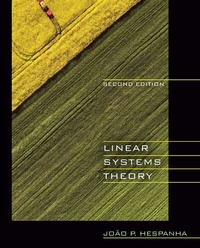
Linear Systems Theory
Second Edition
2nd Edition
Published on 13. February 2018
352 pages
978-1-4008-9008-8 (ISBN)
Description

No detailed description available for "Linear Systems Theory".
More details
Other editions
Additional editions
Book
02/2018
2nd Edition
Princeton University Press
€106.50
Shipment within 10-20 days
Person
João P. Hespanha is professor of electrical engineering in the Center for Control, Dynamical Systems and Computation at the University of California, Santa Barbara. He is the author of Noncooperative Game Theory (Princeton).
Content
- Cover
- Title
- Copyright
- Dedication
- CONTENTS
- PREAMBLE
- LINEAR SYSTEMS I - BASIC CONCEPTS
- I SYSTEM REPRESENTATION
- 1 STATE-SPACE LINEAR SYSTEMS
- 1.1 State-Space Linear Systems
- 1.2 Block Diagrams
- 1.3 Exercises
- 2 LINEARIZATION
- 2.1 State-Space Nonlinear Systems
- 2.2 Local Linearization Around an Equilibrium Point
- 2.3 Local Linearization Around a Trajectory
- 2.4 Feedback Linearization
- 2.5 Practice Exercises
- 2.6 Exercises
- 3 CAUSALITY, TIME INVARIANCE, AND LINEARITY
- 3.1 Basic Properties of LTV/LTI Systems
- 3.2 Characterization of All Outputs to a Given Input
- 3.3 Impulse Response
- 3.4 Laplace and ? Transforms (Review)
- 3.5 Transfer Function
- 3.6 Discrete-Time Case
- 3.7 Additional Notes
- 3.8 Exercises
- 4 IMPULSE RESPONSE AND TRANSFER FUNCTION OF STATE-SPACE SYSTEMS
- 4.1 Impulse Response and Transfer Function for LTI Systems
- 4.2 Discrete-Time Case
- 4.3 Elementary Realization Theory
- 4.4 Equivalent State-Space Systems
- 4.5 LTI Systems in MATLAB®
- 4.6 Practice Exercises
- 4.7 Exercises
- 5 SOLUTIONS TO LTV SYSTEMS
- 5.1 Solution to Homogeneous Linear Systems
- 5.2 Solution to Nonhomogeneous Linear Systems
- 5.3 Discrete-Time Case
- 5.4 Practice Exercises
- 5.5 Exercises
- 6 SOLUTIONS TO LTI SYSTEMS
- 6.1 Matrix Exponential
- 6.2 Properties of the Matrix Exponential
- 6.3 Computation of Matrix Exponentials Using Laplace Transforms
- 6.4 The Importance of the Characteristic Polynomial
- 6.5 Discrete-Time Case
- 6.6 Symbolic Computations in MATLAB®
- 6.7 Practice Exercises
- 6.8 Exercises
- 7 SOLUTIONS TO LTI SYSTEMS: THE JORDAN NORMAL FORM
- 7.1 Jordan Normal Form
- 7.2 Computation of Matrix Powers using the Jordan Normal Form
- 7.3 Computation of Matrix Exponentials using the Jordan Normal Form
- 7.4 Eigenvalues with Multiplicity Larger than 1
- 7.5 Practice Exercise
- 7.6 Exercises
- II STABILITY
- 8 INTERNAL OR LYAPUNOV STABILITY
- 8.1 Lyapunov Stability
- 8.2 Vector and Matrix Norms (Review)
- 8.3 Eigenvalue Conditions for Lyapunov Stability
- 8.4 Positive-Definite Matrices (Review)
- 8.5 Lyapunov Stability Theorem
- 8.6 Discrete-Time Case
- 8.7 Stability of Locally Linearized Systems
- 8.8 Stability Tests with MATLAB®
- 8.9 Practice Exercises
- 8.10 Exercises
- 9 INPUT-OUTPUT STABILITY
- 9.1 Bounded-Input, Bounded-Output Stability
- 9.2 Time Domain Conditions for BIBO Stability
- 9.3 Frequency Domain Conditions for BIBO Stability
- 9.4 BIBO versus Lyapunov Stability
- 9.5 Discrete-Time Case
- 9.6 Practice Exercises
- 9.7 Exercises
- 10 PREVIEW OF OPTIMAL CONTROL
- 10.1 The Linear Quadratic Regulator Problem
- 10.2 Feedback Invariants
- 10.3 Feedback Invariants in Optimal Control
- 10.4 Optimal State Feedback
- 10.5 LQR with MATLAB®
- 10.6 Practice Exercise
- 10.7 Exercise
- III CONTROLLABILITY AND STATE FEEDBACK
- 11 CONTROLLABLE AND REACHABLE SUBSPACES
- 11.1 Controllable and Reachable Subspaces
- 11.2 Physical Examples and System Interconnections
- 11.3 Fundamental Theorem of Linear Equations (Review)
- 11.4 Reachability and Controllability Gramians
- 11.5 Open-Loop Minimum-Energy Control
- 11.6 Controllability Matrix (LTI)
- 11.7 Discrete-Time Case
- 11.8 MATLAB® Commands
- 11.9 Practice Exercise
- 11.10 Exercises
- 12 CONTROLLABLE SYSTEMS
- 12.1 Controllable Systems
- 12.2 Eigenvector Test for Controllability
- 12.3 Lyapunov Test for Controllability
- 12.4 Feedback Stabilization Based on the Lyapunov Test
- 12.5 Eigenvalue Assignment
- 12.6 Practice Exercises
- 12.7 Exercises
- 13 CONTROLLABLE DECOMPOSITIONS
- 13.1 Invariance with Respect to Similarity Transformations
- 13.2 Controllable Decomposition
- 13.3 Block Diagram Interpretation
- 13.4 Transfer Function
- 13.5 MATLAB® Commands
- 13.6 Exercise
- 14 STABILIZABILITY
- 14.1 Stabilizable System
- 14.2 Eigenvector Test for Stabilizability
- 14.3 Popov-Belevitch-Hautus (PBH) Test for Stabilizability
- 14.4 Lyapunov Test for Stabilizability
- 14.5 Feedback Stabilization Based on the Lyapunov Test
- 14.6 MATLAB® Commands
- 14.7 Exercises
- IV OBSERVABILITY AND OUTPUT FEEDBACK
- 15 OBSERVABILITY
- 15.1 Motivation: Output Feedback
- 15.2 Unobservable Subspace
- 15.3 Unconstructible Subspace
- 15.4 Physical Examples
- 15.5 Observability and Constructibility Gramians
- 15.6 Gramian-Based Reconstruction
- 15.7 Discrete-Time Case
- 15.8 Duality for LTI Systems
- 15.9 Observability Tests
- 15.10 MATLAB® Commands
- 15.11 Practice Exercises
- 15.12 Exercises
- 16 OUTPUT FEEDBACK
- 16.1 Observable Decomposition
- 16.2 Kalman Decomposition Theorem
- 16.3 Detectability
- 16.4 Detectability Tests
- 16.5 State Estimation
- 16.6 Eigenvalue Assignment by Output Injection
- 16.7 Stabilization through Output Feedback
- 16.8 MATLAB® Commands
- 16.9 Exercises
- 17 MINIMAL REALIZATIONS
- 17.1 Minimal Realizations
- 17.2 Markov Parameters
- 17.3 Similarity of Minimal Realizations
- 17.4 Order of a Minimal SISO Realization
- 17.5 MATLAB® Commands
- 17.6 Practice Exercises
- 17.7 Exercises
- LINEAR SYSTEMS II - ADVANCED MATERIAL
- V POLES AND ZEROS OF MIMO SYSTEMS
- 18 SMITH-MCMILLAN FORM
- 18.1 Informal Definition of Poles and Zeros
- 18.2 Polynomial Matrices: Smith Form
- 18.3 Rational Matrices: Smith-McMillan Form
- 18.4 McMillan Degree, Poles, and Zeros
- 18.5 Blocking Property of Transmission Zeros
- 18.6 MATLAB® Commands
- 18.7 Exercises
- 19 STATE-SPACE POLES, ZEROS, AND MINIMALITY
- 19.1 Poles of Transfer Functions versus Eigenvalues of State-Space Realizations
- 19.2 Transmission Zeros of Transfer Functions versus Invariant Zeros of State-Space Realizations
- 19.3 Order of Minimal Realizations
- 19.4 Practice Exercises
- 19.5 Exercise
- 20 SYSTEM INVERSES
- 20.1 System Inverse
- 20.2 Existence of an Inverse
- 20.3 Poles and Zeros of an Inverse
- 20.4 Feedback Control of Invertible Stable Systems with Stable Inverses
- 20.5 MATLAB® Commands
- 20.6 Exercises
- VI LQR/LQG OPTIMAL CONTROL
- 21 LINEAR QUADRATIC REGULATION (LQR)
- 21.1 Deterministic Linear Quadratic Regulation (LQR)
- 21.2 Optimal Regulation
- 21.3 Feedback Invariants
- 21.4 Feedback Invariants in Optimal Control
- 21.5 Optimal State Feedback
- 21.6 LQR in MATLAB®
- 21.7 Additional Notes
- 21.8 Exercises
- 22 THE ALGEBRAIC RICCATI EQUATION (ARE)
- 22.1 The Hamiltonian Matrix
- 22.2 Domain of the Riccati Operator
- 22.3 Stable Subspaces
- 22.4 Stable Subspace of the Hamiltonian Matrix
- 22.5 Exercises
- 23 FREQUENCY DOMAIN AND ASYMPTOTIC PROPERTIES OF LQR
- 23.1 Kalman's Equality
- 23.2 Frequency Domain Properties: Single-Input Case
- 23.3 Loop Shaping Using LQR: Single-Input Case
- 23.4 LQR Design Example
- 23.5 Cheap Control Case
- 23.6 MATLAB® Commands
- 23.7 Additional Notes
- 23.8 The Loop-Shaping Design Method (Review)
- 23.9 Exercises
- 24 OUTPUT FEEDBACK
- 24.1 Certainty Equivalence
- 24.2 Deterministic Minimum-Energy Estimation (MEE)
- 24.3 Stochastic Linear Quadratic Gaussian (LQG) Estimation
- 24.4 LQR/LQG Output Feedback
- 24.5 Loop Transfer Recovery (LTR)
- 24.6 Optimal Set-Point Control
- 24.7 LQR/LQG with MATLAB®
- 24.8 LTR Design Example
- 24.9 Exercises
- 25 LQG/LQR AND THE Q PARAMETERIZATION
- 25.1 Q-Augmented LQG/LQR Controller
- 25.2 Properties
- 25.3 Q Parameterization
- 25.4 Exercise
- 26 Q DESIGN
- 26.1 Control Specifications for Q Design
- 26.2 The Q Design Feasibility Problem
- 26.3 Finite-Dimensional Optimization: Ritz Approximation
- 26.4 Q Design Using MATLAB® and CVX
- 26.5 Q Design Example
- 26.6 Exercise
- BIBLIOGRAPHY
- INDEX
