

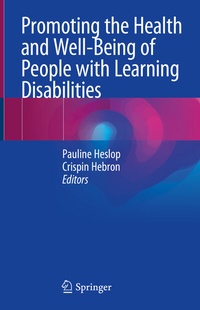
Promoting the Health and Well-Being of People with Learning Disabilities
Published on 10. June 2020
XVI, 149 pages
978-3-030-43488-5 (ISBN)
Description

This textbook presents a practical guide for new and experienced health or social care staff, helping them promote the health and well-being of people with learning disabilities. Given the considerable demand for mandatory training on supporting people with learning disabilities, especially in England, the book provides a valuable resource for all training courses on working with people with learning disabilities.
The chapters are co-written by practitioners and people with learning disabilities and their families, rooting the book in the lived experiences of those concerned. Topics covered include core elements of being happy and healthy, communication, changes in our behaviour when we are unwell, making decisions about our health, accessing health services, how we would want to be treated if we were unwell, the use of psychotropic medication, what a 'good death' would be, and how to keep ourselves healthy. In addition, the chapters include narrativeexamples concerning people with learning disabilities and their families, so as to highlight key points and share best-practice examples. The use of personal reflection is used to consider how we can ensure that people with learning disabilities receive care and support that matches what we would expect for ourselves. Core questions at the end of each chapter ask the reader to reflect on how the chapter content relates to their own work and how they will apply what they have learned.
A consistent theme throughout the book is equality of opportunity for people with learning disabilities to achieve good health. There is now substantial evidence that people with learning disabilities have poorer health than the general population, are more likely to have multiple health needs, and can experience difficulties in having their illnesses diagnosed and treated promptly. This book aims to help those supporting people with learning disabilities to achieve more equal outcomes.
The chapters are co-written by practitioners and people with learning disabilities and their families, rooting the book in the lived experiences of those concerned. Topics covered include core elements of being happy and healthy, communication, changes in our behaviour when we are unwell, making decisions about our health, accessing health services, how we would want to be treated if we were unwell, the use of psychotropic medication, what a 'good death' would be, and how to keep ourselves healthy. In addition, the chapters include narrativeexamples concerning people with learning disabilities and their families, so as to highlight key points and share best-practice examples. The use of personal reflection is used to consider how we can ensure that people with learning disabilities receive care and support that matches what we would expect for ourselves. Core questions at the end of each chapter ask the reader to reflect on how the chapter content relates to their own work and how they will apply what they have learned.
A consistent theme throughout the book is equality of opportunity for people with learning disabilities to achieve good health. There is now substantial evidence that people with learning disabilities have poorer health than the general population, are more likely to have multiple health needs, and can experience difficulties in having their illnesses diagnosed and treated promptly. This book aims to help those supporting people with learning disabilities to achieve more equal outcomes.
More details
Series
Language
English
Place of publication
Cham
Switzerland
Publishing group
Springer International Publishing
Product notice
Reflowable
Illustrations
XVI, 149 p. 17 illus., 6 illus. in color.
File size
2,25 MB
ISBN-13
978-3-030-43488-5 (9783030434885)
DOI
10.1007/978-3-030-43488-5
Schweitzer Classification
Other editions
Additional editions
Pauline Heslop | Crispin Hebron
Promoting the Health and Well-Being of People with Learning Disabilities
Book
06/2020
Springer
€64.19
Shipment within 7-9 days
Persons
Professor Pauline Heslop
(RGN, RSCN, PhD) is a nurse by background and is currently based at the University of Bristol's Norah Fry Centre for Disability Studies. She is recognised nationally and internationally for her expertise in understanding mortality and causes of early death of people with intellectual (learning) disabilities, and publication of her work has led to her being awarded the International Association for the Scientific Study of Intellectual and Developmental Disabilities (IASSIDD) Distinguished Achievement Award in 2016. Pauline has been the University of Bristol Programme Lead for the national Learning Disabilities Mortality Review (LeDeR) Programme in England since 2015.
Crispin Hebron (RNMH. Dip.SW. BSc (Hons). MSc.) works as an Independent Consultant Learning Disability Nurse. He has held a range of roles across the public, private and voluntary sector including work with NHS England as a Clinical Lead to reduce health inequalities for people with learning disabilities and NHS Digital to create a Reasonable Adjustment Flag on patients' electronic records. Crispin has contributed as an investigator to the Confidential Inquiry into premature deaths in people with learning disability published in 2013, run by the Norah Fry Centre for Disability Studies University of Bristol and the 2016 review into using information technology to improve the NHS. Crispin has published various articles and book chapters focusing on equality, health issues and the delivery of effective services for people with learning disabilities.
Crispin Hebron (RNMH. Dip.SW. BSc (Hons). MSc.) works as an Independent Consultant Learning Disability Nurse. He has held a range of roles across the public, private and voluntary sector including work with NHS England as a Clinical Lead to reduce health inequalities for people with learning disabilities and NHS Digital to create a Reasonable Adjustment Flag on patients' electronic records. Crispin has contributed as an investigator to the Confidential Inquiry into premature deaths in people with learning disability published in 2013, run by the Norah Fry Centre for Disability Studies University of Bristol and the 2016 review into using information technology to improve the NHS. Crispin has published various articles and book chapters focusing on equality, health issues and the delivery of effective services for people with learning disabilities.
Content
Chapter 1. Being happy and healthy.- Chapter 2. Communication.- Chapter 3. Behaviour.- Chapter 4. Decision-making.- Chapter 5. Access to health services.- Chapter 6. Providing holistic care.- Chapter 7. Psychotropic medication.- Chapter 8. Death and dying.- Chapter 9. Staying healthy.- Chapter 10. Sources of advice about our health or that of others.
