

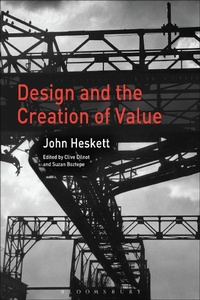
Design and the Creation of Value
1st Edition
Published on 9. February 2017
248 pages
978-1-4742-7427-2 (ISBN)
Description

John Heskett was a pioneering British design historian, with a particular interest in design and economics.
Design and the Creation of Value' publishes for the first time his groundbreaking seminar on design and economic value. In remarkably clear and accessible prose Heskett explores the how the key traditions of economic thought conceive of how value is created. Critically teasing out the role of design in this process, Heskett shows how design's role in innovating and creating value creating value for organisations and products can be given a firm grounding in economic theory.
Featuring examples of businesses which have successfully responded to the value of design in their practice, as well as others who have failed because of their inability to understand value-creation, Heskett looks in detail at the relationship between producers, markets, products and consumers, using these instances to offer a both a strong critique of the limitations conventional economic thought and new model of the economic importance of design thinking in value creation.
Design and the Creation of Value' publishes for the first time his groundbreaking seminar on design and economic value. In remarkably clear and accessible prose Heskett explores the how the key traditions of economic thought conceive of how value is created. Critically teasing out the role of design in this process, Heskett shows how design's role in innovating and creating value creating value for organisations and products can be given a firm grounding in economic theory.
Featuring examples of businesses which have successfully responded to the value of design in their practice, as well as others who have failed because of their inability to understand value-creation, Heskett looks in detail at the relationship between producers, markets, products and consumers, using these instances to offer a both a strong critique of the limitations conventional economic thought and new model of the economic importance of design thinking in value creation.
More details
Edition
1. Auflage
Language
English
Place of publication
London
United Kingdom
Publishing group
Bloomsbury Publishing PLC
Target group
Professional and scholarly
College/higher education
Illustrations
10 mono line drawings
ISBN-13
978-1-4742-7427-2 (9781474274272)
Copyright in bibliographic data and cover images is held by Nielsen Book Services Limited or by the publishers or by their respective licensors: all rights reserved.
Schweitzer Classification
Other editions
Additional editions

John Heskett | Clive Dilnot | Suzan Boztepe
Design and the Creation of Value
Book
02/2017
Bloomsbury Academic
€60.91
Shipment within 15-20 days
Persons
John Heskett (1937-2014) was a prolific and pioneering design academic. He worked as chair and professor of design at Hong Kong Polytechnic University, spent fifteen years as professor of design at the Illinois Institute of Technology in Chicago, and was also a visiting professor at universities in Denmark, Turkey, Chile, Germany, Japan, and Finland.
He authored many classic design texts, including 'Industrial Design' (1980), 'German Design 1870-1918' (1987), and 'Philips: A Study in Corporate Design' (1989). A large part of his research focused on business applications for design. He was especially interested in exploring how design creates economic value, and the role of this in the design policy of governments and corporations.
Clive Dilnot is Professor of Design Studies at the School of Art and Design History and Theory at Parsons, New York. He has taught in Hong Kong and at Harvard University, and served as director of design initiatives at the Art Institute in Chicago. He has written extensively on the history and theory of design, and his most recent work is on design ethics.
Suzan Boztepe is Senior Lecturer at Malmö University, Sweden. Her research focuses on how design creates user and economic value, drives organizational and societal transformation, and catalyzes innovation. She has published widely on strategic design and human-centered methodologies. She completed her doctorate under John Heskett at the Institute of Design, Illinois Institute of Technology, where he originally taught the groundbreaking seminar on design and economic value on which this book is based.
He authored many classic design texts, including 'Industrial Design' (1980), 'German Design 1870-1918' (1987), and 'Philips: A Study in Corporate Design' (1989). A large part of his research focused on business applications for design. He was especially interested in exploring how design creates economic value, and the role of this in the design policy of governments and corporations.
Clive Dilnot is Professor of Design Studies at the School of Art and Design History and Theory at Parsons, New York. He has taught in Hong Kong and at Harvard University, and served as director of design initiatives at the Art Institute in Chicago. He has written extensively on the history and theory of design, and his most recent work is on design ethics.
Suzan Boztepe is Senior Lecturer at Malmö University, Sweden. Her research focuses on how design creates user and economic value, drives organizational and societal transformation, and catalyzes innovation. She has published widely on strategic design and human-centered methodologies. She completed her doctorate under John Heskett at the Institute of Design, Illinois Institute of Technology, where he originally taught the groundbreaking seminar on design and economic value on which this book is based.
Content
Clive Dilnot: Introduction to Design & the Creation of Value
Cameron Weber: A note on John Heskett's economics
Sabine Junginger: Design as an economic necessity for governments and organisations
Clive Dilnot: Notes on editing the manuscript
Design and the Creation of Value
Preface
§1: Design in Economic Life?
Part One: Economic Theory & Design
§2: Neo-Classical Theory
§3: Austrian Theory
§4: Institutional Theory
§5: New Growth Theory
§6: The National System
Part Two: Design & the Creation of Value
§7: Design from Standpoint of Economics
§8: Economics from the Standpoint of Design
§9: Design and Value from the Standpoint of Practice
Appendix 1: Socialist Theory
Appendix 2: Value and Values in Design
Sharon Helmer Poggenpohl: Afterword
Cameron Weber: A note on John Heskett's economics
Sabine Junginger: Design as an economic necessity for governments and organisations
Clive Dilnot: Notes on editing the manuscript
Design and the Creation of Value
Preface
§1: Design in Economic Life?
Part One: Economic Theory & Design
§2: Neo-Classical Theory
§3: Austrian Theory
§4: Institutional Theory
§5: New Growth Theory
§6: The National System
Part Two: Design & the Creation of Value
§7: Design from Standpoint of Economics
§8: Economics from the Standpoint of Design
§9: Design and Value from the Standpoint of Practice
Appendix 1: Socialist Theory
Appendix 2: Value and Values in Design
Sharon Helmer Poggenpohl: Afterword
