

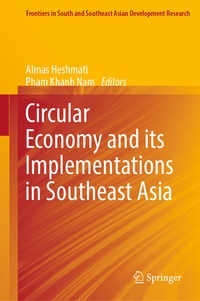
Circular Economy and its Implementations in Southeast Asia
Description

This edited volume explores the implementation of the circular economy (CE) in Southeast Asia, a densely populated region with a significant share of global production. It examines the region's transition from a linear to a circular economy, providing a comprehensive overview of CE applications across various parts of Southeast Asia. The book offers unique and empirical insights into the approaches, methods, laws, and policies that facilitate the transformation to a CE. It highlights how recent research, trends, and attitudes can be practically oriented towards sustainable development. By linking environmental theory with practice, the book provides practitioners with a deeper understanding of CE and the challenges involved in its implementation.
A timely and practical guide, this book is essential for sustainability researchers and policymakers in Asia striving to achieve CE and sustainable development goals. It presents an up-to-date picture of Southeast Asia's fast-growing economy, showcasing the region's heavy investment in development infrastructure and cooperative efforts towards environmental sustainability. Authored by professionals with deep insights into the region's economy and development potential, the chapters offer empirical, research-based perspectives on recent economic trends. This volume fills a crucial knowledge gap regarding Southeast Asian economies, their environmental conditions, and development potential. It also guides emerging economies like Vietnam in sustainable development, helping them avoid the pitfalls of environmental missteps in production, resource utilization, and consumption.
More details
Other editions
Additional editions
Persons
Almas Heshmati is Research Fellow at University of Economics Ho Chi Minh City, Vietnam and Emeritus Professor of Economics at Jönköping University, Sweden. He held similar positions at the Sogang University, Korea University, Seoul National University, University of Kurdistan Hawler, and the MTT Agrifood Research (Finland). He was Research Fellow at the World Institute for Development Economics Research (WIDER) and the United Nations University during 2001-2004. From 1998 until 2001, he was an associate professor of Economics at the Stockholm School of Economics. He has a Ph.D. degree from the University of Gothenburg (1994), where he held a senior researcher position until 1998. His research interests include applied microeconomics, globalization, development economics, efficiency, productivity, and growth with application to agriculture, manufacturing and services, environmental economics, energy economics, and well-being. In addition to many scientific journal articles, he has published books on EU Lisbon Process, Global Inequality, East Asian Manufacturing, Chinese Economy, Technology Transfer, Information Technology, Water Resources, Landmines, Power Generation, Renewable Energy, Development Economics, World Values, Poverty, Well-being, and Economic Growth.
Pham Khanh Nam is a senior research fellow and director of the Environment for Development Center (EfD-Vietnam) at the University of Economics Ho Chi Minh city (UEH University). He received his PhD in Economics from the University of Gothenburg, Sweden. His areas of research interest are environmental and natural resources economics, climate change, and experimental economics. Currently, his research focuses on forest devolution policy, marine plastic pollution, and renewable energy in Vietnam. He has published in a number of peer-reviewed journals, including Journal of Human Resources , Journal of Public Economics , Journal of Economic Behavior and Organization , Journal of Economic Psychology , Oxford Economic Paper , Land Use Policy , or Journal of Development Studies . Pham Khanh Nam has been actively involved in the revision of the Vietnamese Law of Environmental Protection as well as other policy dialogues on circular economy and green growth strategy. He is a member of several task forces under Vietnam's Central Economic Committee and the Ministry of Natural Resources and Environment. He has consulted the World Bank, Asian Development Bank, IUCN, and Vietnam Environment Administration.
Content
Part 1: Waste Management and Recycling.- 1. Circular Economy: A solution for effective waste management - A comparative analysis with the European Union and implications for development in the Asian Region.- 2. A systematic review of E-waste estimation methods and models in SAARC and ASEAN member countries.- 3. Circular Economy Pathways for Solid Waste Management in the Philippines.- Part 2: Regulatory, Monetary and Financial Policy.- 4. Quach Duong Tu and Cao Minh Tuan, A transmission mechanism of monetary policy and circular economy in Vietnam.- 5. Barriers of law regulation to a circular economy in SMEs to integrate in a sustainable development strategy.- 6. International experience on financial policy to promote the process of collecting and recycling scrapped vehicles and lessons for Vietnam.- 7. Electronic banking fraud prevention in Vietnam in the context of a circular economy.- Part 3: Circular economy transition and its implications for sustainable development.- 8. Closing the loop: How energy efficiency labelling supports circular economy goals.- 9. Impact of climate change on circular economy development and ensuring human rights in Vietnam.- 10. EU's legal framework for secondary raw materials and recommendations for Vietnam.- 11. Exploring the ambitions and needs of small and medium-sized enterprises in the transition to the CE in Vietnam.
