

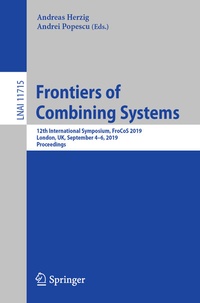
Frontiers of Combining Systems
Description

This book constitutes the proceedings of the 12th International Symposium on Frontiers of Combining Systems, FroCoS 2019, held in London, UK, in September 2019, colocated with the 28th International Conference on Automated Reasoning with Analytic Tableaux and Related Methods, TABLEAUX 2019.
The 20 papers presented were carefully reviewed and selected from 30 submissions. They present research on the development of techniques and methods for the combination and integration of formal systems, their modularization and analysis. The papers are organized in the following topical sections: automated theorem proving and model building, combinations of systems, constraint solving, description logics, interactive theorem proving, modal and epistemic logics, and rewriting and unification.
More details
Other editions
Additional editions
Content
- Intro
- Preface
- Organization
- Abstracts of Invited Talks
- Conflict-Driven Reasoning in Unions of Theories
- Recent and Ongoing Developments of Model-Constructing Satisfiability
- Modularity and Automated Reasoning in Description Logics
- Contents
- Automated Theorem Proving and Model Building
- Symmetry Avoidance in MACE-Style Finite Model Finding
- 1 Introduction
- 2 MACE-Style Finite Model Building for First-Order Logic
- 3 Characterising Symmetry Avoidance
- 4 Symmetry Avoidance Heuristics
- 5 Experimental Evaluation
- 6 Comparing Symmetry Breaking and Symmetry Avoidance
- 6.1 The Effect of Symmetry Breaking
- 6.2 Comparing Breaking and Avoidance
- 6.3 Discussion
- 7 Conclusion and Future Work
- References
- On the Expressivity and Applicability of Model Representation Formalisms
- 1 Introduction
- 2 Preliminaries
- 3 MSLH Model Properties
- 4 Model Representation Formalisms
- 5 Model Finding by Approximation Refinement
- 6 Discussion
- References
- A Neurally-Guided, Parallel Theorem Prover
- 1 Introduction
- 2 Background
- 2.1 Logic and Theorem Proving
- 2.2 Machine Learning and Theorem Proving
- 3 Design
- 3.1 Search
- 3.2 Architecture and Prototype Implementation
- 4 Calculus
- 5 Oracle
- 6 Learned Heuristic
- 6.1 Data Collection
- 6.2 Translation to Graphs
- 6.3 Augmentation
- 6.4 Neural Architecture
- 6.5 Implementation and Training
- 6.6 Network Evaluation
- 7 Experimental Results
- 8 Future Work
- 9 Conclusions
- References
- A Language-Independent Framework for Reasoning About Preferences for Declarative Problem Solving
- 1 Introduction
- 2 Background
- 3 Model Expansion with Preferences
- 3.1 Preference Expression
- 3.2 Prioritized Model Expansion
- 3.3 Conditional Preferences
- 4 Relation to Other Preference-Based Declarative Approaches
- 4.1 Preference-Based SAT
- 4.2 Logic Programs with Preferences
- 4.3 Answer Set Optimization
- 5 Conclusion
- References
- Combinations of Systems
- Ilinva: Using Abduction to Generate Loop Invariants
- 1 Introduction
- 2 Verification Conditions
- 3 Abduction
- 4 Generating Loop Invariants
- 5 Implementation
- 5.1 Overview
- 5.2 Distribution
- 6 Experiments
- 6.1 Results
- 6.2 Discussion
- 7 Conclusion and Future Work
- References
- An Algebra of Modular Systems: Static and Dynamic Perspectives
- 1 Introduction
- 2 Model Expansion, Related Tasks
- 3 Algebras: Static and Dynamic
- 4 Definable Constructs
- 5 Modal Logic
- 5.1 Two-Sorted Syntax, L
- 5.2 Two-Sorted = One-Sorted Syntax
- 5.3 The Main Decision Task: Definition
- 6 Conclusion
- References
- Mechanised Assessment of Complex Natural-Language Arguments Using Expressive Logic Combinations
- 1 Introduction
- 2 Semantical Embedding of (augmented) DDL
- 2.1 Definition of Types
- 2.2 Semantic Characterisation of the DDL by Carmo and Jones
- 2.3 Semantical Embedding of DDL
- 2.4 Verifying the Embedding
- 3 Extending the Embedding
- 3.1 Context Features
- 3.2 Logical Validity
- 3.3 Operator ``dthat''
- 3.4 Operator ``Actually''
- 3.5 Quantification
- 3.6 Some Meta-logical Results
- 4 Examples
- 4.1 Chisholm's Paradox (Propositional)
- 4.2 Chisholm's Paradox (Enhanced)
- 4.3 Applications in Formal Ethics
- 5 Conclusion
- References
- Constraint Solving
- A CDCL-Style Calculus for Solving Non-linear Constraints
- 1 Introduction
- 2 Preliminaries
- 2.1 Separated Linear Form
- 2.2 Trails and Assignments
- 3 The ksmt Algorithm
- 3.1 General Procedure
- 3.2 Concrete Algorithm
- 3.3 Determining Bounds and Resolvents
- 3.4 Non-linear Predicates
- 4 Example
- 5 Schemes for Local Linearisations
- 5.1 Deciding Non-linear Conflicts
- 5.2 Linearisations for Functions in FDA
- 6 Evaluation
- 7 Conclusions and Future Work
- References
- Restricted Cutting Plane Proofs in Horn Constraint Systems
- 1 Introduction
- 2 Preliminaries
- 3 Statement of Problems
- 4 Motivation and Related Work
- 5 The ROR Problem for Horn Constraint Systems
- 6 Horn Clausal Constraint Systems
- 6.1 Addition Rule for Horn Clausal Constraint Systems
- 6.2 Division Rule for Horn Clausal Constraint Systems
- 7 Conclusion
- References
- Description Logics
- The Complexity of the Consistency Problem in the Probabilistic Description Logic ALCME
- 1 Introduction
- 2 The Description Logics ALC and ALCME
- 3 Checking Consistency Using Types
- 4 Complexity Bounds for Consistency in ALCME
- 5 Conclusion
- References
- Extending Forgetting-Based Abduction Using Nominals
- 1 Introduction
- 2 Problem Definition
- 3 Forgetting-Based Abduction
- 4 Extending the System
- 5 Comparing Hypotheses
- 6 Experimental Evaluation
- 7 Conclusion and Future Work
- References
- On the Expressive Power of Description Logics with Cardinality Constraints on Finite and Infinite Sets
- 1 Introduction
- 2 The Logics QFBAPA and CQU
- 3 The DLs ALCSCC , ALCCQU, and ALCQt
- 4 Expressive Power
- 5 Conclusion
- References
- Interactive Theorem Proving
- Verifying an Incremental Theory Solver for Linear Arithmetic in Isabelle/HOL
- 1 Introduction
- 2 The Simplex Algorithm and the Existing Formalization
- 3 The New Simplex Formalization
- 3.1 Minimal Unsatisfiable Cores
- 3.2 Elimination of Unused Variables in Phase 2
- 3.3 Incremental Simplex
- 4 A Formalized Proof of Farkas' Lemma
- 5 Conclusion
- References
- Verifying Randomised Social Choice
- 1 Introduction
- 2 The Main Result
- 3 Definitions
- 4 Gathering Consequences from Profiles
- 5 Tooling
- 5.1 External Tools and Trusted Code Base
- 5.2 Automation in Isabelle/HOL
- 6 The Formal Proof of Theorem 1
- 7 A Mistake in a Related Result
- 8 Related Work
- 9 Conclusion
- References
- Modal and Epistemic Logics
- Epistemic Reasoning with Byzantine-Faulty Agents
- 1 Introduction
- 2 Runs and Systems with Byzantine Faults
- 3 Epistemic Modeling of Byzantine Faults
- 4 Run Modifications
- 5 Byzantine Limitations of Certainty
- 6 Epistemes for Distributed Analysis and Design
- 7 Conclusions and Future Work
- A Appendix
- References
- Two Is Enough - Bisequent Calculus for S5
- 1 Introduction
- 2 The System
- 3 Cut-Free BSC1
- 4 Modified System BSC2
- 5 Extensions
- References
- Rewriting and Unification
- On Asymmetric Unification for the Theory of XOR with a Homomorphism
- 1 Introduction
- 1.1 Outline
- 2 Preliminaries
- 3 An Asymmetric ACUNh-Unification Decision Procedure via an Automata Approach
- 4 Automaton to Find a Complete Set of Unifiers
- 5 Combining Automata Based Asymmetric Algorithms with the Free Theory
- 6 Conclusion
- References
- Reviving Basic Narrowing Modulo
- 1 Introduction
- 2 Preliminaries
- 3 Inference Rules on the Rewrite System
- 4 Inference Rules for Solving the Unification Problem
- 5 Optional Inference Rules
- 6 Completeness Proofs
- 7 Examples of Equational Theories
- 8 Examples of Rewrite Systems
- 9 Conclusion
- References
- Automated Proofs of Unique Normal Forms w.r.t. Conversion for Term Rewriting Systems
- 1 Introduction
- 2 Preliminaries
- 3 Conditional Linearization Revisited
- 3.1 Conditional Linearization
- 3.2 UNC by Conditional Linearization
- 3.3 Automation
- 4 Automating UNC Proof of Non-duplicating TRSs
- 5 Equivalent Transformation for UNC
- 5.1 Equivalent Transformation and Disproof
- 5.2 Automation
- 6 Implementation and Experiment
- 7 Tool
- 8 Conclusion
- References
- Transforming Derivational Complexity of Term Rewriting to Runtime Complexity
- 1 Introduction
- 2 Preliminaries
- 3 From Derivational Complexity to Runtime Complexity
- 4 Related Work
- 5 Implementation and Experimental Evaluation
- 6 Reflections and Conclusion
- References
- Author Index
