

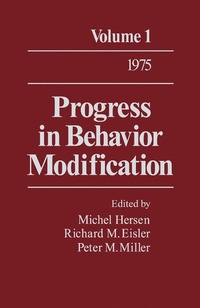
Progress in Behavior Modification
Volume 1
Published on 22. October 2013
370 pages
978-1-4832-7722-6 (ISBN)
Description

Progress in Behavior Modification, Volume 1 reviews advances in the understanding of behavior modification, with emphasis on theoretical underpinnings, research findings and methodologies, and assessment techniques. Control of psychophysiological processes and ethical issues in behavioral control are considered, along with the effects of social influences on behavior and the contribution of behavior therapy to the treatment of physical illness. Comprised of eight chapters, this volume begins with a discussion on the evolution of behavior modification, with particular reference to its application as a methodological approach to the study and treatment of psychological disorders. The next chapter offers an interpersonal analysis of depression from theoretical, research, and therapeutic standpoints, followed by an analysis of developments in the behavioral treatment of phobic and obsessive-compulsive disorders. The ethical and legal ramifications of behavior therapy are also evaluated, paying attention to court decisions, the issue of patients' rights, and the efficacy of the behavioral approach compared to other systems of treatment. The remaining chapters focus on the contribution of behavior modification to the field of juvenile delinquency; advances in token economy research; individual behavior therapy; and the complementary roles of drugs and behavior modification. This book should be of interest to theoreticians, researchers, or practitioners in the fields of psychiatry, psychology, and behavior therapy as well as social work, speech therapy, education, and rehabilitation.
More details
Other editions
Additional editions

Michel Hersen | etc.
Progress in Behaviour Modification: v. 1
Book
06/1975
Academic Press
€55.71
Article exhausted; check different version
Content
List of ContributionsForewordPrefaceAcknowledgmentsHistorical Perspectives in Behavior Modification: Introductory Comments I. Introduction II. Impetus III. Historical Course IV. Publication Trends V. Professional Societies and Behavior Modification VI. Recent Advances VII. Conclusions and Future Perspectives ReferencesThe Behavioral Study and Treatment of Depression I. Introduction II. Behavioral Theories of Depression III. Empirical Studies Consistent with Behavioral Hypotheses IV. Behavioral Treatment of Depression V. Overview and Recommendations for Future Research ReferencesBehavioral Treatments of Phobic and Obsessive-Compulsive Disorders: A Critical Appraisal I. Introduction II. Therapeutic Components III. Studies in Patients IV. Overview and Future Trends ReferencesEthical and Legal Issues of Behavior Modification I. Introduction II. Legal Issues III. Homosexuality IV. Aversive Procedures ReferencesBehavior Modification with Delinquents I. Introduction II. Program Evaluation III. Procedure Evaluation IV. Conclusion ReferencesRecent Advances in Token Economy Research I. Introduction II. Complex and Therapeutically "Relevant" Behaviors ("Symptoms") III. Changes in Nontarget Behaviors IV. Comparative Studies and Combined Treatments V. Role of Punishment VI. Role of Economics VII. Use of Peers VIII. Self-Reinforcement IX. Response Maintenance and Transfer of Training X. Increasing Community Involvement XI. Some New Directions XII. Concluding Comments ReferencesThe Process of Individual Behavior Therapy I. Introduction II. Beginning the Therapy Relationship III. Behavioral Analysis, Assessment, and Diagnosis IV. Treatment Choice V. Assessing the Efficacy of the Treatment Strategy VI. Modification of the Treatment Strategy VII. Decisions about Termination VIII. Critical Issues in Individual Behavior Therapy IX. Conclusion ReferencesDrugs and Behavior Analysis I. Introduction II. Drugs as Adjuncts to Facilitate Behavior Therapy III. Motivating Medication Use IV. Experimental Analysis of Drug Effects V. Drugs as Agents of Punishment, Reinforcement, and Extinction VI. Conclusions ReferencesAuthor IndexSubject Index
