

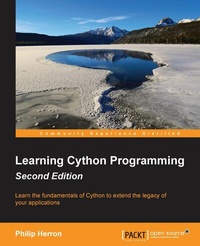
Learning Cython Programming (Second Edition)
Expand your existing legacy applications in C using Python
2nd Edition
Published on 8. July 2025
110 pages
978-1-78528-912-5 (ISBN)
Description

Learn the fundamentals of Cython to extend the legacy of your applications
Key Features
[*]Learn how to extend C applications with pure Python code
[*]Get more from Python - you'll not only learn Cython, you'll also unlock a greater understanding of how to harness Python
[*]Packed with tips and tricks that make Cython look easy, dive into this accessible programming guide and find out what happens when you bring C and Python together!
Book DescriptionCython is a hybrid programming language used to write C extensions for Python language. Combining the practicality of Python and speed and ease of the C language it's an exciting language worth learning if you want to build fast applications with ease. This new edition of Learning Cython Programming shows you how to get started, taking you through the fundamentals so you can begin to experience its unique powers. You'll find out how to get set up, before exploring the relationship between Python and Cython. You'll also look at debugging Cython, before moving on to C++ constructs, Caveat on C++ usage, Python threading and GIL in Cython. Finally, you'll learn object initialization and compile time, and gain a deeper insight into Python 3, which will help you not only become a confident Cython developer, but a much more fluent Python developer too. What you will learn
[*]Reuse Python logging in C
[*]Make an IRC bot out of your C application
[*]Extend an application so you have a web server for rest calls
[*]Practice Cython against your C++ code
[*]Discover tricks to work with Python ConfigParser in C
[*]Create Python bindings for native libraries
[*]Find out about threading and concurrency related to GIL
[*]Expand Terminal Multiplexer Tmux with Cython
Who this book is forThis book is for developers who are familiar with the basics of C and Python programming and wish to learn Cython programming to extend their applications.
Key Features
[*]Learn how to extend C applications with pure Python code
[*]Get more from Python - you'll not only learn Cython, you'll also unlock a greater understanding of how to harness Python
[*]Packed with tips and tricks that make Cython look easy, dive into this accessible programming guide and find out what happens when you bring C and Python together!
Book DescriptionCython is a hybrid programming language used to write C extensions for Python language. Combining the practicality of Python and speed and ease of the C language it's an exciting language worth learning if you want to build fast applications with ease. This new edition of Learning Cython Programming shows you how to get started, taking you through the fundamentals so you can begin to experience its unique powers. You'll find out how to get set up, before exploring the relationship between Python and Cython. You'll also look at debugging Cython, before moving on to C++ constructs, Caveat on C++ usage, Python threading and GIL in Cython. Finally, you'll learn object initialization and compile time, and gain a deeper insight into Python 3, which will help you not only become a confident Cython developer, but a much more fluent Python developer too. What you will learn
[*]Reuse Python logging in C
[*]Make an IRC bot out of your C application
[*]Extend an application so you have a web server for rest calls
[*]Practice Cython against your C++ code
[*]Discover tricks to work with Python ConfigParser in C
[*]Create Python bindings for native libraries
[*]Find out about threading and concurrency related to GIL
[*]Expand Terminal Multiplexer Tmux with Cython
Who this book is forThis book is for developers who are familiar with the basics of C and Python programming and wish to learn Cython programming to extend their applications.
All prices
More details
Edition
2nd Revised edition
Language
English
Place of publication
Birmingham
United Kingdom
Target group
US School Grade: College Graduate Student
Edition type
Revised edition
File size
0,38 MB
ISBN-13
978-1-78528-912-5 (9781785289125)
Copyright in bibliographic data and cover images is held by Nielsen Book Services Limited or by the publishers or by their respective licensors: all rights reserved.
Schweitzer Classification
Other editions
Additional editions
Philip Herron
Learning Cython Programming Second Edition
Book
02/2016
Packt Publishing
€44.60
Shipment within 3-4 weeks
Person
Herron Philip :
Philip Herron is a developer who focuses his passion toward compilers and virtual machine implementations. When he was first accepted to Google Summer of Code 2010, he used inspiration from Paul Biggar's PhD on the optimization of dynamic languages to develop a proof of the concept GCC frontend to compile Python. This project sparked his deep interest in how Python works. After completing a consecutive year on the same project in 2011, Philip applied to Cython under the Python foundation to gain a deeper appreciation of the standard Python implementation. Through this he started leveraging the advantages of Python to control the logic in systems or even add more high-level interfaces, such as embedding Flask web servers in a REST API to a system-level piece of software, without writing any C code. Philip currently works as a software consultant for Instil Software based in Northern Ireland. He develops mobile applications with embedded native code for video streaming. Instil has given him a lot of support in becoming a better engineer. He has written several tutorials for the UK-based Linux Format magazine on Python and loves to share his passion for the Python programming language.
Philip Herron is a developer who focuses his passion toward compilers and virtual machine implementations. When he was first accepted to Google Summer of Code 2010, he used inspiration from Paul Biggar's PhD on the optimization of dynamic languages to develop a proof of the concept GCC frontend to compile Python. This project sparked his deep interest in how Python works. After completing a consecutive year on the same project in 2011, Philip applied to Cython under the Python foundation to gain a deeper appreciation of the standard Python implementation. Through this he started leveraging the advantages of Python to control the logic in systems or even add more high-level interfaces, such as embedding Flask web servers in a REST API to a system-level piece of software, without writing any C code. Philip currently works as a software consultant for Instil Software based in Northern Ireland. He develops mobile applications with embedded native code for video streaming. Instil has given him a lot of support in becoming a better engineer. He has written several tutorials for the UK-based Linux Format magazine on Python and loves to share his passion for the Python programming language.
Content
Table of Contents
Cython won't bite
Understanding cython
Extending applications
Debugging cython
Advanced cython
Cython vs Alternatives
Cython won't bite
Understanding cython
Extending applications
Debugging cython
Advanced cython
Cython vs Alternatives

