

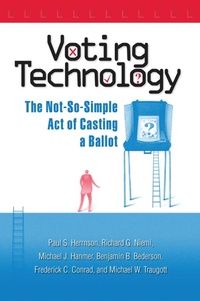
Voting Technology
The Not-So-Simple Act of Casting a Ballot
1st Edition
Published on 19. March 2009
215 pages
978-0-8157-3562-5 (ISBN)
Description

Voting difficulties hung over America's presidential election in 2000 like a dark cloud. Hanging chads, a butterfly ballot, and the Supreme Court remain the most vivid memories of that political donnybrook. Passage of 2002's Help America Vote Act sparked further interest in the physical process of casting a ballot, yet several recent contests still produced confusion at the polls. A solution to at least some of those problems may be found in new technology, but such innovations carry their own concerns and questions. V oting Technology is the first book to investigate in a scientific and authoritative manner how voters respond to the new equipment. The authors¿an interdisciplinary group of experts in American elections, political behavior, human-computer interaction, and human factors psychology¿assess five commercially available voting systems, each one representing a specific class based on shared design principles, as well as a prototype system not currently available. They evaluate the systems against different criteria (including ease of use, speed, and accuracy) using field experiments, laboratory experiments, and expert reviews. The results reveal the good and bad about the new systems, including specific features that contribute to clarity, confusion, or error. Going beyond the concern with spoiled ballots, they determine whether voters actually cast their ballots for the candidates they intended to support. They address fundamental questions of whether voters like and trust the equipment and whether the various systems are equally usable by all voters. Their research also opens up an entirely new line of inquiry by asking about the interaction between ballot format and voter behavior. The concluding chapter pulls together best practices that will guide manufacturers of voting systems, ballot designers, election officials, political observers, and of course, voters. In a political system based on free exercise of personal choice, the least w
More details
Edition
1. Auflage
Language
English
Place of publication
New York
United States
Publishing group
Bloomsbury Publishing Plc
ISBN-13
978-0-8157-3562-5 (9780815735625)
Copyright in bibliographic data and cover images is held by Nielsen Book Services Limited or by the publishers or by their respective licensors: all rights reserved.
Schweitzer Classification
Other editions
Additional editions
Paul S. Herrnson | Richard G. Niemi | Michael J. Hanmer
Voting Technology
The Not-So-Simple Act of Casting a Ballot
Book
12/2007
Brookings Institution
€31.50
Shipment within 10-20 days
Paul S. Herrnson | Richard G. Niemi | Michael J. Hanmer
Voting Technology
The Not-so-simple Act of Casting a Ballot
Book
12/2007
Brookings Institution
€78.13
Article exhausted; check different version
Content
- Front Cover
- Title Page
- Copyright Information
- Table of Contents
- Preface and Acknowledgments
- The Study of Electronic Voting
- A New Generation of Voting Systems
- Voter Reactions to Electronic Voting Systems
- The Accuracy of Electronic Voting Systems
- Inequality in the Voting Booth
- Vote Verification Systems
- Toward More User-Friendly Voting and Election Systems
- Appendix A: Voter Information Guides and Questionnaires
- Appendix B: Characteristics of Respondents in the Field Studies
- Appendix C: Regression Results for Chapter 5 and 6
- Notes
- Authors
- Index
- Back Cover
