

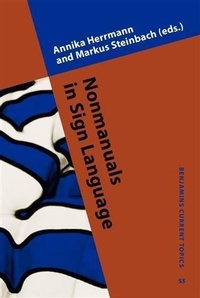
Nonmanuals in Sign Language
1st Edition
Published in July 2013
V, 197 pages
978-90-272-7174-7 (ISBN)
Description

In addition to the hands, sign languages make extensive use of nonmanual articulators such as the body, head, and face to convey linguistic information. This collected volume focuses on the forms and functions of nonmanuals in sign languages. The articles discuss various aspects of specific nonmanual markers in different sign languages and enhance the fact that nonmanuals are an essential part of sign language grammar. Approaching the topic from empirical, theoretical, and computational perspectives, the book is of special interest to sign language researchers, typologists, and theoretical as well as computational linguists that are curious about language and modality. The articles investigate phenomena such as mouth gestures, agreement, negation, topicalization, and semantic operators, and discuss general topics such as language and modality, simultaneity, computer animation, and the interfaces between syntax, semantics, and prosody.
Originally published in Sign Language & Linguistics 14:1 (2011).
Originally published in Sign Language & Linguistics 14:1 (2011).
More details
Other editions
Additional editions
Annika Herrmann | Markus Steinbach
Nonmanuals in Sign Language
Book
06/2013
John Benjamins Publishing Co
€90.10
Shipment within 10-15 days
Persons
Content
- Nonmanuals in Sign Language
- Editorial page
- Title page
- LCC data
- Table of contents
- Nonmanuals in sign languages
- 1. What do nonmanual articulators reveal about the grammar of sign languages?
- 2. Content of this book
- Acknowledgements
- References
- Syntax and prosodic consequences in ASL
- 1. Introduction
- 1.1 The puzzle
- 1.2 Methodology and consultation
- 2. Background on multiple wh-questions
- 2.1 Stacked wh-question
- 2.2 Coordinated wh-question (wh&whQ)
- 2.2.1 Coordinated wh-questions - the 'at all-reading'
- 2.2.2 Coordinated wh-questions - the 'it-reading'
- 2.3 Multi-dominance in coordinated wh-questions
- 2.3.1 The 'at all-reading' as 'non-bulk shared'
- 2.3.2 The 'it-reading' as 'bulk shared'
- 3. Background on wh-questions in ASL
- 3.1 ASL single wh-questions
- 3.1.1 The leftward analysis of wh-movement in ASL
- 3.1.2 The rightward analysis of wh-movement in ASL
- 3.2 ASL multiple wh-questions
- 3.3 An alternative analysis: Remnant Movement
- 4. Deriving three types of multiple wh-questions in ASL with distinct derivations
- 4.1 Remnant movement analysis of stacked multiple wh-questions
- 4.2 Deriving wh&wh-question 'at all-reading' via Parallel Merge and Remnant Movement
- 4.3 Deriving wh&wh-question it-readings via Parallel Merge and Remnant Movement
- 5. Analyzing the derivations to capture prosodic consequences
- 5.1 Background on ASL phrasal level prosodic nonmanuals
- 5.1.1 Wh-marking
- 5.1.2 Focused wh-marking
- 5.2 Background on syntax-prosody interaction
- 5.2.1 Prosodic stress
- 5.2.2 Prosodic subordination and prosodic breaks
- 5.3 Prosodic consequences and new generalizations
- 5.3.1 Prosodic reset as a result of A-bar movement
- 5.3.2 Prosodic breaks as a result of A-bar movement
- 6. Conclusion
- Acknowledgments
- References
- Negation in Turkish Sign Language
- 1. Introduction: Why study negation in TID from a syntactic perspective?
- 2. Background: The syntax of TID
- 3. The data: Source, annotation, and distributional report for negation
- 4. The syntax of negation in TID
- 5. Summary
- Acknowledgments
- References
- Eye gaze and verb agreement in German Sign Language
- 1. Introduction
- 2. Theoretical background
- 2.1 The Boston Group
- 2.2 The San Diego Group
- 2.3 The Berlin Student
- 3. Eye gaze in German Sign Language
- 3.1 The experiment
- 3.2 The results
- 3.3 The scope of eye gaze
- 4. Discussion
- Acknowledgments
- References
- Appendix
- Mouth gestures in British Sign Language
- 1. Mouth actions in sign languages
- 2. Adverbial mouth gestures
- 3. The 'th' mouth gesture in BSL
- 4. Methodology
- 5. Data
- 6. Results
- 6.1 Distribution of tongue protrusion
- 6.2 Individual variation
- 7. Conclusion
- Acknowledgements
- References
- Nonmanual markings for topic constructions in Hong Kong Sign Language
- 1. Introduction
- 2. Topics in spoken languages
- 2.1 Some areas of controversies
- 2.2 Markings of topics in spoken languages
- 3. Topic constructions in sign languages
- 4. Definitions of topic adopted in this study
- 5. Methodology
- 5.1 Data collection and transcription
- 5.2 Identification and coding of topics in the data
- 5.3 Types of features coded and measured in the data
- 6. Results
- 6.1 'Aboutness' topics in the HKSL data
- 6.2 'Scene-setting' topics in the HKSL data
- 6.3 Fronted grammatical objects in the HKSL data
- 7. General discussion and conclusion
- Acknowledgements
- References
- Nonmanuals, semantic operators, domain marking, and the solution to two outstanding puzzles in ASL
- 1. Introduction
- 1.1 Objectives
- 1.2 Argumentation
- 1.3 Structure of paper
- 2. Theoretical background: Nonmanuals and operators
- 2.1 Previous accounts for nonmanuals
- 2.2 Monadic and dyadic operators
- 3. Monadic operators in ASL
- 3.1 Negation and monadic operators
- 3.2 [+wh] - Another simple/monadic operator
- 3.2.1 Accounting for the spread of brow lowering
- 3.2.2 Accounting for the location of what
- 3.3 Summary
- 4. Dyadic operators in ASL
- 4.1 [-wh] - A dyadic/restrictive operator
- 4.2 The understand´ puzzle
- 5. Conclusion
- Acknowledgements
- References
- Linguistics as structure in computer animation
- 1. Background
- 1.1 Animation basics
- 1.2 Advantages of animation
- 1.3 Challenges of animation
- 2. Linguistics as animation structure
- 2.1 A case study: Brows
- 2.1.1 Early linguistic findings
- 2.1.2 A starting point for animation
- 2.1.3 The role of brow motion in language
- 2.1.4 Refining the animation model
- 2.1.5 Recent investigations in co-occurring processes
- 2.1.6 An animation model for co-occurring processes
- 2.1.7 The role of the artist
- 3. Conclusion and future work
- Acknowledgements
- References
- Index
