

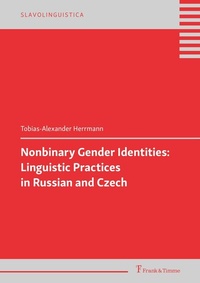
Nonbinary Gender Identities: Linguistic Practices in Russian and Czech
1st Edition
Published on 10. June 2024
420 pages
978-3-7329-8861-7 (ISBN)
Description

How do Russian and Czech nonbinary people use language to construct their identity? This question has hardly been addressed so far, so this volume describes and analyzes the identity-driven linguistic variation of Russian and Czech nonbinary speakers. If a linguistic feature indexes the gender binary in the standard variety, then a nonbinary speaker - who desires to express their gender identity - in interaction employs an alternative that lacks this feature to perform and thus linguistically construct nonbinary identity. This hypothesis is investigated using a triangulation of quantitative and qualitative methods, banking on data from corpora and surveys. Among the most relevant practices that have emerged are the overt introduction of gender identity labels as well as pronouns and/or chosen agreement patterns into discourse, the alternation of gender agreement patterns, and the use of plural endings with singular meaning.
Tobias-Alexander Herrmann studied Eastern and Central European Regional Studies (Slavic Philology, Political Sciences) and Slavistics at the University of Cologne (Germany). Currently, he is working there as a postdoctoral researcher at the Slavic Department. His research interests include sociolinguistics, corpus linguistics, and empirical discourse linguistics.
Tobias-Alexander Herrmann studied Eastern and Central European Regional Studies (Slavic Philology, Political Sciences) and Slavistics at the University of Cologne (Germany). Currently, he is working there as a postdoctoral researcher at the Slavic Department. His research interests include sociolinguistics, corpus linguistics, and empirical discourse linguistics.
More details
Other editions
Additional editions
Tobias-Alexander Herrmann
Nonbinary Gender Identities: Linguistic Practices in Russian and Czech
Book
06/2024
1st Edition
Frank & Timme
€68.00
Shipment within 7-9 days
Person
Tobias-Alexander Herrmann studied Eastern and Central European Regional Studies (Slavic Philology, Political Sciences) and Slavistics at the University of Cologne (Germany). Currently, he is working there as a postdoctoral researcher at the Slavic Department. His research interests include sociolinguistics, corpus linguistics, and empirical discourse linguistics.
Content
- Intro
- List of Tables
- List of Figures
- List of Abbreviations
- Introduction
- Structure of the book and chapter outlines
- Theoretical framework
- Terminology
- Background
- Modern approaches
- Postmodernist approaches
- Poststructuralism
- Performativity
- Indexicality
- Identities
- Grammar as discourse
- Gender and gender agreement in Russian and Czech
- Nonbinary linguistic practices
- Literature review
- English
- Various languages
- Slavic languages
- Materials and Methods
- Data collection I: A corpus with nonbinary linguistic practices
- Linking theory and practice
- Scraping and storing data
- Procedure and data analysis I
- Singling out thematic clusters
- Identifying patterns and themes
- Data collection II: Polling nonbinary individuals
- Survey design
- Sociodemographic information
- Nonbinary language use
- Procedure and data analysis II
- Survey procedure
- Processing survey data
- Interim conclusion
- Linguistic agency in discourse
- Materials and Methods
- Survey & data collection
- Methods for analysis
- Results
- Q1 & Q2
- Q3
- Q4
- Q5
- Comparison of Q4 and Q5
- Q6 & Q7
- Q8
- Q9
- Q10 & Q11
- Russian
- Czech
- Comparison and interim discussion
- Interim conclusion
- Gender reinterpretation
- Identity labels
- Materials and Methods
- Results
- Nonbinary identity labels in Russian
- Nonbinary identity labels in Czech
- Interim conclusion
- Pronoun practice
- The case of Russian
- The emergence of the pronoun practice
- Form and function of the pronoun practice
- Distributional patterns
- The case of Czech
- Form and function of the pronoun practice
- Distributional patterns
- Interim conclusion
- Gender alternation
- Overview
- Number of genders
- Types of alternation
- Meanings of gender alternation
- Distribution
- Attitudes
- Interim conclusion
- The neuter gender
- Overview
- Distribution in Russian
- Distribution in Czech
- Attitudes
- Russian
- Czech
- The neuter gender for nonbinary identity construction?
- Interim conclusion
- Summary
- Gender neutralization
- Alternative ungendered constructions
- Overview: Types of alternative constructions
- Russian
- Czech
- Distribution
- Russian
- Czech
- Attitudes
- A generalization of ungendered constructions
- Interim conclusion
- Plural agreement
- The case of English singular they
- The case of Russian
- Full plural pattern: Using my
- Full plural pattern: Using vy
- Singular oni & singular-plural pattern
- The case of Czech
- Using first person plural: Mykání
- Using second person plural: Vykání
- Using third person plural: Onikání & singular-plural pattern
- A generalization of plural agreement with singular meaning
- Interim conclusion
- Summary
- Gender specification
- Graphemic Approaches
- Materials and Methods
- Gender graphemes in Russian
- Types of gender graphemes and general distribution
- Distribution of first person instances
- Meaning of gender graphemes
- Gender graphemes in Czech
- Types of gender graphemes and general distribution
- Distribution of first person instances
- Meaning of gender graphemes
- Explaining the data
- Interim conclusion
- Neopronouns, neoforms, neogrammar
- Classification of neoforms
- Formal aspects
- Semantic aspects
- Ideological aspects
- Cross-linguistic evidence
- Modeling the emergence of novel coinages
- Gender-related neoforms in Russian
- Morphology and semantics of neoforms
- Usage and distribution
- Attitudes
- Gender-related neoforms in Czech
- Morphology and semantics of neoforms
- Usage and distribution
- Attitudes
- A generalization of neoforms
- Classification of neoforms: Mapping identity
- Popularity of neoforms: The many disadvantages
- Function of neoforms: Making space for nonbinary identities
- Interim conclusion
- Nonbinary naming practices
- Gender marking on names
- Materials and Methods
- Results
- Types and usage of names
- Classification of names
- Levels of onymic genderization
- Interim conclusion
- Summary
- Conclusion and outlook
- General summary
- Directions for future research
- Primary Sources
- References
- Survey of nonbinary respondents
