

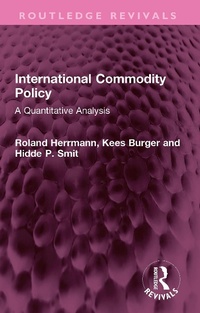
International Commodity Policy
A Quantitative Analysis
1st Edition
Published on 1. April 2023
326 pages
978-1-000-86989-7 (ISBN)
Description

For decades, instabilities on world commodity markets have been a central issue in the international policy dialogue. Price stabilization and compensatory financing schemes have been discussed and implemented as instruments to stabilize export earnings of developing countries and to counter the negative consequences of world market instabilities.
Originally published in 1993 and reissued in 2023, this book provides a quantitative analysis and evaluation of international commodity policies in the late 20th century. The authors investigate whether major international commodity policies have reached their primary objectives and to what extent they have had economic side effects. After reviews of the history and politics of international commodity policy, the authors deal with three important compensatory financing schemes: the Compensatory Financing Facility (CFF) of the International Monetary Fund (IMF), the STABEX scheme of the EC-ACP Convention of Lome, and the Cereal Import Facility introduced as an extension of the IMF's CFF. Three commodity agreements, i.e. the International Coffee Agreement, the International Natural Rubber Agreement, and the International Cocoa Agreements, are then covered as are the commodity protocols for sugar and beef laid down in the Convention of Lome. In a final section, the stabilization policies are compared and evaluated. The authors apply an ex-post approach when analyzing major commodity agreements and compensatory financing schemes. The measured impacts differ from those of ex-ante approaches based on models of a functioning price or earnings stabilization. A major reason is that existing policies were not strictly targeted at stabilization but contained strong redistributive elements as well. As a consequence, both compensatory financing and commodity agreements had only limited success in terms of stabilization, but individual exporting countries gained strongly from grant elements in compensation payments or from price-support elements in commodity arrangements. The book identifies the effectiveness of the implemented commodity policies from an international point of view as well as national interests in those policies.
Nearly 30 years later, volatile world commodity markets are still a major issue in the policy dialogue. Although topics, policy instruments and concepts have changed, this book remains a fundamental contribution to the study of international commodity policy. It will be of great interest to students of commodity policy and economic development and economists in national and international organizations dealing with market stabilization.
Originally published in 1993 and reissued in 2023, this book provides a quantitative analysis and evaluation of international commodity policies in the late 20th century. The authors investigate whether major international commodity policies have reached their primary objectives and to what extent they have had economic side effects. After reviews of the history and politics of international commodity policy, the authors deal with three important compensatory financing schemes: the Compensatory Financing Facility (CFF) of the International Monetary Fund (IMF), the STABEX scheme of the EC-ACP Convention of Lome, and the Cereal Import Facility introduced as an extension of the IMF's CFF. Three commodity agreements, i.e. the International Coffee Agreement, the International Natural Rubber Agreement, and the International Cocoa Agreements, are then covered as are the commodity protocols for sugar and beef laid down in the Convention of Lome. In a final section, the stabilization policies are compared and evaluated. The authors apply an ex-post approach when analyzing major commodity agreements and compensatory financing schemes. The measured impacts differ from those of ex-ante approaches based on models of a functioning price or earnings stabilization. A major reason is that existing policies were not strictly targeted at stabilization but contained strong redistributive elements as well. As a consequence, both compensatory financing and commodity agreements had only limited success in terms of stabilization, but individual exporting countries gained strongly from grant elements in compensation payments or from price-support elements in commodity arrangements. The book identifies the effectiveness of the implemented commodity policies from an international point of view as well as national interests in those policies.
Nearly 30 years later, volatile world commodity markets are still a major issue in the policy dialogue. Although topics, policy instruments and concepts have changed, this book remains a fundamental contribution to the study of international commodity policy. It will be of great interest to students of commodity policy and economic development and economists in national and international organizations dealing with market stabilization.
More details
Series
Edition
1. Auflage
Language
English
Place of publication
London
United Kingdom
Publishing group
Taylor & Francis Ltd
Target group
College/higher education
ISBN-13
978-1-000-86989-7 (9781000869897)
Copyright in bibliographic data and cover images is held by Nielsen Book Services Limited or by the publishers or by their respective licensors: all rights reserved.
Schweitzer Classification
Other editions
Additional editions
Book
04/2025
1st Edition
Routledge
€42.00
Shipment within 10-20 days

Book
04/2023
1st Edition
Routledge
€148.56
Shipment within 10-20 days
Persons
Roland Herrmann is Professor Emeritus of Agricultural and Food Market Analysis at Justus Liebig University, Giessen, Germany. Kees Burger, 1950-2016, was Associate Professor of Development Economics at Wageningen University and Research, Wageningen, Netherlands. Hidde P. Smit is an Independent Consultant on Analysis and Forecasts for the Rubber Economy. He was Secretary General of the International Rubber Study Group in London and Singapore (2005 - 2009) and Head of the Economic Research Division of the Economic and Social Institute, Free University Amsterdam (1995-2004).
Content
Part 1: The Politics and Economics of Commodity Agreements and Compensatory Financing 1. The History of Politics of International Commodity Agreements and Compensatory Financing 2. The Economics of Stabilization: A Historical Survey Part 2: Compensatory Financing: An Economic Evaluation of Current Programmes 3. The International Monetary Fund's Compensatory Financing Facility 4. Commodity-Related Financial Compensation by the European Community 5. Food Security and Compensatory Financing: A Discussion of the International Monetary Fund's Cereal Import Facility Part 3: Commodity Arrangements: An Economic Evaluation of Current Programmes 6. The International Coffee Agreement 7. The International Natural Rubber Agreement 8. The International Cocoa Agreement 9. Commodity Protocols 10. A Comparison and Evaluation of the Arrangements.
