

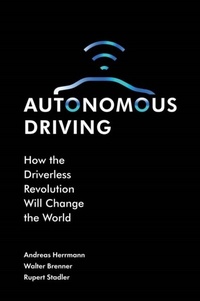
Autonomous Driving
How the Driverless Revolution will Change the World
1st Edition
Published on 26. March 2018
464 pages
978-1-78714-833-8 (ISBN)
Description

This book looks at the latest advances in autonomous driving, demonstrating that a future once considered science fiction is now close at hand.
Acceptance of driverless cars relies on more than just the technology that delivers it; in this book the authors consider the shift in attitudes required for social acceptance and a move towards considering cars one aspect of a wider mobility solution. In addition, a clear demand is arising from gridlocked megacities across the globe. Autonomous driving offers a solution for the high pollution levels and management of the transport infrastructure where current methods are proving insufficient in places of high population density.
Having highlighted the need for driverless cars, the book concludes with an ambitious agenda to ensure the successful delivery of autonomous driving. Political requirements, including investment in a new infrastructure and a commitment to collaboration across borders factors in the ten-point plan for governments seeking to establish international leaders in the latest advances in mobility services.
From ethical considerations in the programming of automated driving procedures to changes in attitudes towards car ownership and design, this title is a comprehensive look at the latest revolution in mobility.
Acceptance of driverless cars relies on more than just the technology that delivers it; in this book the authors consider the shift in attitudes required for social acceptance and a move towards considering cars one aspect of a wider mobility solution. In addition, a clear demand is arising from gridlocked megacities across the globe. Autonomous driving offers a solution for the high pollution levels and management of the transport infrastructure where current methods are proving insufficient in places of high population density.
Having highlighted the need for driverless cars, the book concludes with an ambitious agenda to ensure the successful delivery of autonomous driving. Political requirements, including investment in a new infrastructure and a commitment to collaboration across borders factors in the ten-point plan for governments seeking to establish international leaders in the latest advances in mobility services.
From ethical considerations in the programming of automated driving procedures to changes in attitudes towards car ownership and design, this title is a comprehensive look at the latest revolution in mobility.
Reviews / Votes
Herrmann, a professor of marketing, Brenner, a professor of information management, and Stadler, the CEO of Audi, explore how driverless cars will change people's lives, the automotive and technology industry, environmental protection, the economy, legal and regulatory conditions, and other aspects of the world. They discuss facts about human driving, trends and disruptive technology related to mobility, the history and different levels of autonomous driving, economic aspects, and development phases; the technology of autonomous driving, including digitized and connected cars and cybersecurity and data privacy; the arena of autonomous driving, including areas of current use and the stakeholders and players involved; customers and their mobility behavior and expectations, as well as use cases, whether autonomous driving can fail, and product positioning; framework conditions for autonomous driving, including protection and liability, norms and standards, and ethics and morals; the impact on vehicle design, human-machine interaction, time, cost, and safety; the impact on companies and their business models, value chains, the sharing economy, and the insurance industry; the impact on society in the areas of work and welfare, competitiveness, emerging societies, and urban development; and the actions needed by the auto industry and government to manage the transition. -- Annotation (c)2018 * (protoview.com) *More details
Language
English
Place of publication
Bingley
United Kingdom
Target group
Professional and scholarly
File size
9,84 MB
ISBN-13
978-1-78714-833-8 (9781787148338)
Copyright in bibliographic data and cover images is held by Nielsen Book Services Limited or by the publishers or by their respective licensors: all rights reserved.
Schweitzer Classification
Other editions
Additional editions
Andreas Herrmann | Walter Brenner | Rupert Stadler
Autonomous Driving
How the Driverless Revolution will Change the World
Book
03/2018
Emerald Publishing Limited
€34.00
Shipment within 10-20 days
Persons
Andreas Herrmann is Director of the Institute for Customer Insight at the University of St Gallen and Head of the Audi Lab for Market Research. He has extensive experience in the automobile industry having worked as Controller at Audi AG and through consultancy work, where he has collaborated with Mercedes, BMW, Volkswagen and Porsche. Andreas is author of 15 books and over 200 articles in the areas of management, consumer behaviour and marketing. Walter Brenner is Managing Director of the Institute of Information Management at the University of St Gallen and former Dean of the School of Management. Previously, he was Head of Application Development at Lonza AG, and before this he provided consultancy services in the IT, financial, service and machine sectors. Walter is author and editor of 30 books and more than 300 scientific publications.
Rupert Stadler is Chairman of the Board of Management at AUDI AG. He joined AUDI AG in 1990 as Controller in the Sales and Marketing area before switching to Volkswagen/Audi Espana SA as Commercial Director in 1994. In that capacity he was responsible for controllership, accounts, personnel and organisation. From 1997, Rupert was Head of the Board of Management's Office for the Volkswagen Group and was Head of Group Product Planning from 2002. He became an AUDI AG Board Member in 2003, and in 2007 he was made Chairman of the Board of Management.
Rupert Stadler is Chairman of the Board of Management at AUDI AG. He joined AUDI AG in 1990 as Controller in the Sales and Marketing area before switching to Volkswagen/Audi Espana SA as Commercial Director in 1994. In that capacity he was responsible for controllership, accounts, personnel and organisation. From 1997, Rupert was Head of the Board of Management's Office for the Volkswagen Group and was Head of Group Product Planning from 2002. He became an AUDI AG Board Member in 2003, and in 2007 he was made Chairman of the Board of Management.
Content
Part 1. Evolutions and Revolutions in Mobility Part 2. Perspectives on Autonomous Driving
Part 3. The Technology of Autonomous Driving
Part 4. The Arena of Autonomous Driving
Part 5. Customers and their Mobility Behavior
Part 6. Framework Conditions for Autonomous Driving
Part 7. Impact on Vehicles
Part 8. Impact on Companies
Part 9. Impact on Society
Part 10. What needs to be done?
Part 3. The Technology of Autonomous Driving
Part 4. The Arena of Autonomous Driving
Part 5. Customers and their Mobility Behavior
Part 6. Framework Conditions for Autonomous Driving
Part 7. Impact on Vehicles
Part 8. Impact on Companies
Part 9. Impact on Society
Part 10. What needs to be done?
