

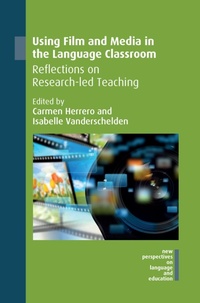
Using Film and Media in the Language Classroom
Reflections on Research-led Teaching
Published on 11. July 2019
232 pages
978-1-78892-450-4 (ISBN)
Description

This book demonstrates the positive impact of using film and audiovisual material in the language classroom. The chapters are evidence-based and address different levels and contexts of learning around the world. They demonstrate the benefits of using moving images and films to develop intercultural awareness and promote multilingualism, and suggest Audiovisual Translation (AVT) activities and projects to enhance language learning. The book will be a valuable continuing professional development resource for language teachers and those involved in curriculum development, as well as bringing the latest research, theory and pedagogical techniques to teacher training courses.
Reviews / Votes
Using Film and Media in the Language Classroom is a volume that gathers new methodological trends and research proposals for practitioners and scholars interested in the use of audiovisual materials in foreign language education. It constitutes an updated and necessary reference for anybody attracted to this field, be it from a teaching, learning or research perspective. * Noa Talavan Zanon, Universidad Nacional de Educacion a Distancia, Spain * This book brings together some inspiring international specialists with new ideas on how film and media can be integrated into foreign language classes. They argue rightly that language now lives in a world of screens, and show how language learning can meet the needs of learners in this new world. * Michael Kelly, Professor Emeritus, University of Southampton, UK * In contrast to studies which focus on role plays and drama in the foreign language classroom, this book advances research relevant to audio-visual literacy, especially film, a growing pedagogical tool within the edutainment field. Not only is Herrero and Vanderschelden's book an excellent boost to multiliteracy, multimodality, and the moving image, it contains a refreshing discussion on latest developments within film, multilingualism, cultural and intercultural studies. * Maher Bahloul, American University of Sharjah, United Arab Emirates * Herrero and Vanderschelden's edited volume offers many useful ideas and opens up discussion concerning both multilingualism and multimodality in film-based language teaching [...] Given the scarcity of research in the field up to date, Herrero, Vanderschelden and the international contributors they brought together provide new insights into a hopefully growing field of practice. -- Jan-Erik Leonhardt, Goethe University Frankfurt, Germany * ELT Journal, 2020 * The volume is a valuable pedagogical tool for every language teacher around the world. Carmen Herrero and Isabelle Vanderschelden's excellent edited anthology demonstrates the bene?tsofusingmovingimagesintheclassroom andbringstogetherthelatestresearch,techniques and developments within ?lm and, mainly, audiovisual translation. -- Conxita Domenech, University of Wyoming, USA * Journal of Spanish Language Teaching, 2020 *More details
Series
Language
English
Place of publication
Bristol
United Kingdom
Target group
College/higher education
ISBN-13
978-1-78892-450-4 (9781788924504)
Copyright in bibliographic data and cover images is held by Nielsen Book Services Limited or by the publishers or by their respective licensors: all rights reserved.
Schweitzer Classification
Other editions
Additional editions
Carmen Herrero | Isabelle Vanderschelden
Using Film and Media in the Language Classroom
Reflections on Research-led Teaching
Book
07/2019
Multilingual Matters
€55.90
Shipment within 3-4 weeks
Persons
Carmen Herrero is Principal Lecturer and Spanish Section Lead in the Department of Languages, Information and Communications at Manchester Metropolitan University, UK. She is Director of FLAME (Research Group for Film, Languages and Media Education) (www2.mmu.ac.uk/languages/flame/) and has co-founded the Film in Language Teaching Association (www.filta.org.uk). She has published widely on Spanish film and the use of film in language teaching.
Isabelle Vanderschelden is Senior Lecturer and French Section Lead in the Department of Languages, Information and Communications at Manchester Metropolitan University, UK. She has published widely on French film including a film study guide on Amelie (IB Tauris, 2007) and Studying French Cinema (Auteur, 2013). She is a co-founder of FILTA and a member of FLAME.
Isabelle Vanderschelden is Senior Lecturer and French Section Lead in the Department of Languages, Information and Communications at Manchester Metropolitan University, UK. She has published widely on French film including a film study guide on Amelie (IB Tauris, 2007) and Studying French Cinema (Auteur, 2013). She is a co-founder of FILTA and a member of FLAME.
Content
Carmen Herrero and Isabelle Vanderschelden: Introduction
Part I. Film Literacy and Languages
Chapter 1. Kieran Donaghy: Using Film to Teach Languages in a World of Screens
Part II. Multilingualism, Intercultural Awareness and Competence
Chapter 2. Brian Tomlinson: Developing Intercultural Awareness through Reflected Experience of Films and Other Visual Media
Chapter 3. Isabella Seeger: Addressing 'Super-Diversity' in the Language Classroom through Film and Peer-Generated YouTube Content
Chapter 4. Anne-Laure Dubrac : Playing the Part: Media Re-Enactments as Tools for Learning Second Languages
Part III. Audio-visual Translation and Subtitling
Chapter 5. Melissa Cokely and Carmen Munoz: Vocabulary Acquisition through Captioned Videos and Visual Prompts
Chapter 6. Joan C. Mora and Eva Cervino-Povedano: The Effects of Bimodal L2 Input on the Processing of Function Words by Spanish EFL Learners: an Eye-Tracking Study
Chapter 7. Anca Daniela Frumuselu: A Friend in Need Is a Film Indeed'. Teaching Colloquial Expressions through Television Series and Subtitling
Chapter 8. Rosa Alonso Perez: Enhancing Student Motivation through Film Subtitling Projects
Chapter 9. Juan Pedro Rica Peromingo and Angela Saenz Herrero: Audiovisual Translation (AVT) Modes as a L2 Learning Pedagogical Tool: Traditional Modes and Linguistic Accessibility
Part IV. Teacher Training and Resources
Chapter 10. Jelena Bobkina and Elena Dominguez: Teaching the Teachers: Double Proposals/Film-based Teaching in Higher Education
Chapter 11. Mark Goodwin: An Analysis of The Success of the 'Cultural Topic' at A Level
Chapter 12. Stavroula Sokoli and Patrick Zabalbeascoa Terran: Clipflair In Language Learning: Theory and Practice
Afterword. Carmen Herrero: Present and Future Directions for Video, Film and Audiovisual Media in Language Teaching
Part I. Film Literacy and Languages
Chapter 1. Kieran Donaghy: Using Film to Teach Languages in a World of Screens
Part II. Multilingualism, Intercultural Awareness and Competence
Chapter 2. Brian Tomlinson: Developing Intercultural Awareness through Reflected Experience of Films and Other Visual Media
Chapter 3. Isabella Seeger: Addressing 'Super-Diversity' in the Language Classroom through Film and Peer-Generated YouTube Content
Chapter 4. Anne-Laure Dubrac : Playing the Part: Media Re-Enactments as Tools for Learning Second Languages
Part III. Audio-visual Translation and Subtitling
Chapter 5. Melissa Cokely and Carmen Munoz: Vocabulary Acquisition through Captioned Videos and Visual Prompts
Chapter 6. Joan C. Mora and Eva Cervino-Povedano: The Effects of Bimodal L2 Input on the Processing of Function Words by Spanish EFL Learners: an Eye-Tracking Study
Chapter 7. Anca Daniela Frumuselu: A Friend in Need Is a Film Indeed'. Teaching Colloquial Expressions through Television Series and Subtitling
Chapter 8. Rosa Alonso Perez: Enhancing Student Motivation through Film Subtitling Projects
Chapter 9. Juan Pedro Rica Peromingo and Angela Saenz Herrero: Audiovisual Translation (AVT) Modes as a L2 Learning Pedagogical Tool: Traditional Modes and Linguistic Accessibility
Part IV. Teacher Training and Resources
Chapter 10. Jelena Bobkina and Elena Dominguez: Teaching the Teachers: Double Proposals/Film-based Teaching in Higher Education
Chapter 11. Mark Goodwin: An Analysis of The Success of the 'Cultural Topic' at A Level
Chapter 12. Stavroula Sokoli and Patrick Zabalbeascoa Terran: Clipflair In Language Learning: Theory and Practice
Afterword. Carmen Herrero: Present and Future Directions for Video, Film and Audiovisual Media in Language Teaching
