

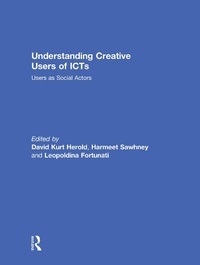
Understanding Creative Users of ICTs
Users as Social Actors
1st Edition
Published on 13. September 2013
120 pages
978-1-135-75843-1 (ISBN)
Description

The disjuncture between the design intent of the developers of ICTs and the needs of the users has often led to surprising use of new technologies, as users have refused to become mere agents of the designers. Individual users have adopted their own uses of ICTs based on the complex webs of relations and meanings in which they function as social actors. Instead of adjusting these webs to new ICTs, they have fit the ICTs into their pre-existing social webs, often resulting in imaginative and creative uses of new technologies, not envisaged by the original designers.
The contributions in this volume provide studies of such integrations of ICTs into the lives of human users, and demonstrate that such uses should not be regarded as 'faulty' or 'mistaken', merely because they 'fail' to meet the expectations of the original designers of the ICTs. Instead, human users should be given precedence over ICTs, and the creative uses of 'universal' technologies by individual users should be emphasised and studied, so as to move towards a better understanding and appreciation of the integration of ICTs into human lives.
This book was originally published as special issue of The Information Society.
The contributions in this volume provide studies of such integrations of ICTs into the lives of human users, and demonstrate that such uses should not be regarded as 'faulty' or 'mistaken', merely because they 'fail' to meet the expectations of the original designers of the ICTs. Instead, human users should be given precedence over ICTs, and the creative uses of 'universal' technologies by individual users should be emphasised and studied, so as to move towards a better understanding and appreciation of the integration of ICTs into human lives.
This book was originally published as special issue of The Information Society.
More details
Edition
1. Auflage
Language
English
Place of publication
London
United Kingdom
Publishing group
Taylor & Francis Ltd
Target group
College/higher education
Professional and scholarly
Product notice
Reflowable
Illustrations
6 s/w Tabellen, 10 s/w Photographien bzw. Rasterbilder, 7 s/w Zeichnungen
6 Tables, black and white; 7 Line drawings, black and white; 10 Halftones, black and white
ISBN-13
978-1-135-75843-1 (9781135758431)
Copyright in bibliographic data and cover images is held by Nielsen Book Services Limited or by the publishers or by their respective licensors: all rights reserved.
Schweitzer Classification
Other editions
Additional editions
David Kurt Herold | Harmeet Sawhney | Leopoldina Fortunati
Understanding Creative Users of ICTs
Users as Social Actors
Book
05/2017
1st Edition
Routledge
€77.03
Shipment within 10-20 days
David Kurt Herold | Harmeet Sawhney | Leopoldina Fortunati
Understanding Creative Users of ICTs
Users as Social Actors
Book
02/2012
1st Edition
Routledge
€223.21
Shipment within 15-20 days
Persons
David Kurt Herold taught and researched in China for over nine years, before joining the Hong Kong Polytechnic University as Lecturer for Sociology. His research focuses on the use of ICTs by humans, online and offline China, encounters between Chinese and non-Chinese online, and online education.
Harmeet Sawhney studied engineering, business, mass communication, and telecommunications policy and worked in marketing and advertising before joining the faculty of the Department of Telecommunications, Indiana University, Bloomington. His research interests focus on how telecommunications networks are envisioned and created.
Leopoldina Fortunati studied letters and philosophy before embracing sociology. She taught at several Italian universities before joining the Faculty of Education and the Department of Human Sciences, University of Udine, Italy. Her research interests focus on cultural processes and social phenomena, and in particular on the practices of use of communication and information technologies.
Harmeet Sawhney studied engineering, business, mass communication, and telecommunications policy and worked in marketing and advertising before joining the faculty of the Department of Telecommunications, Indiana University, Bloomington. His research interests focus on how telecommunications networks are envisioned and created.
Leopoldina Fortunati studied letters and philosophy before embracing sociology. She taught at several Italian universities before joining the Faculty of Education and the Department of Human Sciences, University of Udine, Italy. Her research interests focus on cultural processes and social phenomena, and in particular on the practices of use of communication and information technologies.
Content
1. Understanding creative uses of ICTs: Users as social actors David Kurt Herold, Harmeet Sawhney and Leopoldina Fortunati 2. The Future of the Press: Insights from the Sociotechnical Approach Leopoldina Fortunati and Mauro Sarrica 3. Can the Web Be Made Accessible for People with Intellectual Disabilities?, Helen Kennedy, Simon Evans and Siobhan Thomas 4. "General Aesthesia": Mutations of Value and Cognition in New Media Practices, Helen Grace 5. Digital Cameras, Personal Photography and the Reconfiguration of Spatial Experiences, Dong-Hoo Lee 6. The Reality beyond the Hype: Mobile Internet is Primarily an Extension of PC-Based Internet, Petter Nielsen and Annita Fjuk 7. Cultivating Interaction Ubiquity at Work, Carsten Sorensen 8. The "Crisis of the Summons": A Transformation in the Pragmatics of "Notifications," from Phone Rings to Instant Messaging, Christian Licoppe 9. Living in the Mediatope: A Multimethod Study on the Evolution of Media Technologies in the Domestic Environment, Thorsten Quandt and Thilo von Pape 10. Mobilising Poverty?: Mobile Phone Use and Everyday Spatial Mobility Among Low-Income Families in Santiago, Chile, Sebastian Ureta
