

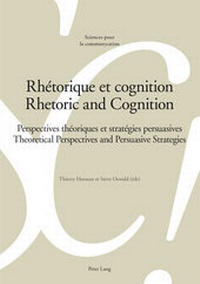
Rhétorique et cognition - Rhetoric and Cognition
Perspectives théoriques et stratégies persuasives - Theoretical Perspectives and Persuasive Strategies
180th Edition
Published on 6. August 2014
VIII, 354 pages
978-3-0352-0271-7 (ISBN)
Description

Ce volume met l'accent sur le lien entre démarches cognitives et art du discours qui a toujours été un des enjeux de la rhétorique. Sans ajouter une nouvelle couche à l'examen critique des sophismes, les contributions de cet ouvrage n'ont pas pour but de dénoncer les effets de certains schèmes argumentatifs que d'aucuns jugeraient fallacieux, mais d'étudier leur fonctionnement et leurs effets cognitifs hic et nunc. Quels sont les mécanismes qui expliquent la « performance » des arguments réputés fallacieux ? Comment fonctionnent les stratégies rhétoriques à l'intersection entre cognition, sciences du langage et société ?
This volume gathers contributions from two disciplines which have much to gain from one another - rhetoric and cognitive science - as they both have much to say in the broad realm of argumentation studies. This collection neither condemns the fallacious effects of specific argument schemes nor adds yet another layer to fallacy criticism, but studies how argumentation and fallacies work, hic et nunc. What are the linguistic and cognitive mechanisms behind the «performance » of fallacious arguments? How do rhetorical strategies work at the interface of cognition, language science and society?
This volume gathers contributions from two disciplines which have much to gain from one another - rhetoric and cognitive science - as they both have much to say in the broad realm of argumentation studies. This collection neither condemns the fallacious effects of specific argument schemes nor adds yet another layer to fallacy criticism, but studies how argumentation and fallacies work, hic et nunc. What are the linguistic and cognitive mechanisms behind the «performance » of fallacious arguments? How do rhetorical strategies work at the interface of cognition, language science and society?
More details
Other editions
Additional editions
Thierry Herman | Steve Oswald
Rhétorique et cognition - Rhetoric and Cognition
Perspectives théoriques et stratégies persuasives - Theoretical Perspectives and Persuasive Strategies
Book
07/2014
Peter Lang Verlag
€106.90
Shipment within 10-15 days
Persons
Thierry Herman est maître d'enseignement et de recherche dans les Universités de Neuchâtel et de Lausanne. Formé en linguistique textuelle et analyse du discours, il a fait état de recherches portant sur l'exploitation des techniques rhétoriques dans le discours politique, médiatique ou universitaire. Membre fondateur du Collectif Romand de Recherches en Argumentation (CoRReA), il s'intéresse aux formes langagières des schèmes argumentatifs et à leurs effets persuasifs.
Steve Oswald est chercheur post-doctoral dans les Universités de Fribourg et de Neuchâtel. Il a obtenu sa thèse en 2010 à l'Université de Neuchâtel avec un travail portant sur la communication manipulatoire et non-coopérative. Ses recherches actuelles se situent à l'interface de la pragmatique linguistique, l'argumentation, l'analyse du discours et les sciences cognitives. Egalement membre fondateur du Collectif Romand de Recherches en Argumentation (CoRReA), il étudie les liens entre les arguments fallacieux et leurs soubassements cognitifs pour l'élaboration d'une approche cognitive de la rhétorique.
Thierry Herman is a senior lecturer at the Universities of Neuchâtel and Lausanne. Trained in textual linguistics and discourse analysis, his research concerns the use of rhetorical techniques in political, media and academic discourse. Founding member of the Collectif Romand de Recherches en Argumentation (CoRReA), he is interested in the linguistic form of argumentative schemes and their persuasive effects.
Steve Oswald is a postdoctoral fellow at the Universities of Fribourg and Neuchâtel. His dissertation (2010, University of Neuchâtel) investigated uncooperative and manipulative communication. His current research explores the interface between linguistic pragmatics, argumentation, discourse analysis and cognitive science. He is also a founding member of the CoRReA and he studies the relationship between fallacious argumentation and its cognitive counterpart for the elaboration of a cognitive account of rhetoric.
Steve Oswald est chercheur post-doctoral dans les Universités de Fribourg et de Neuchâtel. Il a obtenu sa thèse en 2010 à l'Université de Neuchâtel avec un travail portant sur la communication manipulatoire et non-coopérative. Ses recherches actuelles se situent à l'interface de la pragmatique linguistique, l'argumentation, l'analyse du discours et les sciences cognitives. Egalement membre fondateur du Collectif Romand de Recherches en Argumentation (CoRReA), il étudie les liens entre les arguments fallacieux et leurs soubassements cognitifs pour l'élaboration d'une approche cognitive de la rhétorique.
Thierry Herman is a senior lecturer at the Universities of Neuchâtel and Lausanne. Trained in textual linguistics and discourse analysis, his research concerns the use of rhetorical techniques in political, media and academic discourse. Founding member of the Collectif Romand de Recherches en Argumentation (CoRReA), he is interested in the linguistic form of argumentative schemes and their persuasive effects.
Steve Oswald is a postdoctoral fellow at the Universities of Fribourg and Neuchâtel. His dissertation (2010, University of Neuchâtel) investigated uncooperative and manipulative communication. His current research explores the interface between linguistic pragmatics, argumentation, discourse analysis and cognitive science. He is also a founding member of the CoRReA and he studies the relationship between fallacious argumentation and its cognitive counterpart for the elaboration of a cognitive account of rhetoric.
Content
Contenu/Contents: Dan Sperber/Fabrice Clément/Christophe Heintz/Olivier Mascaro/Hugo Mercier/Gloria Origgi/Deirdre Wilson : La vigilance épistémique - Didier Maillat : Manipulation et cognition: un modèle pragmatique - Vasco Correia: Biased argumentation and critical thinking - Emmanuelle Danblon : Vers une naturalisation de la rhétorique? Problèmes épistémologiques - Evgenia Paparouni: A case for emotion awareness - Thierry Herman : L'argument d'autorité: de sa structure à ses effets - Sara Greco Morasso/Carlo Morasso: Argumentation from expert opinion in science journalism: The case of Eureka's Fight Club - Ioana Agatha Filimon: Two-sided rhetorical strategies in top management's letters to shareholders and stakeholders from corporate reports - Fabrizio Macagno: Presupposing redefinitions - Louis de Saussure : Présuppositions discursives, assertion d'arrière-plan et persuasion - Steve Oswald/Marcin Lewinski: Pragmatics, cognitive heuristics and the straw man fallacy.
